Numerical Analysis in Electrical Engineering with MATLAB: Book Guide
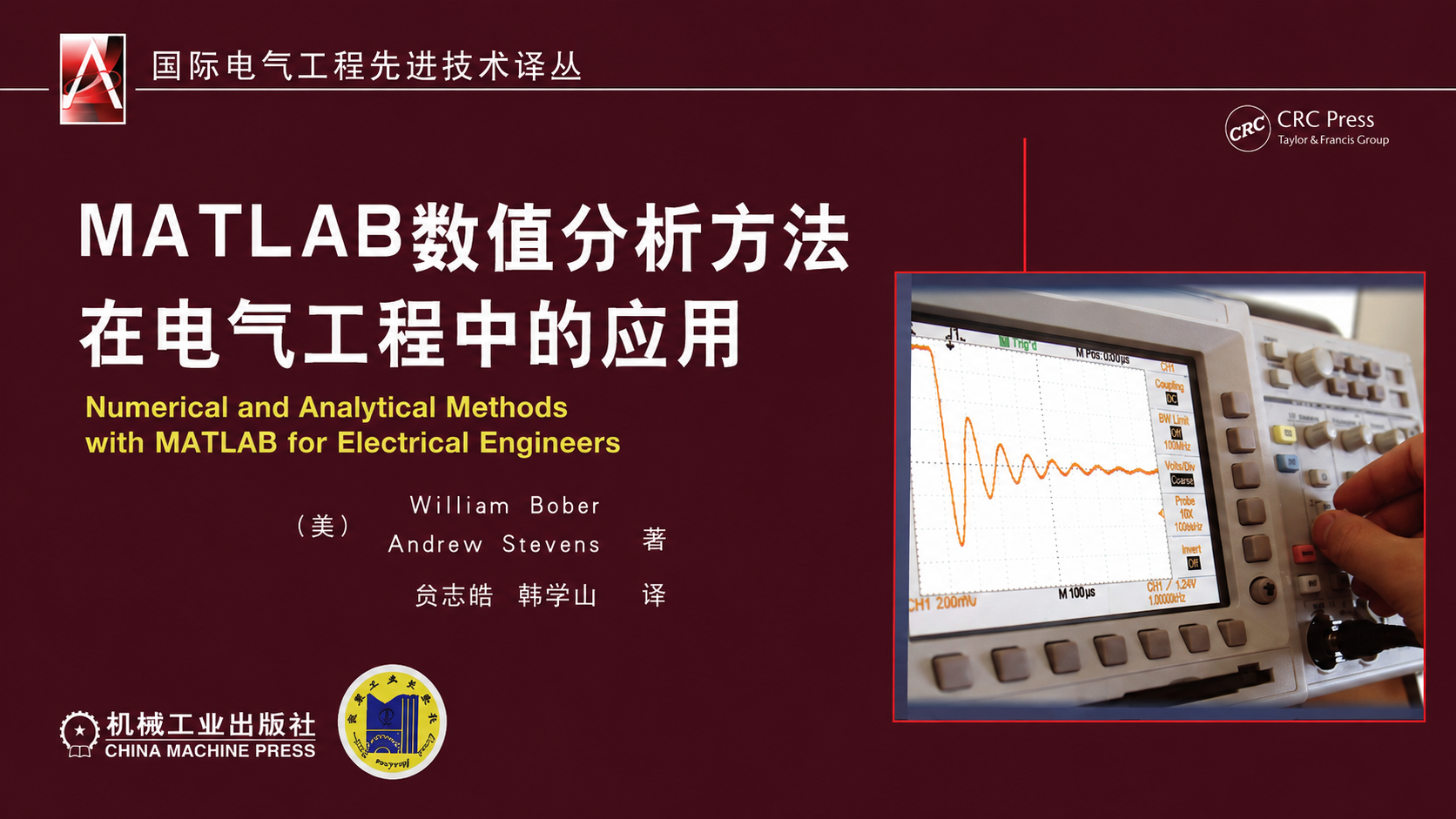
Applications of Numerical Analysis Methods in Electrical Engineering with MATLAB is a technical textbook by William Bober and Andrew Stevens that connects numerical analysis with practical electrical engineering problems through MATLAB-based examples.
The Chinese edition was translated by Yun Zhihao and Han Xueshan and published by China Machine Press in 2014 as part of the International Advanced Technology Series in Electrical Engineering. Drawing on the authors’ teaching and research experience, the book presents numerical methods as practical engineering tools rather than treating them solely as mathematical abstractions.
Its coverage spans MATLAB fundamentals, matrix methods, nonlinear equation solving, numerical integration, ordinary differential equations, Laplace and Fourier transforms, curve fitting, optimization, and Simulink. The book then applies these techniques to engineering problems involving circuits, signals and systems, automatic control, electric machines, power electronics, and power systems.
📘 Book Overview #
The central objective of the book is to show how numerical analysis methods can be implemented and applied to electrical engineering problems using MATLAB.
Rather than separating mathematical theory from engineering practice, the authors use concise computational examples to demonstrate how numerical techniques can be selected, implemented, and interpreted in engineering workflows.
The book begins with the role of numerical methods in electrical engineering and an introduction to MATLAB. It then progresses through core numerical-analysis topics before introducing Simulink as a complementary environment for modeling and simulation.
The major topics include:
- Numerical methods for electrical engineers
- MATLAB fundamentals
- Matrix and linear-system operations
- Algebraic and transcendental equation solving
- Numerical integration
- Ordinary differential equations
- Laplace transforms
- Fourier transforms and signal processing
- Curve fitting
- Mathematical optimization
- Simulink modeling and simulation
This structure gives the book a practical progression from computational foundations to engineering-oriented modeling.
🔬 Numerical Methods and MATLAB Applications #
One of the book’s defining characteristics is its emphasis on MATLAB implementations of numerical methods.
The mathematical techniques are introduced together with computational procedures and examples, allowing readers to connect equations and algorithms with executable engineering workflows.
Linear systems and matrices #
Matrix operations and systems of linear equations form an important computational foundation for electrical engineering. They are directly relevant to circuit equations, state-space representations, network analysis, and other engineering models.
The book introduces matrix concepts and numerical solution techniques that can be implemented using MATLAB.
Algebraic and transcendental equations #
Many electrical engineering models result in nonlinear algebraic or transcendental equations that cannot be solved conveniently through closed-form analytical expressions.
The book addresses numerical root-finding methods and demonstrates how MATLAB can be used to obtain practical solutions.
Numerical integration and differential equations #
Numerical integration is essential when an engineering quantity must be calculated from sampled or numerically defined data.
Similarly, systems of ordinary differential equations provide a mathematical basis for modeling dynamic electrical systems. The book introduces numerical techniques for solving these systems and relates them to engineering applications.
Transform methods and signal processing #
The coverage of Laplace transforms and Fourier transforms connects numerical computation with classical electrical engineering analysis.
Fourier-transform methods are particularly relevant to signal processing and frequency-domain analysis, while Laplace transforms provide a foundation for analyzing dynamic systems and circuits.
Curve fitting and optimization #
The book also introduces curve fitting and mathematical optimization, two techniques commonly used when engineering problems involve experimental data, parameter estimation, or the search for an optimal design.
These methods extend MATLAB’s role beyond direct equation solving into data analysis and engineering design.
⚙️ RLC Circuits as a Unifying Example #
RLC circuits serve as an important thread throughout the material, providing a familiar electrical-engineering context for comparing different numerical techniques.
Using circuit models as examples helps demonstrate how mathematical formulations can be translated into computational procedures. Readers can examine how different numerical methods behave when applied to electrical systems rather than studying each algorithm in isolation.
This approach is particularly useful for understanding the relationship between:
- Circuit equations and matrix representations
- Differential equations and transient analysis
- Transform methods and frequency-domain analysis
- Numerical integration and computed circuit quantities
- MATLAB scripts and engineering models
- Simulink diagrams and system-level simulation
The result is a workflow-oriented treatment of numerical analysis that connects mathematical methods with actual electrical engineering problems.
🧠 Simulink and Engineering Modeling #
The final part of the book introduces Simulink and its applications.
While MATLAB provides a programming and numerical-computing environment, Simulink offers a graphical modeling framework that is particularly useful for dynamic systems and control-oriented applications.
The book’s combination of MATLAB and Simulink provides a bridge between numerical algorithms and system simulation. This is relevant to applications such as automatic control, signals and systems, electronic circuits, electric machines and their control, power electronic devices, and power systems.
For engineering students and practicing engineers, this combination illustrates how numerical calculations can evolve into more comprehensive simulation and modeling workflows.
👨🔬 Authors and Creation Background #
William Bober and Andrew Stevens developed the book from their extensive experience in engineering education and research.
William Bober #
Dr. William Bober earned a bachelor’s degree in Civil Engineering from the City College of New York, a master’s degree in Engineering Science from Pratt Institute, and a Ph.D. in Engineering Science and Aeronautical Engineering from Purdue University.
During his career at Rochester Institute of Technology (RIT), Bober was the lead author of Fluid Mechanics, published by John Wiley & Sons. He also published research papers in the International Journal of Mathematical Education in Science and Technology (IJMEE) and co-authored Numerical and Analytical Methods with MATLAB.
His multidisciplinary engineering background is reflected in the book’s emphasis on applying numerical techniques to practical engineering problems.
Andrew Stevens #
Dr. Andrew Stevens earned his bachelor’s degree from MIT, master’s degree from the University of Pennsylvania, and Ph.D. from Columbia University, with his academic training focused on Electrical Engineering.
In 2001, he became president of Electrical Science, a consulting firm specializing in electrical hardware and software.
The Simplified Chinese edition of the book was exclusively licensed to China Machine Press for publication and distribution in Mainland China.
📚 Publication Information #
The first edition of Applications of Numerical Analysis Methods in Electrical Engineering with MATLAB was published by China Machine Press in March 2014.
| Publication Detail | Information |
|---|---|
| Title | Applications of Numerical Analysis Methods in Electrical Engineering with MATLAB |
| Authors | William Bober, Andrew Stevens |
| Chinese Translators | Yun Zhihao, Han Xueshan |
| Publisher | China Machine Press |
| Edition | 1st Edition |
| Publication Date | March 2014 |
| ISBN | 978-7-111-45305-5 |
| Series | International Advanced Technology Series in Electrical Engineering |
| Language | Chinese |
| Length | 274 pages |
| Format | Illustrated, approximately 24 cm |
The Chinese edition was published specifically for the Mainland China market under an exclusive licensing arrangement.
🗂️ Table of Contents #
The book contains 11 chapters covering numerical computation, MATLAB, mathematical methods, signal processing, optimization, and simulation.
- Chapter 1: Numerical Methods for Electrical Engineers
- Chapter 2: MATLAB Fundamentals
- Chapter 3: Matrices
- Chapter 4: Roots of Algebraic and Transcendental Equations
- Chapter 5: Numerical Integration
- Chapter 6: Numerical Integration of Ordinary Differential Equations
- Chapter 7: Laplace Transforms
- Chapter 8: Fourier Transforms and Signal Processing
- Chapter 9: Curve Fitting
- Chapter 10: Optimization
- Chapter 11: Simulink
🎓 Intended Audience #
The book is particularly relevant to electrical engineering students, engineers, and technical readers who need practical numerical-computing techniques.
For students, it provides a structured introduction to applying MATLAB to common electrical engineering mathematics. For practicing engineers, its value lies in connecting numerical methods with circuit analysis, signal processing, control, simulation, and optimization.
Its RLC-circuit examples also provide a consistent engineering context for comparing different numerical approaches.
Overall, Applications of Numerical Analysis Methods in Electrical Engineering with MATLAB serves as a bridge between numerical mathematics, MATLAB programming, and electrical engineering simulation, emphasizing practical implementation rather than purely theoretical treatment.