
Design with Operational Amplifiers and Analog ICs: A Practical Guide
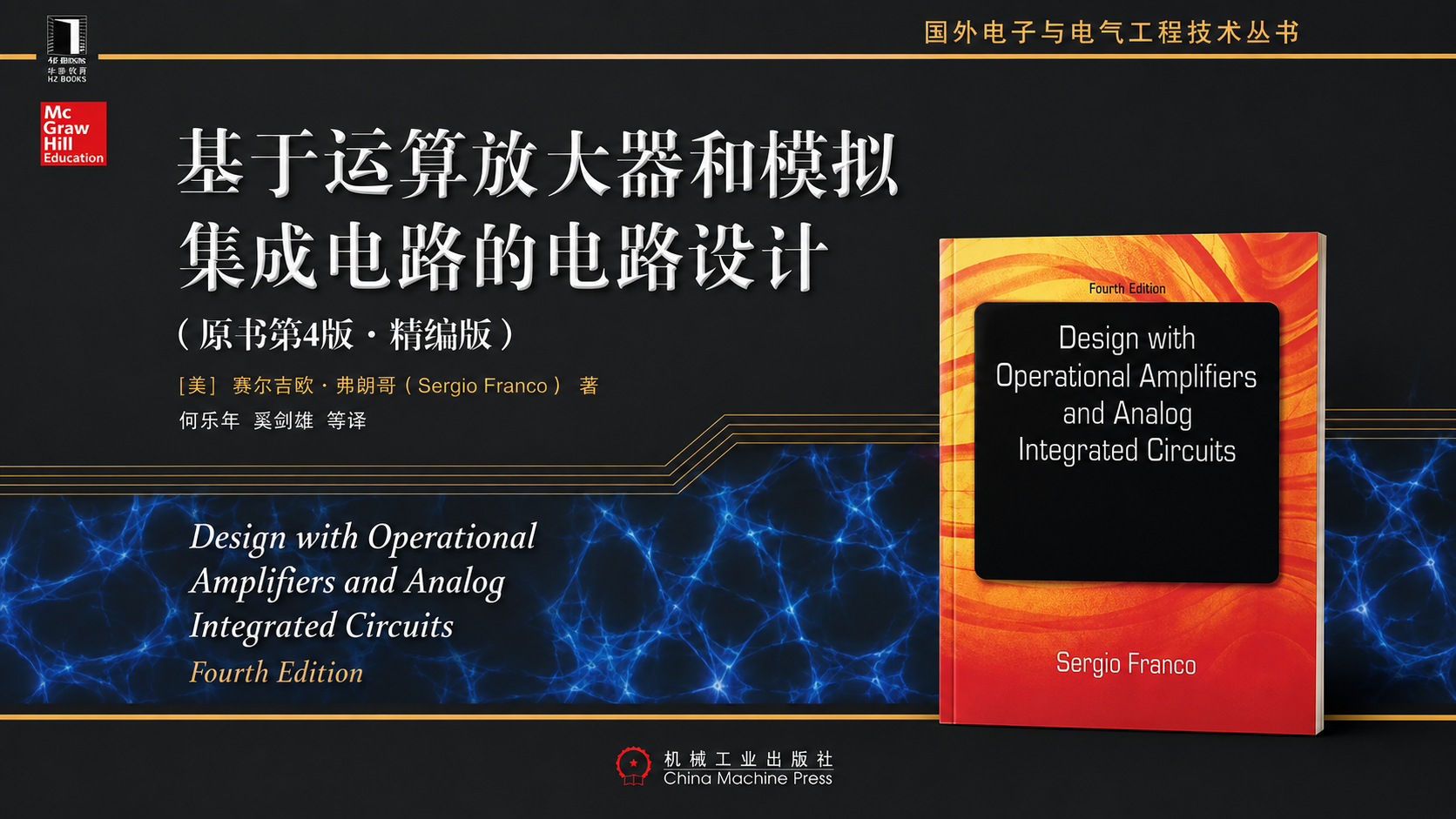
Design with Operational Amplifiers and Analog Integrated Circuits by Sergio Franco is a comprehensive textbook on operational amplifier and analog integrated circuit design. The book combines circuit theory with practical engineering considerations, using real-world devices and implementation constraints to bridge the gap between idealized analysis and production-level analog design.
Written from the perspective of an engineer and educator with extensive experience in integrated circuit development, the book progresses from fundamental operational amplifier concepts to feedback networks, active filters, non-ideal device behavior, stability, nonlinear circuits, signal generation, voltage references, data converters, and phase-locked loops.
Its organization makes the book useful both as an advanced academic text and as a reference for engineers designing analog and mixed-signal systems.
🔌 From Ideal Op Amps to Practical Analog Design #
The book is divided into three major sections that progressively increase the level of practical complexity.
Part 1: Fundamental circuits and active filtering #
Chapters 1 through 4 establish the theoretical foundation using ideal operational amplifiers.
The material covers:
- Operational amplifier fundamentals
- Resistive feedback circuits
- Active filter design
- Frequency-selective circuit behavior
Starting with ideal op-amp assumptions allows fundamental relationships to be established clearly before introducing the limitations that dominate real hardware.
Part 2: Real-World Limitations and Stability #
Chapters 5 through 8 transition from ideal circuit analysis to practical device behavior.
The topics include:
- Static op-amp limitations
- Dynamic limitations
- Analog circuit noise
- Feedback and stability
This section addresses the effects that often determine whether an otherwise correct circuit will operate reliably in hardware. Offset, bandwidth, slew-related behavior, noise, frequency response, and feedback stability all become important once real devices replace ideal models.
Part 3: Applied Analog Circuit Design #
Chapters 9 through 13 focus on practical applications of operational amplifiers and analog IC techniques.
The section covers:
- Nonlinear circuits
- Signal generators
- Voltage references
- Regulated power supplies
- D/A converters
- A/D converters
- Nonlinear amplifiers
- Phase-locked loops
These chapters demonstrate how the concepts developed earlier can be combined into complete analog and mixed-signal subsystems.
🧠 Why Feedback Matters in Analog IC Design #
Negative feedback is one of the central concepts connecting the different sections of the book.
Feedback allows designers to control gain, bandwidth, impedance, linearity, and other circuit characteristics, but it also introduces stability requirements. A design that provides excellent closed-loop gain under low-frequency conditions can become unstable when additional poles, parasitic capacitances, or frequency-dependent device behavior are introduced.
The fourth edition expands its treatment of negative feedback, making feedback analysis an important part of the transition from basic op-amp circuits to practical analog systems.
📈 Active Filters and Frequency-Domain Design #
Active filters form a major part of the book’s early circuit-design material.
Unlike passive filters, active implementations can provide gain while performing frequency-selective signal processing. Operational amplifiers also allow designers to implement filter responses without relying exclusively on inductors, which can be impractical in many integrated or compact electronic systems.
The book’s treatment of active filters provides a foundation for understanding:
- Filter topology selection
- Frequency response
- Feedback interactions
- Gain and bandwidth requirements
- Practical implementation constraints
The two dedicated chapters on active filters allow filtering concepts to be developed before the discussion moves into more advanced real-world limitations.
⚙️ Static and Dynamic Op-Amp Limitations #
Real operational amplifiers deviate significantly from the ideal model.
The book separates these limitations into static and dynamic behavior, providing a useful framework for understanding their impact on circuit performance.
Static limitations #
Static characteristics can affect the DC operating point and low-frequency accuracy of analog circuits. Practical designs therefore need to account for non-ideal device behavior rather than assuming infinite gain, zero offset, or ideal input characteristics.
Dynamic limitations #
Dynamic behavior determines how accurately an amplifier can respond to changing signals.
Bandwidth, frequency-dependent gain, slew-related constraints, and other dynamic effects become increasingly important as signal frequency and amplitude increase. These characteristics directly influence settling behavior, distortion, and closed-loop performance.
Understanding these limitations is essential when moving from schematic-level equations to actual component selection and circuit verification.
🔊 Noise and Analog Signal Integrity #
Noise is another fundamental constraint in analog circuit design.
Unlike digital logic, where sufficient voltage margins can often make moderate electrical disturbances irrelevant, analog systems must preserve signal integrity across a continuous range of amplitudes.
Noise analysis therefore becomes particularly important in:
- Sensor interfaces
- Instrumentation
- Communication systems
- Data converters
- Precision references
- Low-level signal amplification
The dedicated noise chapter places these considerations within the broader framework of practical op-amp and analog IC design.
🌀 Stability and Feedback Analysis #
Feedback stability becomes increasingly important as analog circuits become more complex.
Operational amplifiers and feedback networks contain frequency-dependent elements that can introduce phase shift. If sufficient loop gain remains at frequencies where the accumulated phase shift approaches an unstable condition, oscillation or excessive ringing can occur.
The book’s dedicated treatment of stability complements its expanded discussion of negative feedback and provides a foundation for analyzing closed-loop analog circuits.
For engineers, this is one of the key transitions from simply calculating circuit gain to designing circuits that remain robust across frequency, loading, and component variation.
📡 Nonlinear Circuits and Signal Generators #
The later chapters move beyond linear amplification into nonlinear analog functions.
Nonlinear circuits can be used for functions such as waveform shaping, signal generation, limiting, and other forms of analog processing.
Signal generators extend these concepts into complete circuits capable of producing controlled waveforms. These applications demonstrate how feedback, nonlinear behavior, timing, and frequency response can be combined to create practical analog functions.
🔋 Voltage References and Regulated Power Supplies #
Voltage references provide stable electrical reference points for analog and mixed-signal systems.
They are particularly important in:
- Data converters
- Precision measurement systems
- Analog signal processing
- Power-management circuits
- Control systems
The book also addresses regulated power supplies, connecting reference generation with practical power regulation and analog control.
These circuits demonstrate that analog design principles are not limited to signal amplification but also apply to the infrastructure required by complete electronic systems.
🔢 D/A and A/D Converter Design #
Digital-to-analog and analog-to-digital converters represent a major intersection between analog and digital electronics.
ADC and DAC performance depends on both analog circuit behavior and digital-system requirements. Parameters such as noise, linearity, reference accuracy, bandwidth, settling, and dynamic behavior can all influence converter performance.
Including data converters within the same design framework as op amps, filters, feedback, and references helps illustrate how individual analog building blocks combine into mixed-signal systems.
🔄 Nonlinear Amplifiers and Phase-Locked Loops #
The final chapter extends the discussion into nonlinear amplification and phase-locked loops.
PLLs are particularly important because they combine analog feedback, frequency generation, phase detection, filtering, and control.
They are widely used in:
- Clock generation
- Frequency synthesis
- Communication systems
- Timing recovery
- RF and mixed-signal systems
The inclusion of PLLs demonstrates the progression of the book from individual operational amplifier circuits toward complete feedback-based analog systems.
🧪 Fourth Edition Enhancements #
The fourth edition expands the book’s practical coverage while retaining its progression from fundamentals to advanced applications.
Important additions and expanded topics include:
- Deeper treatment of negative feedback
- PCB layout considerations
- Current-feedback amplifiers (CFAs)
- Switching regulators
- Phase-locked loops
These additions are significant because modern analog performance depends not only on circuit equations but also on topology selection, layout, parasitics, power architecture, and high-frequency feedback behavior.
The concise fourth edition published in Chinese condenses the original material while retaining the core engineering topics and expanding coverage in several areas.
📚 Publication History #
Several Chinese and English editions have been published over the years.
- 2004: Xi’an Jiaotong University Press published a Chinese translation of the third edition, translated by Liu Shutang.
- 2009: Xi’an Jiaotong University Press issued another edition.
- 2017: Xi’an Jiaotong University Press published a new Chinese translation by Rong Mei, Liu Shutang, and Zhu Maolin.
- 2018: China Machine Press published the Fourth Edition · Concise Edition, translated by He Lenian, Xi Jianxiong, and others.
- 2020: Xi’an Jiaotong University Press published an English reprint of the fourth edition.
The different editions reflect the book’s continued use as a reference for analog circuit and integrated-circuit education.
👨🏫 About Sergio Franco #
Sergio Franco is Professor Emeritus of Electrical Engineering at San Francisco State University.
Born in Friuli, Italy, Franco earned his Ph.D. from the University of Illinois at Urbana-Champaign. Before joining San Francisco State University in 1980, he developed extensive industrial experience spanning solid-state physics, pattern recognition, integrated circuit design, medical electronics, consumer electronics, and automotive electronics.
His combination of industrial and academic experience strongly influences the engineering-oriented approach of Design with Operational Amplifiers and Analog Integrated Circuits.
Franco has also authored other technical works, including Electric Circuits Fundamentals and Analog Circuit Design: Discrete & Integrated.
📖 Complete Chapter Structure #
The full edition is organized into three major parts.
Part 1: Fundamentals and Filtering #
- Chapter 1: Operational Amplifier Fundamentals
- Chapter 2: Resistive Feedback Circuits
- Chapter 3: Active Filters I
- Chapter 4: Active Filters II
Part 2: Practical Limitations and Stability #
- Chapter 5: Static Op-Amp Limitations
- Chapter 6: Dynamic Op-Amp Limitations
- Chapter 7: Noise
- Chapter 8: Stability
Part 3: Applied Circuit Design #
- Chapter 9: Nonlinear Circuits
- Chapter 10: Signal Generators
- Chapter 11: Voltage References and Regulated Power Supplies
- Chapter 12: D/A and A/D Converters
- Chapter 13: Nonlinear Amplifiers and Phase-Locked Loops
🎯 Who Should Read This Book? #
The book is particularly relevant to senior undergraduate and graduate students studying electrical and electronic engineering, as well as practicing engineers working in analog, mixed-signal, communications, control, instrumentation, and embedded hardware design.
Its strongest value comes from the way it connects ideal circuit theory with the constraints encountered in real implementations. Instead of treating operational amplifiers as ideal mathematical blocks, the book progressively introduces noise, bandwidth limitations, feedback stability, nonlinear behavior, layout, and device-level effects.
For engineers working with analog ICs, precision circuits, active filters, power regulation, data converters, or feedback systems, this progression provides a practical framework for understanding why an analog circuit behaves differently in silicon or on a PCB than it does in an ideal schematic.