
Design with Operational Amplifiers and Analog ICs: 4th Edition
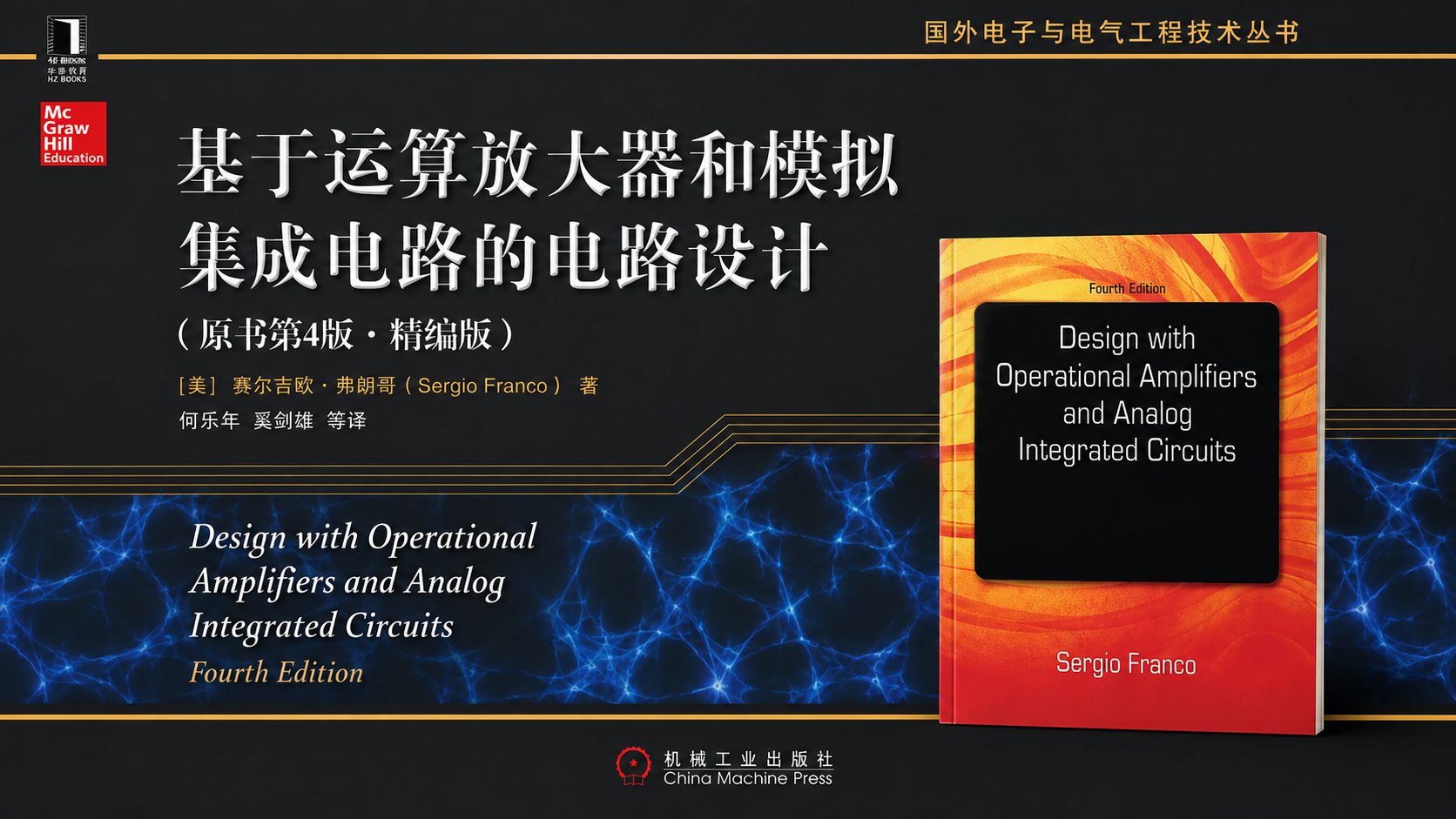
Design with Operational Amplifiers and Analog Integrated Circuits, 4th Edition, by Sergio Franco, provides a comprehensive treatment of operational amplifier circuits and analog integrated-circuit design. The book combines fundamental circuit theory with practical design considerations, making it useful for engineers and advanced students working with analog signal-processing and mixed-signal systems.
The fourth edition expands its treatment of negative feedback, circuit stability, and practical layout considerations, while adding coverage of current-feedback amplifiers, switching regulators, and phase-locked loops (PLLs).
Rather than treating operational amplifiers as ideal building blocks, the text systematically examines the non-ideal characteristics that determine real circuit behavior, including offset, bias currents, bandwidth limitations, noise, transient response, stability, and feedback interactions.
📚 Author and Technical Background #
Sergio Franco was born in Friuli, Italy, and joined the faculty of the Department of Electrical Engineering at San Francisco State University in 1980.
During his academic career, Franco trained hundreds of engineers who went on to work in the semiconductor and electronics industries. He earned his Ph.D. from the University of Illinois at Urbana-Champaign and later became Professor Emeritus of the department.
Before entering academia, Franco gained industry experience across several technical fields, including:
- Solid-state physics
- Pattern recognition
- Integrated-circuit design
- Medical electronics
- Consumer electronics
- Automotive electronics
His broader textbook portfolio includes Analog Circuit Design: Discrete & Integrated and Electric Circuits Fundamentals.
This combination of academic and industrial experience is reflected in the book’s emphasis on both analytical techniques and practical circuit implementation.
🔌 Chapter 1: Operational Amplifier Fundamentals #
The opening chapter establishes the theoretical foundation for operational amplifier analysis.
Topics include:
- Amplifier fundamentals
- Operational amplifier architecture
- Basic op amp configurations
- Ideal op amp analysis
- Negative feedback
- Feedback in practical op amp circuits
- Loop gain
- Blackman’s formula
- Op amp power supplies
The chapter establishes the relationship between open-loop amplifier characteristics and closed-loop circuit behavior. Negative feedback receives particular attention because it forms the basis for controlling gain, bandwidth, impedance, distortion, and stability in practical amplifier systems.
🔄 Chapter 2: Resistive Feedback Circuits #
The second chapter applies feedback concepts to practical signal-conditioning circuits.
Major circuit categories include:
- Current-to-voltage converters
- Voltage-to-current converters
- Current amplifiers
- Difference amplifiers
- Instrumentation amplifiers
- Instrumentation applications
- Transducer bridge amplifiers
Instrumentation amplifiers and bridge interfaces are particularly relevant to sensor systems, where high input impedance, accurate gain, common-mode rejection, and low offset are important design requirements.
⚙️ Chapter 3: Static Op Amp Limitations #
Real operational amplifiers deviate significantly from the ideal model. This chapter examines the static limitations that introduce DC errors into precision analog circuits.
Key topics include:
- Simplified op amp models
- Input bias current
- Output offset current
- Low-bias-current amplifiers
- Input offset voltage
- Low-offset-voltage amplifiers
- Offset-error compensation
- Input common-mode range
- Output voltage swing
- Absolute maximum ratings
These characteristics become especially important in precision measurement systems, where small DC errors can become significant relative to the desired signal.
📈 Chapter 4: Dynamic Op Amp Limitations #
Dynamic behavior determines how an amplifier responds to changing signals and how its performance varies with frequency.
The chapter covers:
- Open-loop frequency response
- Closed-loop frequency response
- Input and output impedance
- Transient response
- Finite gain-bandwidth product
- Integrator limitations
- Filter limitations
- Current-feedback amplifiers
The discussion of finite gain-bandwidth product is particularly important because idealized op amp equations can produce misleading results when applied beyond the amplifier’s usable frequency range.
The chapter also introduces current-feedback amplifiers, whose bandwidth characteristics and feedback behavior differ fundamentally from conventional voltage-feedback architectures.
🌡️ Chapter 5: Noise #
Noise analysis is essential for analog systems operating with low-level signals.
The book examines:
- Noise properties
- Dynamic noise analysis
- Noise sources
- Noise in operational amplifier circuits
- Photodiode amplifier noise
- Low-noise operational amplifiers
The treatment connects individual noise mechanisms with their impact at the system level. This is particularly relevant to transimpedance amplifiers, sensor interfaces, and other circuits where the signal may approach the intrinsic noise floor of the electronics.
📐 Chapter 6: Stability #
Feedback improves amplifier performance but also introduces the possibility of instability. This chapter develops the techniques required to analyze and compensate feedback systems.
Core topics include:
- Stability fundamentals
- Gain and phase margin
- Stability measurements
- Op amp frequency compensation
- Feedback poles
- Lead and lag compensation
- Current-feedback amplifier stability
- Composite amplifiers
Understanding gain margin and phase margin is essential when designing high-bandwidth feedback circuits, especially when external loads, capacitive elements, or additional poles alter the loop response.
🔀 Chapter 7: Nonlinear Circuits #
Operational amplifiers can also be used as building blocks for nonlinear signal-processing circuits.
This chapter covers:
- Voltage comparators
- Comparator applications
- Schmitt triggers
- Precision rectifiers
- Analog switches
- Peak detectors
- Sample-and-hold amplifiers
These circuits demonstrate how feedback can be intentionally combined with nonlinear elements to implement functions that cannot be modeled adequately as simple linear amplifiers.
🎛️ Chapter 8: Signal Generators #
The eighth chapter focuses on generating periodic and time-varying signals using analog circuitry.
Topics include:
- Sine-wave generators
- Multivibrators
- Monolithic timers
- Triangular-wave generators
- Sawtooth-wave generators
- Monolithic waveform generators
- Voltage-to-frequency converters
- Frequency-to-voltage converters
These circuits provide practical examples of oscillation, threshold control, feedback, integration, and waveform shaping.
🔋 Chapter 9: Voltage References and Regulated Power Supplies #
The final section provided in the source material moves from signal amplification to analog power-management circuits.
It covers:
- Power-supply performance specifications
- Voltage references
- Voltage-reference applications
- Linear voltage regulators
- Linear regulator applications
- Switching regulators
- Error amplifiers
- Voltage-mode control
- Peak current-mode control
- Peak current-mode control for boost converters
The inclusion of switching regulators broadens the book beyond conventional small-signal analog design. Feedback, compensation, error amplification, and control-loop behavior become directly applicable to power-conversion systems.
Switching and Current-Mode Control #
Peak current-mode control is particularly useful because it combines voltage regulation with cycle-by-cycle current information. This architecture can improve transient behavior and simplify certain converter-control problems, while also introducing additional stability considerations that must be addressed during compensation.
🧠 Core Engineering Themes #
Across these chapters, several concepts repeatedly connect the different areas of analog design.
Negative Feedback #
Negative feedback is one of the central themes of the book. It provides a framework for understanding how amplifier gain, bandwidth, impedance, distortion, and stability interact.
Non-Ideal Device Behavior #
Practical design requires accounting for parameters that disappear from ideal op amp models:
- Finite gain
- Limited bandwidth
- Input offset
- Bias currents
- Noise
- Output limitations
- Slew and transient behavior
- Stability constraints
These characteristics often determine whether an analytically correct circuit will actually meet its system-level specifications.
Stability and Compensation #
Feedback systems must be designed around their complete frequency response rather than their nominal DC gain alone. Poles, zeros, parasitic capacitances, external loads, and compensation networks all influence closed-loop stability.
Practical Circuit Design #
The book’s emphasis extends beyond mathematical circuit analysis to practical implementation. Layout, power supplies, signal integrity, component selection, and device limitations all influence the final behavior of an analog design.
📖 Overall Scope of the 4th Edition #
The fourth edition provides a progression from fundamental operational amplifier concepts toward increasingly complex analog systems:
- Op amp fundamentals establish the analytical framework.
- Feedback circuits apply those principles to signal-conditioning architectures.
- Static limitations introduce real-world DC errors.
- Dynamic limitations address bandwidth and transient behavior.
- Noise analysis addresses signal integrity at low signal levels.
- Stability theory explains feedback-loop behavior and compensation.
- Nonlinear circuits extend op amp applications beyond linear amplification.
- Signal generators demonstrate analog timing and waveform generation.
- Voltage references and regulators extend feedback concepts into power-management systems.
This structure makes the material particularly relevant to engineers who need to move from ideal circuit equations to real analog hardware.
🏁 Final Takeaways #
Design with Operational Amplifiers and Analog Integrated Circuits, 4th Edition, presents operational amplifier design as a combination of circuit theory, device limitations, feedback analysis, and practical implementation.
Its strongest technical themes include:
- Operational amplifier fundamentals
- Negative-feedback analysis
- Precision amplifier design
- Static and dynamic non-idealities
- Analog noise analysis
- Gain and phase stability
- Current-feedback amplifiers
- Nonlinear signal processing
- Analog waveform generation
- Voltage references and linear regulators
- Switching regulators and current-mode control
For engineers working with analog front ends, instrumentation, signal conditioning, feedback amplifiers, or power-management circuits, the book provides a broad technical foundation for understanding not only how an analog circuit should work in theory, but also why real hardware behaves differently and how those differences can be managed during design.