
RF Circuit Engineering Design: Practical RF Design Guide
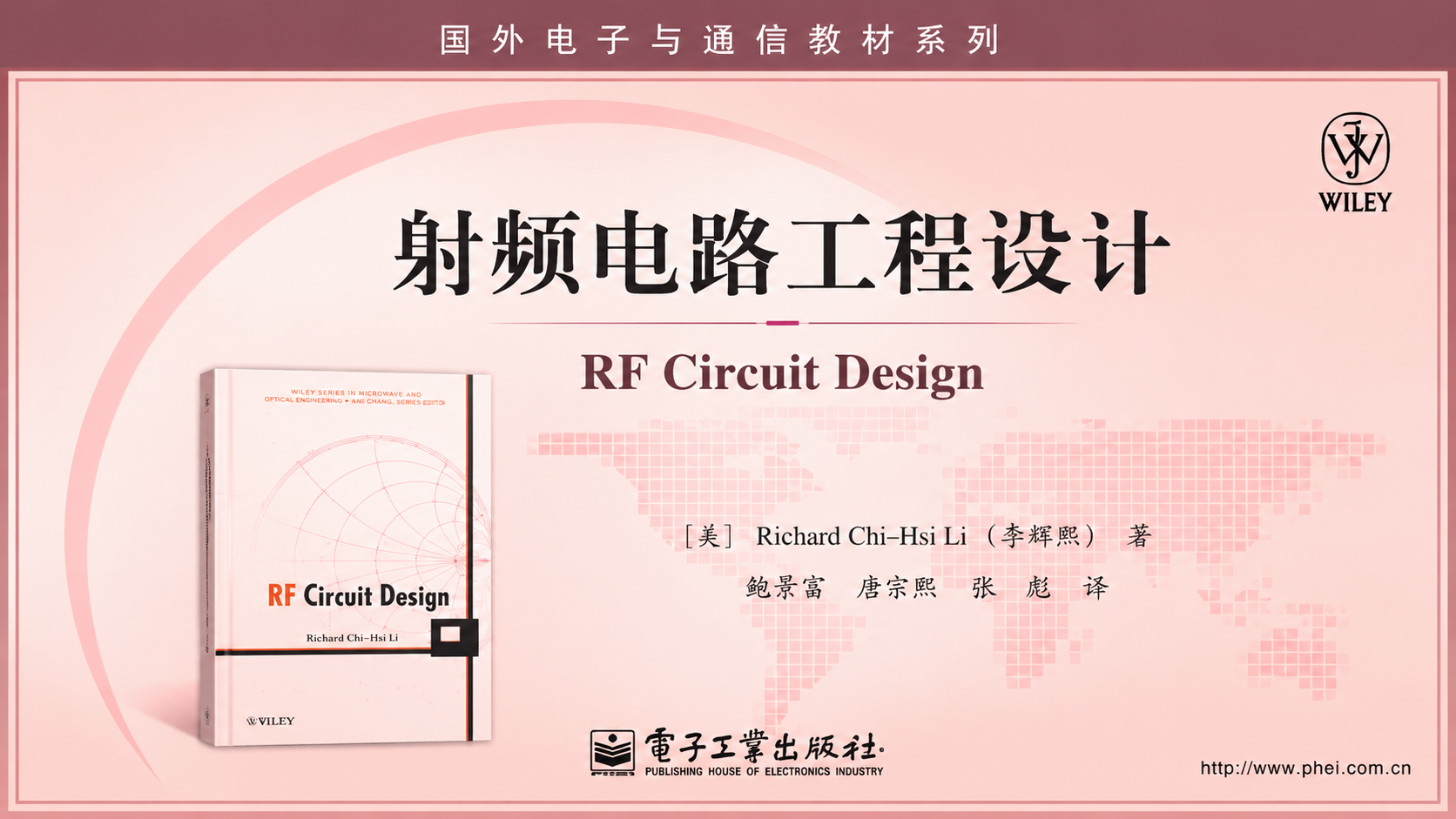
RF Circuit Engineering Design is an engineering-focused technical textbook authored by Chinese-American RF engineer Ji-Xi Li, with contributions from Jingfu Bao. Published by the Publishing House of Electronics Industry in June 2011, the book presents a practical framework for designing, analyzing, and optimizing radio-frequency circuits and communication systems.
Rather than treating RF design as a collection of isolated circuit techniques, the book connects transistor-level implementation, passive networks, PCB and IC-level effects, manufacturing considerations, and complete RF system performance.
The material is organized around three complementary areas: individual RF circuit modules, practical design techniques, and system-level analysis. This progression takes the reader from components such as low-noise amplifiers, mixers, oscillators, and power amplifiers to impedance matching, grounding, RFIC integration, design-for-manufacturability, and system metrics such as gain, noise, and nonlinearity.
📡 A Practical Framework for RF Circuit Design #
The book’s engineering-oriented approach makes it particularly relevant to RF engineers, circuit designers, researchers, and students working with wireless communication hardware.
Its technical coverage can be divided into three major modules.
Individual RF modules #
The first section focuses on the fundamental building blocks found in RF communication systems:
- Low-noise amplifiers (LNAs)
- Passive and active mixers
- Differential pairs
- RF baluns
- Tuned filters
- Voltage-controlled oscillators (VCOs)
- Power amplifiers (PAs)
These chapters address both circuit topology and practical implementation considerations, including gain, noise, linearity, frequency response, biasing, and integration.
Design techniques and practical considerations #
The second section moves beyond individual circuits and addresses the engineering problems that often determine whether an RF design performs correctly in hardware.
Topics include:
- Differences between RF, analog, and digital circuit design
- Voltage and power transfer
- Impedance conjugate matching
- Narrowband and broadband impedance matching
- Device impedance and gain
- RF impedance measurement
- Grounding and current coupling
- RFIC and SoC integration
- Design for manufacturability (DFM)
- Monte Carlo analysis and six-sigma design
This section emphasizes that RF performance depends not only on the schematic but also on physical implementation, interconnects, grounding structures, parasitic effects, substrate coupling, and manufacturing variation.
RF system analysis #
The final section evaluates RF circuits at the system level.
It examines major parameters including:
- Power gain
- Noise and noise figure
- Nonlinearity
- Other system-level performance metrics
- Complete RF system analysis
This system perspective is important because optimizing one circuit parameter can negatively affect another. RF design therefore requires balancing gain, noise, linearity, bandwidth, stability, power consumption, and implementation constraints.
👨🔬 Ji-Xi Li: RF Communication Engineering Experience #
Ji-Xi Li brings extensive academic and industrial experience to the book.
He graduated from the Department of Physics at Fudan University in 1958 and initially worked at the Institute of Geophysics of the Chinese Academy of Sciences, where he researched ionospheric and upper-atmosphere sounding technologies. He later served as a lecturer in space science at the University of Science and Technology of China.
Li also served as secretary to Academician Zhao Jiuzhang and contributed the ionosphere section to Upper Atmospheric Physics, edited by Zhao Jiuzhang.
Beginning in 1979, Li shifted his primary focus toward RF communication system engineering in the United States. Over more than three decades, he held engineering and senior technical positions at companies including Motorola, Texas Instruments, and RCA.
His engineering work covered mobile phones, communication satellites, and other RF products. He accumulated more than 80 internal technical reports and held three U.S. patents.
Li also maintained an active role in technical education. After returning to China to lecture in 1984, he delivered more than 50 seminars, training programs, and academic presentations across mainland China, Taiwan, Hong Kong, and Singapore.
🎓 Jingfu Bao: RF Circuits and Microwave Systems #
Jingfu Bao is a Ph.D., professor, doctoral supervisor, senior member of the Chinese Institute of Electronics (CIE), and IEEE member.
He studied electronic engineering at the University of Electronic Science and Technology of China (UESTC), where he completed his bachelor’s, master’s, and doctoral degrees before joining its Microwave Center.
Bao later spent several years working in Japan before returning to UESTC in 2005, where he continued his teaching and research activities.
His more than two decades of RF engineering experience includes the development of:
- 26.5–40 GHz millimeter-wave frequency synthesizers
- Ultra-wideband, low-phase-noise microwave frequency synthesizers
- 18–140 GHz harmonic mixers
- WCDMA mobile RF front-ends
- Low-power Bluetooth modules
- Digital TV tuner modules
- Microwave broadband VCOs
- High-linearity, high-efficiency power amplifiers
Bao has published more than 100 papers, co-authored five books, and received multiple provincial and ministerial science and technology awards.
🔧 Part 1: Individual RF Circuit Modules #
The first major section builds the foundation through detailed treatment of common RF building blocks.
Chapter 1: Low-Noise Amplifiers #
The LNA chapter introduces single-ended transistor architectures and cascode implementations, including automatic gain control considerations.
Topics include:
- Introduction to LNA architectures
- Single-ended single-transistor LNAs
- Single-ended cascode LNAs
- LNA automatic gain control performance
The emphasis is on achieving useful gain while controlling noise and maintaining suitable RF performance.
Chapter 2: Mixers #
The mixer chapter examines the frequency-conversion circuits used throughout RF transceivers.
It covers:
- Passive mixers
- Active mixers
- Practical mixer design schemes
- Supporting analytical material
The discussion provides a foundation for understanding the tradeoffs between conversion gain, linearity, noise, isolation, and power consumption.
Chapter 3: Differential Pairs #
Differential signaling is examined from both theoretical and practical perspectives.
Key topics include:
- Why differential pairs are required
- DC bias isolation
- Differential-pair operating principles
- Common-mode rejection ratio (CMRR)
The chapter connects differential circuit theory with the requirements of RF signal paths and integrated implementations.
Chapter 4: RF Baluns #
Baluns provide the interface between balanced and unbalanced RF circuits and are essential in many RF front-end architectures.
The book covers:
- Transformer baluns
- LC baluns
- Microstrip-line baluns
- Hybrid baluns
The treatment highlights how different balun implementations affect RF performance, integration, and physical design.
Chapter 5: Tuned Filters #
The tuned-filter chapter examines resonant circuits and coupling mechanisms used for frequency-selective behavior.
Topics include:
- Tuned filters in communication systems
- Coupling between resonant circuits
- Circuit modeling
- Secondary coupling effects
- Filter performance
Chapter 6: Voltage-Controlled Oscillators #
VCOs are central to frequency synthesis and phase-locked-loop architectures.
The chapter addresses:
- Three-point oscillators
- Single-ended oscillator architectures
- VCO and PLL relationships
- Single-ended VCO design
- Differential VCOs
- Quadrature VCOs
Chapter 7: Power Amplifiers #
The PA section addresses RF power generation and output-stage design.
It covers:
- Power amplifier classifications
- Single-ended PA design
- Single-ended PA IC implementation
- Push-pull architectures
- Temperature compensation
- Output-power control
- Linear power amplifiers
The discussion highlights the competing requirements of output power, efficiency, linearity, thermal behavior, and control.
🧭 Part 2: RF Design Techniques and Engineering Practice #
The second major section focuses on practical issues that frequently determine real-world RF performance.
Chapter 8: RF Circuit Design vs. Digital Circuit Design #
RF and digital circuits operate under fundamentally different constraints.
The chapter compares:
- Digital and analog circuit behavior
- RF and digital modules within communication systems
- High-speed digital design considerations
- Design methodologies for RF and digital hardware
The distinction is particularly important in mixed-signal systems, where digital switching activity can introduce unwanted coupling into sensitive RF paths.
Chapter 9: Voltage and Power Transfer #
Efficient signal transfer requires understanding the relationship between source impedance, load impedance, voltage, and power.
The chapter covers:
- Voltage transfer
- Power transfer
- Impedance conjugate matching
- Additional effects introduced by matching networks
These principles form the theoretical basis for many practical RF matching decisions.
Chapter 10: Narrowband Impedance Matching #
Narrowband matching techniques are developed using return-loss analysis and matching networks.
Topics include:
- Return-loss adjustment
- Single-element matching networks
- Two-element matching networks
- Three-element matching networks
- Matching when source or load impedance differs from 50 Ω
- Practical matching components
Smith-chart-based analysis provides a foundation for translating complex impedances into practical RF matching networks.
Chapter 11: Broadband Impedance Matching #
Broadband matching introduces additional constraints because the impedance must be controlled over a wider frequency range.
The chapter examines:
- Narrowband versus broadband return loss
- Smith-chart impedance transformations
- Single-element branches
- Two-element branches
- Broadband IQ modulator matching
- Broadband matching network design
Chapter 12: Device Impedance and Gain #
This chapter connects transistor-level device behavior with RF gain and impedance.
It covers:
- Miller effect
- Bipolar transistor small-signal models
- Common-emitter configurations
- Common-base configurations
- Common-collector configurations
- MOSFET small-signal models
- Common-source configurations
- Common-gate configurations
- Common-drain configurations
- Comparisons between bipolar and MOSFET implementations
The resulting framework helps engineers evaluate how device topology affects gain, impedance, bandwidth, and high-frequency behavior.
Chapter 13: RF Impedance Measurement #
Accurate impedance characterization is essential when validating RF designs.
The chapter compares:
- Scalar voltage measurements
- Vector voltage measurements
- Direct network-analyzer impedance measurements
- Alternative network-analyzer techniques
- Circulator-based impedance measurement
These methods provide practical tools for correlating simulated RF behavior with measured hardware.
Chapter 14: RF Grounding #
Grounding is treated as an RF circuit element rather than simply an ideal reference node.
The chapter examines:
- The meaning of grounding
- Hidden grounding problems in schematics
- Poor grounding implementations
- Practical limitations of nominally zero capacitance
- Quarter-wavelength microstrip structures
This perspective is critical because ground impedance and current paths can strongly influence RF isolation, stability, noise, and electromagnetic coupling.
Chapter 15: Ground-Plane Equipotentiality and Current Coupling #
The book extends its grounding analysis to multilayer PCBs and IC structures.
Topics include:
- Equipotential ground planes
- Forward and reverse current coupling
- Multiple metal layers in PCBs and ICs
These concepts are particularly relevant to high-frequency systems where shared return paths can create unintended coupling between functional blocks.
Chapter 16: RFIC and SoC Design #
RF integration introduces additional challenges associated with interference, isolation, substrate coupling, and physical implementation.
The chapter addresses:
- RF interference and isolation
- Metal shielding of RF modules
- RFIC development requirements
- Signal propagation through IC substrates
- External electromagnetic interference suppression
- RFIC and RF-module grounding rules
- RFIC design bottlenecks
- SoC integration
- Future RF system-on-chip development
The material emphasizes that RFIC performance depends heavily on physical layout and isolation in addition to transistor-level circuit design.
Chapter 17: Design for Manufacturability #
RF designs must remain functional across process, voltage, temperature, component, and manufacturing variation.
The DFM chapter introduces:
- Design for manufacturability
- Six-sigma design principles
- Approaches for achieving six-sigma performance
- Monte Carlo analysis
This provides a bridge between nominal circuit simulation and production-oriented engineering.
📊 Part 3: RF System Analysis #
The final section moves from individual circuits to complete RF system behavior.
Chapter 18: Major RF Parameters and System Analysis #
System-level RF analysis evaluates how individual blocks interact and how their combined behavior affects overall performance.
The chapter covers:
- Power gain
- Noise
- Nonlinearity
- Additional RF performance parameters
- Complete RF system analysis
Rather than optimizing an isolated component, system analysis considers the cumulative effects of cascaded gain stages, noise sources, nonlinear behavior, matching networks, and other RF subsystems.
🎯 Engineering Value of the Book #
The main strength of RF Circuit Engineering Design is its progression from circuit fundamentals to implementation and finally to system analysis.
Its coverage spans the complete RF engineering workflow:
- Design individual RF building blocks.
- Analyze device impedance, gain, noise, and linearity.
- Develop narrowband or broadband matching networks.
- Control grounding and unwanted current coupling.
- Integrate RF functions into RFIC and SoC architectures.
- Account for manufacturing variation through DFM and statistical analysis.
- Evaluate complete system-level performance.
For engineers working on RF transceivers, microwave circuits, wireless communication systems, RFICs, and mixed-signal hardware, this structure provides a useful connection between theoretical RF concepts and practical implementation constraints.
The book’s emphasis on impedance, grounding, coupling, measurement, manufacturability, and system analysis is especially valuable because these factors frequently determine whether a theoretically sound RF circuit can achieve its expected performance in actual hardware.