
Engineering Electromagnetics 8th Edition: Tsinghua University Complete Guide
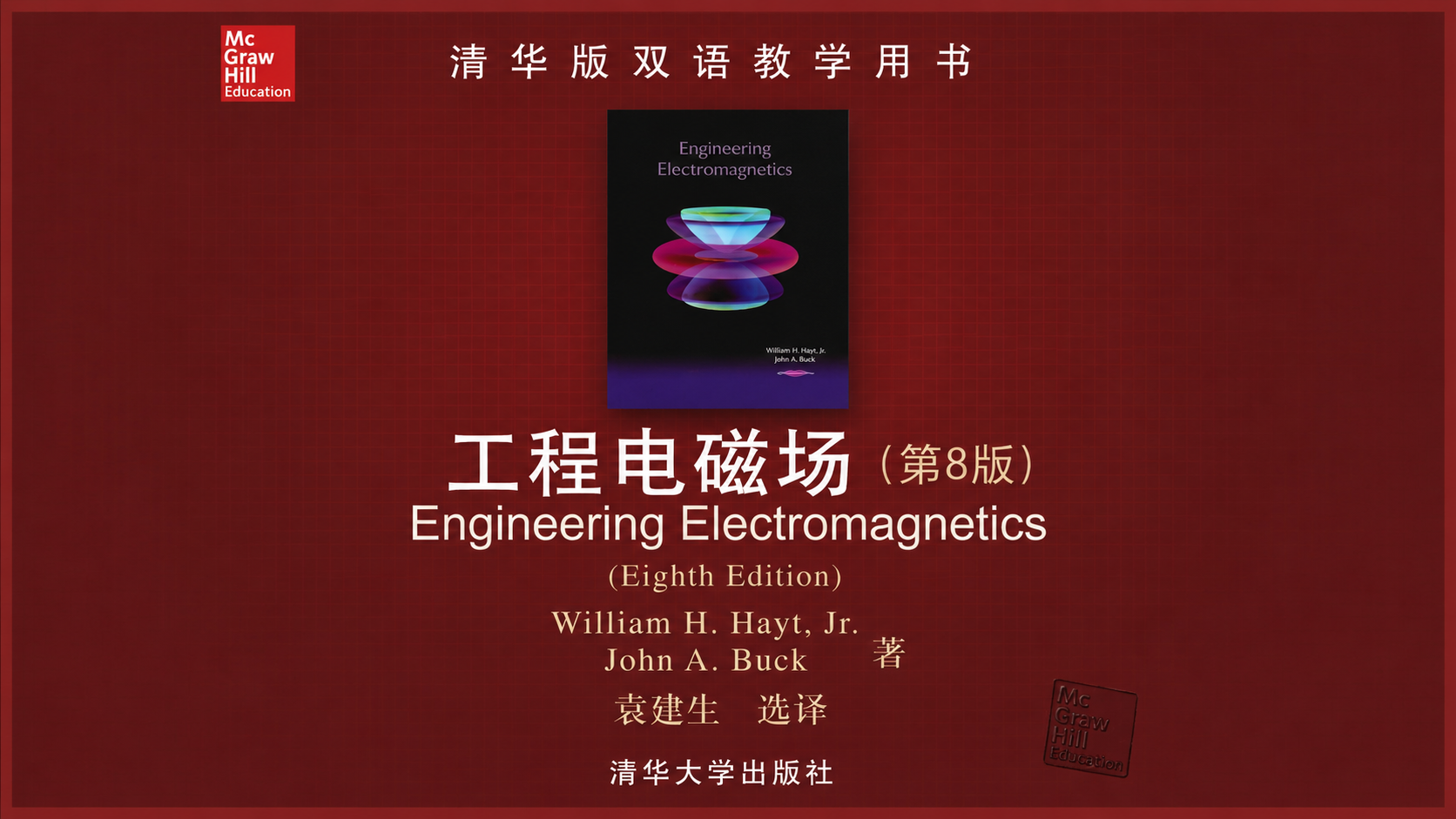
Engineering Electromagnetics, 8th Edition, by William H. Hayt and John A. Buck is a widely used engineering textbook covering the fundamental principles of electromagnetic fields and waves. The book develops electromagnetics from vector analysis and electrostatics through magnetostatics, time-varying fields, transmission lines, wave propagation, guided waves, radiation, and antenna systems.
Published in Chinese by Tsinghua University Press in 2014, the edition is designed for electrical and electronic engineering education and follows the progression commonly used in undergraduate electromagnetics curricula.
A central strength of the book is its emphasis on physical understanding rather than excessively formal mathematical derivations. Vector calculus, field equations, boundary conditions, and Maxwell’s equations are introduced as tools for solving practical engineering problems.
The complete text contains 14 chapters, supported by appendices covering vector analysis, units, material constants, uniqueness, complex permittivity, and selected problem solutions.
🧭 From Vector Analysis to Maxwell’s Equations #
The book establishes a continuous path from mathematical foundations to electromagnetic system behavior.
The progression can be summarized as:
- Vector analysis and coordinate systems
- Electrostatic fields and Coulomb’s law
- Electric flux and Gauss’s law
- Electric potential and energy
- Conductors and dielectric materials
- Capacitance and potential equations
- Steady magnetic fields
- Magnetic forces, materials, and inductance
- Time-varying fields and Maxwell’s equations
- Transmission lines
- Uniform plane waves
- Reflection and dispersion
- Guided waves
- Electromagnetic radiation and antennas
This structure allows the fundamental field relationships to be developed before applying them to increasingly complex electromagnetic systems.
⚡ Electrostatic Fields and Electric Potential #
The first six chapters establish the foundation of electrostatics.
Chapter 1: Vector Analysis #
The book begins with the mathematical language required for electromagnetic field analysis.
Topics include:
- Scalars and vectors
- Vector algebra
- Rectangular coordinates
- Vector components and unit vectors
- Vector fields
- Dot products
- Cross products
- Cylindrical coordinates
- Spherical coordinates
These concepts provide the mathematical framework for describing electromagnetic quantities that vary throughout three-dimensional space.
Chapter 2: Coulomb’s Law and Electric Field Intensity #
The second chapter introduces the electric field through Coulomb’s experimental law.
It covers:
- Coulomb’s law
- Electric field intensity
- Continuous volume charge distributions
- Line charges
- Sheet charges
- Electric-field streamlines
The progression from discrete charges to continuous distributions establishes the field-based approach used throughout the remainder of the text.
Chapter 3: Electric Flux Density and Gauss’s Law #
Electric flux density provides another way to characterize electric fields and charge distributions.
The chapter develops:
- Electric flux density
- Gauss’s law
- Symmetrical charge distributions
- Differential volume elements
- Divergence
- Maxwell’s first equation
- The vector operator ∇
- The divergence theorem
Gauss’s law becomes particularly useful when symmetry allows electric-field distributions to be solved without directly integrating Coulomb’s law.
Chapter 4: Energy and Potential #
The book then introduces electric potential as an alternative representation of electrostatic fields.
Topics include:
- Work performed in moving a charge
- Line integrals
- Potential difference
- Electric potential
- Potential fields of point charges
- Conservative electric fields
- Potential gradients
- Electric dipoles
- Electrostatic energy density
The relationship between electric field and potential provides the foundation for later applications involving capacitors, dielectric structures, and semiconductor junctions.
Chapter 5: Conductors and Dielectrics #
Real materials modify electromagnetic fields, making material behavior an essential part of field analysis.
The chapter covers:
- Current and current density
- Current continuity
- Metallic conductors
- Conductor properties
- Electromagnetic boundary conditions
- Method of images
- Semiconductors
- Dielectric materials
- Dielectric boundary conditions
These concepts become particularly important when analyzing interfaces between different materials.
Chapter 6: Capacitance #
Capacitance is developed from the underlying electric-field distribution rather than treated solely as a circuit parameter.
The chapter examines:
- Capacitance definition
- Parallel-plate capacitors
- Practical capacitance examples
- Two-wire transmission lines
- Field sketches for two-dimensional problems
- Poisson’s equation
- Laplace’s equation
- p-n junction capacitance
The inclusion of Poisson’s and Laplace’s equations connects circuit-level capacitance with field-based numerical and analytical methods.
🧲 Steady Magnetic Fields and Magnetic Materials #
Chapters 7 and 8 develop the magnetic-field counterpart to the electrostatic material.
Chapter 7: The Steady Magnetic Field #
The chapter introduces the fundamental laws governing static magnetic fields:
- Biot-Savart law
- Ampere’s circuital law
- Curl
- Stokes’ theorem
- Magnetic flux
- Magnetic flux density
- Scalar magnetic potential
- Vector magnetic potential
The chapter concludes by deriving the steady-magnetic-field laws, connecting integral and differential descriptions of magnetic fields.
Chapter 8: Magnetic Forces, Materials, and Inductance #
The next chapter extends magnetic-field analysis into forces, materials, and energy storage.
Topics include:
- Force on a moving charge
- Force on a current element
- Force between current elements
- Force and torque on closed circuits
- Magnetic materials
- Magnetization
- Permeability
- Magnetic boundary conditions
- Magnetic circuits
- Magnetic potential energy
- Forces on magnetic materials
- Inductance
- Mutual inductance
The treatment of magnetic circuits and ferromagnetic materials provides an engineering bridge between field theory and practical electromagnetic devices.
🌀 Time-Varying Fields and Maxwell’s Equations #
Chapter 9 provides the theoretical transition from static fields to dynamic electromagnetic systems.
Chapter 9: Time-Varying Fields and Maxwell’s Equations #
The chapter introduces:
- Faraday’s law
- Displacement current
- Maxwell’s equations in point form
- Maxwell’s equations in integral form
- Retarded potentials
Maxwell’s equations unify the electric and magnetic field relationships developed throughout the earlier chapters.
This unification is critical because electromagnetic waves, transmission lines, antennas, and optical systems can all be understood as consequences of the same fundamental field equations.
📡 Transmission Line Theory #
Chapter 10 moves electromagnetic field theory into practical high-frequency signal transmission.
Chapter 10: Transmission Lines #
The chapter covers the complete transmission-line model, including:
- Physical transmission-line propagation
- Transmission-line equations
- Lossless propagation
- Sinusoidal voltage propagation
- Complex analysis of waves
- Phasor-form transmission-line equations
- Low-loss propagation
- Power transmission
- Decibel-based loss characterization
- Reflection at discontinuities
- Voltage standing wave ratio (VSWR)
- Finite-length transmission lines
- Practical transmission-line examples
- Smith charts
- Transient analysis
Transmission-line theory is fundamental to RF, microwave, high-speed digital, and communication-system design because electrical interconnects can no longer be treated as ideal wires when their physical length becomes significant relative to the signal wavelength.
Smith Chart Analysis #
The Smith chart provides a graphical method for analyzing complex impedances, reflection coefficients, standing waves, and matching networks.
Its inclusion gives engineers a practical method for translating electromagnetic transmission-line behavior into impedance-matching decisions.
🌊 Electromagnetic Wave Propagation #
Chapters 11 and 12 introduce the behavior of electromagnetic waves in free space and material media.
Chapter 11: Uniform Plane Waves #
The chapter examines:
- Wave propagation in free space
- Wave propagation in dielectric materials
- Poynting’s theorem
- Electromagnetic power flow
- Propagation in good conductors
- Skin effect
- Wave polarization
Poynting’s theorem connects electromagnetic fields to power transmission, while skin-effect analysis explains why electromagnetic fields become concentrated near conductor surfaces at high frequencies.
Chapter 12: Reflection and Dispersion #
The next chapter examines what happens when electromagnetic waves encounter material boundaries.
Topics include:
- Normal-incidence reflection
- Standing-wave ratio
- Multiple-interface reflections
- Arbitrary propagation directions
- Oblique incidence
- Total reflection
- Total transmission
- Dispersive media
- Pulse broadening
These concepts are essential for understanding practical propagation through layered materials, optical structures, transmission media, and RF environments.
📶 Guided Waves and Waveguides #
Chapter 13 applies electromagnetic wave theory to structures that constrain propagation.
Chapter 13: Guided Waves #
The chapter covers:
- Transmission-line fields
- Primary transmission-line constants
- Basic waveguide operation
- Parallel-plate waveguides
- Wave-equation analysis
- Rectangular waveguides
- Planar dielectric waveguides
- Optical fibers
Waveguides demonstrate how conductor and dielectric boundaries can control electromagnetic modes and propagation characteristics.
The progression from parallel-plate structures to rectangular waveguides, dielectric guides, and optical fibers shows how the same field equations apply across very different physical implementations.
📡 Electromagnetic Radiation and Antennas #
The final chapter applies electromagnetic field theory to radiation and antenna systems.
Chapter 14: Electromagnetic Radiation and Antennas #
Topics include:
- Hertzian dipole radiation
- Antenna specifications
- Magnetic dipoles
- Thin-wire antennas
- Two-element arrays
- Uniform linear arrays
- Antennas as receiving systems
The chapter establishes the relationship between electromagnetic radiation, antenna geometry, field distribution, directivity, and reception.
This provides a natural endpoint for the textbook: the mathematical and physical principles introduced at the beginning are ultimately used to analyze systems that generate and receive electromagnetic waves.
🧮 Engineering-Focused Learning Approach #
A distinguishing characteristic of the eighth edition is its emphasis on physical interpretation.
Rather than relying primarily on lengthy mathematical derivations, the book uses diagrams, highlighted equations, engineering examples, and structured exercises to reinforce the relationship between mathematical models and physical electromagnetic behavior.
Each chapter includes a substantial collection of graded problems, giving students opportunities to apply the equations to progressively more complex engineering scenarios.
The book also moves selected traditional material, including some treatment of separation-of-variables techniques, toward an online companion environment containing supplementary animations, interactive quizzes, and numerical computation resources.
📘 Appendices and Reference Material #
The appendices provide supporting mathematical and engineering references.
Appendix A: Vector Analysis #
The vector-analysis appendix covers:
- General curvilinear coordinates
- Divergence
- Gradient
- Curl
- Vector identities
This material provides a useful reference when working with Maxwell’s equations in cylindrical, spherical, or other coordinate systems.
Appendix B: Units #
A dedicated appendix provides electromagnetic unit-system information for engineering calculations.
Appendix C: Material Constants #
This section provides reference values for relevant electromagnetic material properties.
Appendix D: The Uniqueness Theorem #
The uniqueness theorem provides an important theoretical foundation for determining when electromagnetic boundary-value problems have a unique solution.
Appendix E: Complex Permittivity #
The appendix discusses the origin and interpretation of complex permittivity in electromagnetic materials.
Appendix F: Problem Answers #
Answers to odd-numbered problems are provided as a reference for checking calculations.
👨🏫 About William H. Hayt #
William H. Hayt received his bachelor’s and master’s degrees from Purdue University and his Ph.D. from the University of Illinois.
After four years of industrial experience, he returned to Purdue University, where he became a professor and later served as Head of the School of Electrical Engineering. He retired as Professor Emeritus in 1986.
In addition to Engineering Electromagnetics, Hayt authored three other textbooks and was an IEEE Fellow and member of the American Society for Engineering Education.
His teaching contributions were recognized through multiple honors at Purdue, including a Best Teacher Award. In 1999, his name was permanently included in the Book of Great Teachers at Purdue Memorial Union.
🎯 Who Should Study Engineering Electromagnetics? #
The eighth edition is particularly suitable for undergraduate students and engineers working in electrical engineering, electronics, communications, RF systems, microwave engineering, antennas, and related disciplines.
Its progression makes it useful for understanding the physical foundations behind technologies such as:
- RF transmission systems
- Microwave circuits
- Antennas
- Wireless communications
- Transmission lines
- Waveguides
- Optical fibers
- Electromagnetic compatibility
- High-speed interconnects
- Electric and magnetic devices
The most important value of the book is its unified treatment of electromagnetic phenomena. Electrostatic fields, magnetic fields, transmission lines, electromagnetic waves, waveguides, and antennas are not presented as unrelated subjects; they are progressively connected through vector analysis and Maxwell’s equations.
For engineers who need a strong field-theory foundation while maintaining a practical focus, Engineering Electromagnetics, 8th Edition provides a comprehensive path from fundamental electromagnetic concepts to real-world propagation, guided-wave, and antenna systems.