
Engineering Electromagnetics 8th Edition: XiAn Jiaotong University, Fields, Waves and Antennas
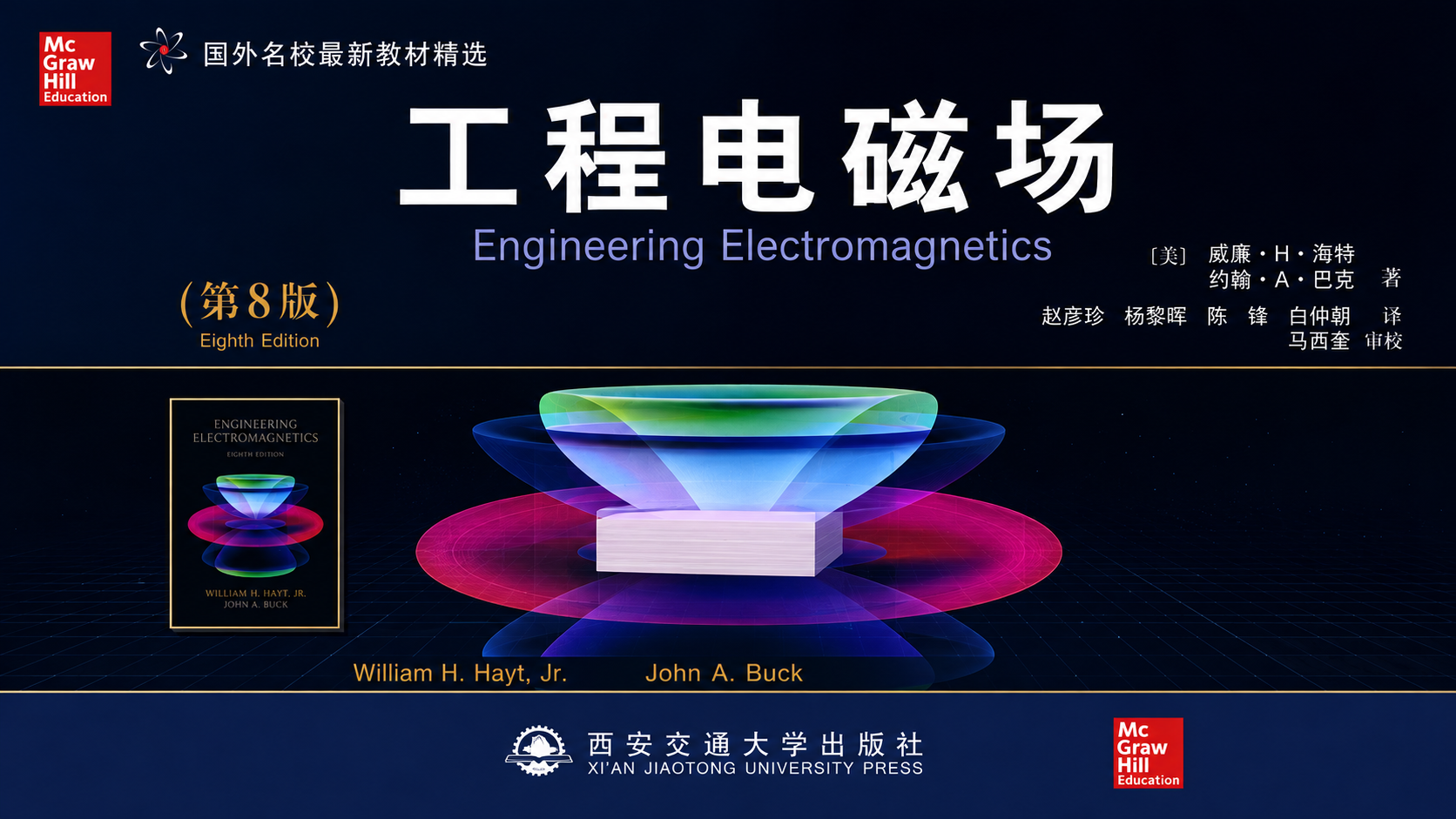
Engineering Electromagnetics, 8th Edition, by William H. Hayt and John A. Buck is a comprehensive engineering textbook covering electromagnetic fields, waves, transmission systems, guided propagation, radiation, and antennas.
The Chinese edition was published by Xi’an Jiaotong University Press on August 30, 2013. With 485 pages, it is part of the publisher’s series of selected textbooks from leading international universities.
The eighth edition maintains the classical progression from vector analysis and electrostatics to magnetostatics, time-varying fields, Maxwell’s equations, transmission lines, electromagnetic waves, and guided-wave systems. It also strengthens its treatment of electromagnetic radiation and antennas while expanding the discussion of rectangular waveguides.
A major emphasis of the book is engineering intuition. Mathematical relationships are supported by illustrations, physical analogies, worked examples, and graded exercises, making abstract field concepts easier to connect with practical electrical and electronic systems.
🧭 A Structured Path Through Electromagnetic Field Theory #
The textbook builds electromagnetic theory in a deliberate sequence.
It begins with the mathematical tools needed to describe vector fields, then introduces electric and magnetic fields independently before combining them through Maxwell’s equations.
The progression is:
- Vector analysis
- Electric fields and Coulomb’s law
- Electric flux and Gauss’s law
- Electric potential and energy
- Conductors and dielectrics
- Capacitance
- Steady magnetic fields
- Magnetic forces, materials, and inductance
- Time-varying fields and Maxwell’s equations
- Transmission lines
- Uniform plane waves
- Reflection and dispersion
- Guided electromagnetic waves
- Electromagnetic radiation and antennas
This organization makes the book suitable for developing a field-theory foundation before moving into RF, microwave, waveguide, and antenna applications.
⚡ Vector Analysis and Electric Fields #
The first six chapters establish the mathematical and physical foundations of electrostatics.
Chapter 1: Vector Analysis #
The opening chapter introduces the vector mathematics required for electromagnetic analysis.
Topics include:
- Scalars and vectors
- Vector algebra
- Rectangular coordinates
- Vector components and unit vectors
- Vector fields
- Dot products
- Cross products
- Cylindrical coordinates
- Spherical coordinates
These concepts become essential when electromagnetic quantities vary spatially in three dimensions.
Chapter 2: Coulomb’s Law and Electric Field Intensity #
The second chapter introduces electric fields from charge distributions.
It covers:
- Coulomb’s law
- Electric field intensity
- Continuous volume charge distributions
- Line charges
- Sheet charges
- Electric-field streamlines
The progression from discrete charge to continuous distributions provides the basis for more advanced field calculations.
Chapter 3: Electric Flux Density, Gauss’s Law, and Divergence #
This chapter introduces electric flux density and develops Gauss’s law as both an integral and differential concept.
Topics include:
- Electric flux density
- Gauss’s law
- Symmetrical charge distributions
- Differential volume elements
- Divergence
- Maxwell’s first equation
- The ∇ operator
- Divergence theorem
The treatment establishes an important connection between charge density and the divergence of the electric field.
Chapter 4: Energy and Potential #
The book then moves from electric field intensity to potential-based analysis.
The chapter examines:
- Work performed in moving charges
- Line integrals
- Potential difference
- Electric potential
- Point-charge potential fields
- Conservative fields
- Potential gradients
- Electric dipoles
- Electrostatic energy density
Potential methods are particularly useful for analyzing capacitive structures and boundary-value problems.
Chapter 5: Conductors and Dielectrics #
Material behavior introduces additional constraints on electromagnetic fields.
The chapter covers:
- Current density
- Continuity of current
- Metallic conductors
- Conductor properties
- Boundary conditions
- Method of images
- Semiconductor materials
- Dielectric materials
- Dielectric boundary conditions
These principles form the basis for understanding how electric fields behave at material interfaces.
Chapter 6: Capacitance #
Capacitance is derived from electric-field behavior rather than treated solely as a lumped circuit parameter.
Topics include:
- Definition of capacitance
- Parallel-plate capacitors
- Practical capacitance examples
- Two-conductor transmission lines
- Field-based capacitance estimation
- Poisson’s equation
- Laplace’s equation
- p-n junction capacitance
The inclusion of Poisson’s and Laplace’s equations provides an introduction to analytical field solutions for electrostatic structures.
🧲 Magnetic Fields, Materials and Inductance #
Chapters 7 and 8 develop the corresponding magnetic-field framework.
Chapter 7: The Steady Magnetic Field #
The chapter introduces the principal laws and mathematical tools used for steady magnetic fields.
It covers:
- Biot-Savart law
- Ampere’s circuital law
- Curl
- Stokes’ theorem
- Magnetic flux
- Magnetic flux density
- Scalar magnetic potential
- Vector magnetic potential
- Derivation of steady-magnetic-field laws
The combination of integral and differential formulations prepares the reader for Maxwell’s equations.
Chapter 8: Magnetic Forces, Materials, and Inductance #
The next chapter extends magnetic analysis to forces, materials, and energy storage.
Topics include:
- Force on moving charges
- Force on current elements
- Force between current elements
- Force and torque on closed circuits
- Magnetic materials
- Magnetization
- Permeability
- Magnetic boundary conditions
- Magnetic circuits
- Magnetic potential energy
- Magnetic forces
- Self-inductance
- Mutual inductance
These concepts connect electromagnetic field theory with practical magnetic components and electromechanical systems.
🌀 Maxwell’s Equations and Time-Varying Fields #
Chapter 9 provides the central theoretical bridge between static electromagnetic fields and propagating electromagnetic waves.
Chapter 9: Time-Varying Fields and Maxwell’s Equations #
The chapter covers:
- Faraday’s law
- Displacement current
- Maxwell’s equations in point form
- Maxwell’s equations in integral form
- Retarded potentials
Maxwell’s equations unify the electric and magnetic field relationships developed in the preceding chapters.
They also provide the theoretical foundation for transmission lines, electromagnetic waves, waveguides, antennas, and radiation.
📡 Transmission Lines and High-Frequency Signal Propagation #
Chapter 10 applies electromagnetic theory to practical guided signal transmission.
Chapter 10: Transmission Lines #
The chapter develops transmission-line behavior from physical propagation through mathematical modeling.
Key topics include:
- Physical wave propagation
- Transmission-line equations
- Lossless propagation
- Sinusoidal voltage propagation
- Complex wave analysis
- Phasor-domain solutions
- Low-loss propagation
- Power transmission
- Loss characterization
- Reflection at discontinuities
- Voltage standing wave ratio (VSWR)
- Finite-length transmission lines
- Practical transmission-line examples
- Smith-chart methods
- Transient analysis
Transmission-line theory is fundamental to RF and microwave engineering because interconnects become distributed electromagnetic structures when their electrical length is significant.
Smith Chart and Impedance Analysis #
The Smith chart provides a graphical framework for analyzing transmission-line impedances and reflections.
It is particularly useful for understanding:
- Reflection coefficients
- Normalized impedance
- Standing-wave behavior
- Transmission-line transformations
- Impedance matching
This makes the chapter directly relevant to practical RF circuit and microwave-system design.
🌊 Uniform Plane Electromagnetic Waves #
Chapter 11 introduces electromagnetic waves in homogeneous environments.
Chapter 11: Uniform Plane Electromagnetic Waves #
Topics include:
- Propagation in free space
- Propagation in dielectrics
- Poynting’s theorem
- Electromagnetic power flow
- Propagation in good conductors
- Skin effect
- Wave polarization
The chapter connects Maxwell’s equations to propagating electromagnetic energy and establishes the field relationships needed for subsequent reflection and waveguide analysis.
🔄 Reflection, Refraction and Dispersion #
Chapter 12 examines how electromagnetic waves behave at interfaces and in dispersive media.
Chapter 12: Reflection and Dispersion of Plane Waves #
The chapter addresses:
- Normal-incidence reflection
- Standing-wave ratio
- Multilayer interfaces
- Arbitrary incidence angles
- Oblique reflection
- Total reflection
- Total transmission
- Dispersive media
- Pulse broadening
These topics are important for understanding electromagnetic propagation through layered structures and materials whose properties vary with frequency.
📶 Guided Electromagnetic Waves #
Chapter 13 extends the wave-propagation framework to structures that constrain electromagnetic fields.
Chapter 13: Guided Electromagnetic Waves #
The chapter introduces guided-wave behavior and develops the concepts needed to analyze structures such as transmission lines and waveguides.
The eighth edition places greater emphasis on rectangular waveguide analysis, strengthening the connection between field theory and practical microwave propagation.
Guided-wave analysis is particularly relevant to:
- Microwave systems
- RF hardware
- Waveguide components
- Optical communication
- High-frequency signal propagation
The same Maxwell-equation framework used for free-space waves can be applied to these structures once their boundary conditions are defined.
📡 Electromagnetic Radiation and Antennas #
The addition and expansion of radiation and antenna material is one of the important features of the eighth edition.
Chapter 14: Electromagnetic Radiation and Antennas #
This chapter introduces the principles governing electromagnetic radiation and antenna operation.
The material connects field distributions with the generation and reception of electromagnetic energy, providing a natural transition from wave propagation to practical wireless systems.
Topics include electromagnetic radiation mechanisms, antenna behavior, and the relationship between field distributions and antenna characteristics.
This makes the eighth edition more comprehensive for students progressing from fundamental electromagnetics into RF and wireless engineering.
🧠 Engineering-Oriented Teaching Approach #
A major feature of the eighth edition is its focus on physical intuition.
Electromagnetic fields are often difficult to visualize because they involve spatially distributed quantities that cannot be directly observed. The book addresses this challenge through:
- Step-by-step concept development
- Detailed illustrations
- Physical analogies
- Worked engineering examples
- Highlighted equations
- Structured problem sets
This approach helps connect mathematical expressions with the physical behavior they describe.
The result is a textbook that emphasizes not only how to derive electromagnetic relationships, but also how to interpret and apply them.
📝 Graded Problems and Interactive Resources #
The eighth edition includes extensive end-of-chapter exercises designed to reinforce the material.
It introduces approximately 130 new problems, with problems categorized using a three-point difficulty scale. This gives students and instructors a clearer indication of the expected analytical complexity.
The textbook is also supported by online learning resources, including:
- Interactive modules
- Animations
- Illustrations
- Self-assessment quizzes
- Supplementary learning materials
These resources complement the mathematical treatment by providing additional ways to visualize electromagnetic behavior.
📚 Appendices and Reference Material #
The appendices provide supporting material needed throughout the textbook.
Appendix A: Vector Analysis #
This appendix serves as a reference for vector operations and electromagnetic field mathematics.
Appendix B: Electromagnetic Units #
The book provides reference information on electromagnetic unit systems used in engineering analysis.
Appendix C: Material Constants #
Relevant electromagnetic material constants are collected for convenient reference.
Appendix D: Uniqueness Theorem #
The uniqueness theorem provides the mathematical foundation for determining whether electromagnetic boundary-value problems have unique solutions.
Appendix E: Complex Permittivity #
This appendix explains the origin and interpretation of complex permittivity in electromagnetic materials.
Appendix F: Odd-Numbered Problem Answers #
Answers to odd-numbered exercises are provided to help students verify their calculations.
Technical Glossary #
An English-Chinese glossary of technical terms provides additional support for readers working across Chinese and English electromagnetic engineering terminology.
👨🏫 About William H. Hayt #
William H. Hayt received his B.S. and M.S. degrees from Purdue University and his Ph.D. from the University of Illinois.
After spending four years in industry, he returned to Purdue University and became a professor and Head of the School of Electrical Engineering. He retired in 1986 as Professor Emeritus.
Hayt was an IEEE Fellow and a member of the American Society for Engineering Education. He received multiple teaching honors during his academic career and was later recognized in Purdue University’s Book of Great Teachers.
His work on Engineering Electromagnetics established a widely used framework for teaching electromagnetic field theory to engineering students.
👨🔬 About John A. Buck #
John A. Buck is a former professor at the Georgia Institute of Technology and has contributed to engineering education in electromagnetics and related fields.
He is also the author of Fundamentals of Optical Fibers, reflecting his broader expertise in electromagnetic and optical propagation.
His contribution to Engineering Electromagnetics complements Hayt’s foundational treatment with additional expertise in electromagnetic wave and optical-system analysis.
📖 Complete Chapter Structure #
The eighth edition contains 14 chapters.
Chapters 1–6: Electrostatic Foundations #
- Chapter 1: Vector Analysis
- Chapter 2: Coulomb’s Law and Electric Field Intensity
- Chapter 3: Electric Flux Density, Gauss’s Law, and Divergence
- Chapter 4: Energy and Potential
- Chapter 5: Conductors and Dielectrics
- Chapter 6: Capacitance
Chapters 7–9: Magnetic Fields and Maxwell’s Equations #
- Chapter 7: The Steady Magnetic Field
- Chapter 8: Magnetic Forces, Materials, and Inductance
- Chapter 9: Time-Varying Fields and Maxwell’s Equations
Chapters 10–14: Waves, Guided Propagation and Radiation #
- Chapter 10: Transmission Lines
- Chapter 11: Uniform Plane Electromagnetic Waves
- Chapter 12: Reflection and Dispersion of Plane Waves
- Chapter 13: Guided Electromagnetic Waves
- Chapter 14: Electromagnetic Radiation and Antennas
🎯 Who Should Study This Edition? #
Engineering Electromagnetics, 8th Edition is particularly suitable for undergraduate electrical and electronic engineering students and for engineers who need a structured foundation in electromagnetic field theory.
Its coverage is directly applicable to areas such as:
- RF engineering
- Microwave engineering
- Antenna design
- Wireless communications
- Transmission-line analysis
- Waveguide systems
- Optical communications
- Electromagnetic compatibility
- High-speed interconnects
- Electromagnetic field simulation
The strongest feature of the eighth edition is the continuity between its chapters. Vector analysis leads naturally to electric and magnetic fields; those fields are unified by Maxwell’s equations; Maxwell’s equations lead to waves; and wave behavior ultimately explains transmission lines, waveguides, radiation, and antennas.
For engineers building a foundation in RF, microwave, communications, or electromagnetic system design, this progression makes Engineering Electromagnetics, 8th Edition a useful reference for connecting mathematical field theory with practical engineering behavior.