
Python Source Code Analysis: A Deep Dive into CPython Internals
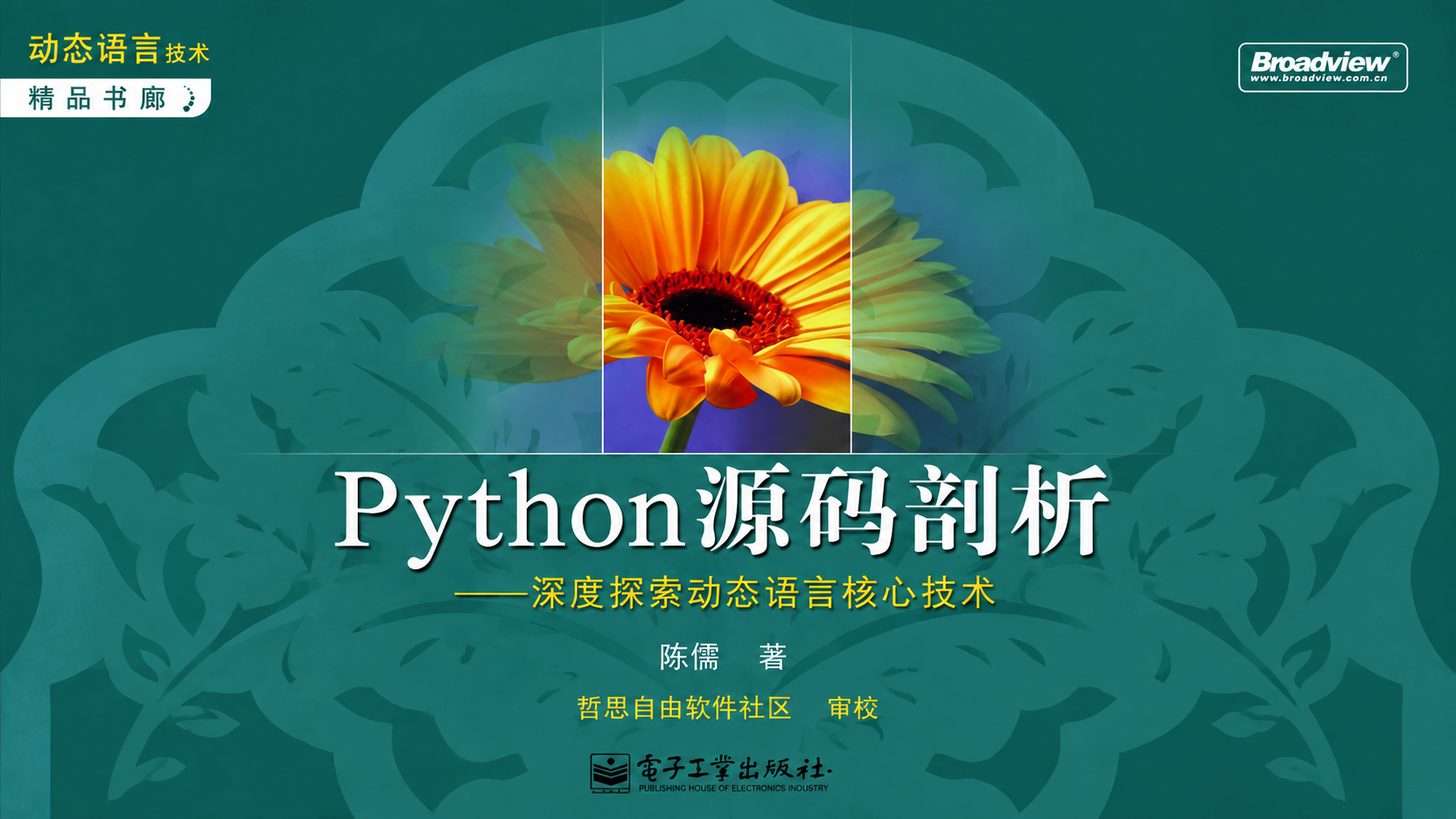
Python Source Code Analysis is a technical monograph by Chen Ru, published by the Publishing House of Electronics Industry in June 2008. The book examines the internal implementation of the CPython interpreter, specifically the Python 2.5 codebase, and explains how a dynamic language is implemented at the C level.
Rather than treating Python as a high-level scripting language, the book approaches it as a runtime system. It follows Python execution from source parsing and compilation through bytecode generation, virtual-machine execution, object management, function calls, class construction, module loading, threading, and garbage collection.
Although the implementation details correspond to an older CPython release, many of the underlying concepts remain valuable for developers who want to understand how dynamic languages work beneath the language syntax.
The book is particularly useful for experienced Python developers, C programmers, runtime engineers, and anyone interested in interpreter implementation.
📚 Book Overview #
Publication Details #
- Author: Chen Ru
- Publisher: Publishing House of Electronics Industry
- Publication: June 2008
- Primary implementation covered: CPython 2.5
- Audience: Python developers, dynamic-language enthusiasts, and C programmers
- Reported Douban rating: 8.7/10 based on 833 reviews
The book combines C source-code analysis with diagrams, execution traces, and simplified examples. It also introduces Small Python, a reduced interpreter implementation designed to make the core mechanisms easier to follow.
The result is effectively a guided tour through the CPython runtime rather than a conventional Python programming textbook.
🏗️ CPython Architecture from Source to Execution #
The book begins with the overall structure of CPython and establishes the relationship between Python source code, the compiler, bytecode, runtime objects, and the virtual machine.
A typical execution pipeline can be viewed conceptually as:
Python source → parsing → compilation → code objects → bytecode → frames → evaluation loop → Python objects
Understanding this pipeline provides the context required for the later discussions of functions, classes, exceptions, imports, and memory management.
Chapter 0: Compiling Python #
The opening chapter covers the practical and architectural foundations required to work with the interpreter source code.
Key topics include:
- Overall Python architecture
- CPython source-tree organization
- Building Python on Windows
- Building Python on Unix/Linux
- Modifying the interpreter source
- The historical development path of Python
- Important considerations when working with CPython internals
For developers studying interpreter implementation, being able to compile and modify the runtime is an important prerequisite for validating theories against actual behavior.
🧱 Part 1: Python’s Built-in Object System #
The first major section focuses on one of the defining characteristics of Python: almost everything exposed to Python code is represented through an object structure managed by the runtime.
Chapter 1: Understanding Python Objects #
The discussion begins with PyObject, the fundamental structure underlying CPython objects in the Python 2.5 implementation.
Major topics include:
PyObjectand the foundation of the object system- Fixed-size and variable-size objects
- Type objects
- Object creation
- Object behavior
- Metatype relationships
- Polymorphism
- Reference counting
- Classification of Python objects
The chapter establishes an important CPython concept: an object’s behavior is closely associated with its type object, while the object itself carries runtime state and reference-count information.
Chapter 2: Integer Objects #
The implementation of integers provides a concrete example of how a built-in Python type is represented and managed.
The chapter examines:
PyIntObject- Integer object creation
- Multiple object-creation paths
- Small-integer caching
- Large integers
- Integer allocation and destruction
- Initialization of the small-integer pool
- Direct experimentation with
PyIntObject
The discussion illustrates how an apparently simple Python expression such as integer creation involves object allocation, type information, reference management, and runtime optimizations.
Chapter 3: String Objects #
The string implementation introduces another set of optimization techniques used by CPython.
Topics include:
PyStringObjectPyString_Type- String creation
- String interning
- Character-buffer pooling
- Performance considerations
- Direct experimentation with string internals
String interning demonstrates how CPython can reuse immutable objects to reduce memory consumption and improve comparison performance in appropriate cases.
Chapter 4: List Objects #
The list implementation demonstrates how CPython manages dynamically sized containers.
The chapter covers:
PyListObject- List creation
- Element assignment
- Insertion
- Deletion
- Internal storage
- Buffer management
- List-specific optimization and experimentation
The underlying representation provides a useful foundation for understanding why Python lists provide efficient indexed access while insertion and deletion in the middle of a list have different performance characteristics.
Chapter 5: Dictionary Objects #
Dictionaries receive a detailed treatment because hash tables are central to Python’s object model and runtime.
The chapter examines:
- Hash-table fundamentals
PyDictObject- Dictionary entries
- Hash-table organization
- Object creation
- Key lookup
- Insertion
- Deletion
- Internal storage management
- Practical dictionary operations
Understanding dictionary internals also helps explain the importance of hashing, equality semantics, collision handling, and resizing in Python programs.
Chapter 6: Small Python #
The first part concludes with Small Python, a simplified Python implementation.
Rather than navigating the entire CPython codebase at once, the reader can use this reduced implementation to understand the essential concepts behind:
- Object representation
- Interpretation
- Runtime execution
- Interactive execution
Small Python therefore provides a conceptual bridge between individual built-in object implementations and the complete virtual machine.
⚙️ Part 2: The Python Virtual Machine #
The second part moves from individual objects to the execution engine itself.
It explains how Python source code becomes executable bytecode, how execution environments are represented, and how the virtual machine implements expressions, control flow, functions, and classes.
Chapter 7: Code Objects, Bytecode, and .pyc Files
#
Python source code is compiled into a representation that the virtual machine can execute.
The chapter analyzes:
- Python program execution
PyCodeObject- The relationship between code objects and
.pycfiles PyCodeObjectin the C implementation.pycfile structure- Accessing code objects from Python
.pycgeneration- Serialization of strings and code objects
- Python bytecode
- Parsing compiled files
The key concept is that the Python virtual machine does not execute source text directly. It executes compiled instructions represented by code objects and bytecode.
Chapter 8: The Python Virtual Machine Framework #
The next chapter introduces the runtime environment in which bytecode executes.
The central structure is PyFrameObject.
Topics include:
- Execution environments
PyFrameObject- Frame memory layout
- Accessing frame objects
- Modules
- Names and bindings
- Namespaces
- Scope resolution
- The VM execution framework
- The overall Python runtime environment
Frames are fundamental because they connect executable code with its current execution state, local variables, global namespaces, and evaluation context.
Chapter 9: Expression Evaluation #
The expression-evaluation chapter examines how the VM turns Python expressions into runtime operations.
It covers:
- Creation of simple built-in objects
- Creation of complex built-in objects
- Symbol resolution
- Numeric operations
- Output operations
- Other expression-handling mechanisms
This section provides the connection between bytecode instructions and the underlying C implementations responsible for performing operations.
Chapter 10: Control Flow #
Control-flow statements are implemented through bytecode operations and instruction jumps rather than being interpreted directly as high-level language constructs.
The chapter examines:
ifstatements- Comparison operations
- Conditional jumps
forloops- Iterator initialization
- Iteration control
- Loop termination
whileloopscontinuebreak- Exception-based control flow
Studying these mechanisms reveals how seemingly different Python constructs ultimately become operations executed by the same interpreter loop.
Chapter 11: Function Implementation #
Python functions require considerably more runtime machinery than a simple sequence of instructions.
The chapter explores:
PyFunctionObject- Function-object creation
- Function invocation
- Function namespaces
- Positional arguments
- Default parameters
*args**kwargs- Local-variable access
- Nested functions
- Closures
- Decorators
Closures and decorators are particularly interesting because they expose the relationship between function objects, lexical state, namespaces, and runtime object references.
Chapter 12: Classes and the Python Object Model #
The class implementation section examines how Python’s dynamic object model constructs classes and instances at runtime.
Major topics include:
- Relationships between Python objects
- Types versus classes
- Base classes
- Type information
- Base-class lists
tp_dict- User-defined classes
- Instance creation
- Attribute lookup
- Instance
__dict__ - Descriptors
- Function transformation
- Bound and unbound methods
- Descriptor-based behavior
Descriptors are particularly important because they form a foundational mechanism behind method binding and many higher-level Python features.
🔬 Part 3: Advanced CPython Runtime Mechanisms #
The final part moves into the infrastructure surrounding the virtual machine, including runtime initialization, imports, threads, the GIL, and memory management.
Chapter 13: Runtime Initialization #
Before Python code can execute, CPython must construct and initialize its runtime environment.
The chapter covers:
- Thread-environment initialization
- Thread state
__builtin__sys__main__- Module search paths
- Interactive mode
- Script execution
- Virtual-machine startup
- Global and local namespaces
This provides a low-level view of what happens between launching the Python executable and executing the first line of user code.
Chapter 14: Dynamic Module Loading #
Python’s import statement hides a substantial amount of runtime machinery.
The chapter first examines the behavior of importing modules and packages before moving into the underlying implementation.
Topics include:
- Standard
import - Nested imports
- Package imports
from ... import- Symbol aliases
- Module reloading
- Module and package discovery
- Module loading
- Import semantics
- The historical
impmodule - Module namespace management
Understanding import internals is useful for explaining issues involving module initialization, circular imports, package resolution, and dynamically loaded components.
Chapter 15: Python Multithreading and the GIL #
Threading is examined from the perspective of CPython’s runtime rather than simply its high-level API.
The chapter discusses:
- The Global Interpreter Lock
- Thread scheduling
- Python thread creation
- Thread initialization
- Scheduling behavior
- Blocked threads
- Thread destruction
- Synchronization
- Mutual exclusion
Lockobjects- The
threadingmodule - Synchronization primitives
- The
Threadclass
The GIL is particularly important because it illustrates how interpreter-level synchronization can influence the relationship between Python threads and CPU-bound workloads.
Although modern Python has evolved significantly beyond the implementation discussed in the book, the historical CPython threading model remains useful for understanding why interpreter design decisions have such a large impact on concurrency.
Chapter 16: CPython Memory Management #
The final chapter examines one of the most important components of a language runtime: memory management.
The discussion covers:
- CPython’s memory architecture
- Small-object allocation
- Blocks
- Pools
- Arenas
- Pool-management structures
- Reference counting
- Cyclic garbage collection
- Tri-color marking concepts
- Generational collection
- Mark-and-sweep
- The garbage-collection lifecycle
- The
gcmodule
The book’s explanation of memory management demonstrates that CPython’s memory model is not based on a single garbage-collection mechanism.
Instead, reference counting handles the majority of object lifetime management, while cyclic garbage collection addresses reference cycles that cannot be reclaimed through simple reference-count decrements.
🧠 What This Book Teaches About CPython #
The most valuable aspect of Python Source Code Analysis is its ability to connect Python language features with concrete runtime mechanisms.
Several recurring concepts tie the book together.
Everything is an object #
Python’s runtime represents integers, strings, lists, dictionaries, functions, classes, and many other entities as runtime objects with associated type information.
This object-centric design provides the foundation for Python’s dynamic behavior.
Types define behavior #
CPython’s type objects do more than identify an object’s type. They provide the runtime with the operations associated with that type.
This mechanism allows Python to implement polymorphic behavior while keeping the interpreter’s core execution machinery relatively generic.
Bytecode connects language and runtime #
Python syntax is transformed into bytecode and code objects before execution.
The interpreter then processes these instructions within execution frames.
This abstraction separates the language’s source-level syntax from the mechanisms required to execute it.
Frames represent execution state #
A frame captures the state required to execute a piece of Python code, including references to code objects and relevant namespaces.
This concept is central to understanding function calls, recursion, exceptions, debugging, and stack inspection.
Reference counting and garbage collection solve different problems #
Reference counting provides deterministic object lifetime behavior for most objects, while cyclic garbage collection handles reference cycles.
This division is a fundamental characteristic of CPython’s historical memory-management architecture.
🔧 Why CPython Internals Still Matter #
The book analyzes Python 2.5, so many implementation details should not be transferred directly to current CPython versions.
Modern CPython has undergone major architectural changes involving the interpreter loop, bytecode format, object implementations, memory management, imports, concurrency, and execution performance.
Nevertheless, the conceptual framework remains valuable.
A developer who understands:
- Object headers and type metadata
- Reference counting
- Code objects
- Bytecode
- Frames
- Namespaces
- Descriptors
- Function objects
- Module loading
- Thread state
- Interpreter locking
- Memory allocators
- Cyclic garbage collection
has a much stronger foundation for investigating Python’s runtime behavior.
This knowledge is particularly useful when debugging performance problems, analyzing memory behavior, writing CPython extensions, investigating interpreter behavior, or contributing to runtime-level projects.
📖 Recommended Reading Strategy #
Because the book dives directly into implementation details, reading it sequentially is not always the most efficient approach for an experienced developer.
A practical progression is:
- Start with the object model and
PyObject. - Study built-in objects, particularly integers, strings, lists, and dictionaries.
- Move to
PyCodeObjectand bytecode. - Study
PyFrameObjectand the evaluation model. - Examine function and class implementation.
- Continue with module loading and runtime initialization.
- Finish with threading and memory management.
The most productive approach is to treat the book as an interpreter-engineering reference rather than a conventional programming guide.
When studying an implementation detail, it is also useful to compare the historical Python 2.5 behavior discussed in the book with the corresponding mechanism in a modern CPython release. This makes it possible to separate enduring interpreter concepts from implementation details that have since changed.
🏁 Final Assessment #
Python Source Code Analysis provides a low-level view of Python that is difficult to obtain from ordinary Python programming books.
Its primary value is not memorizing historical CPython structures. Instead, it is learning how a dynamic language can be constructed from a relatively small set of fundamental mechanisms:
objects → types → bytecode → frames → evaluation → namespaces → functions → classes → modules → threads → memory management
The book’s Python 2.5 focus makes it historically dated as a description of the current interpreter, but its exploration of dynamic-language implementation remains highly relevant.
For developers who already understand Python syntax and want to understand what happens beneath that syntax, the book offers a valuable bridge from high-level Python programming to interpreter engineering and C-level runtime implementation.