DC/AC Fundamentals: A Systems Approach — Book Review
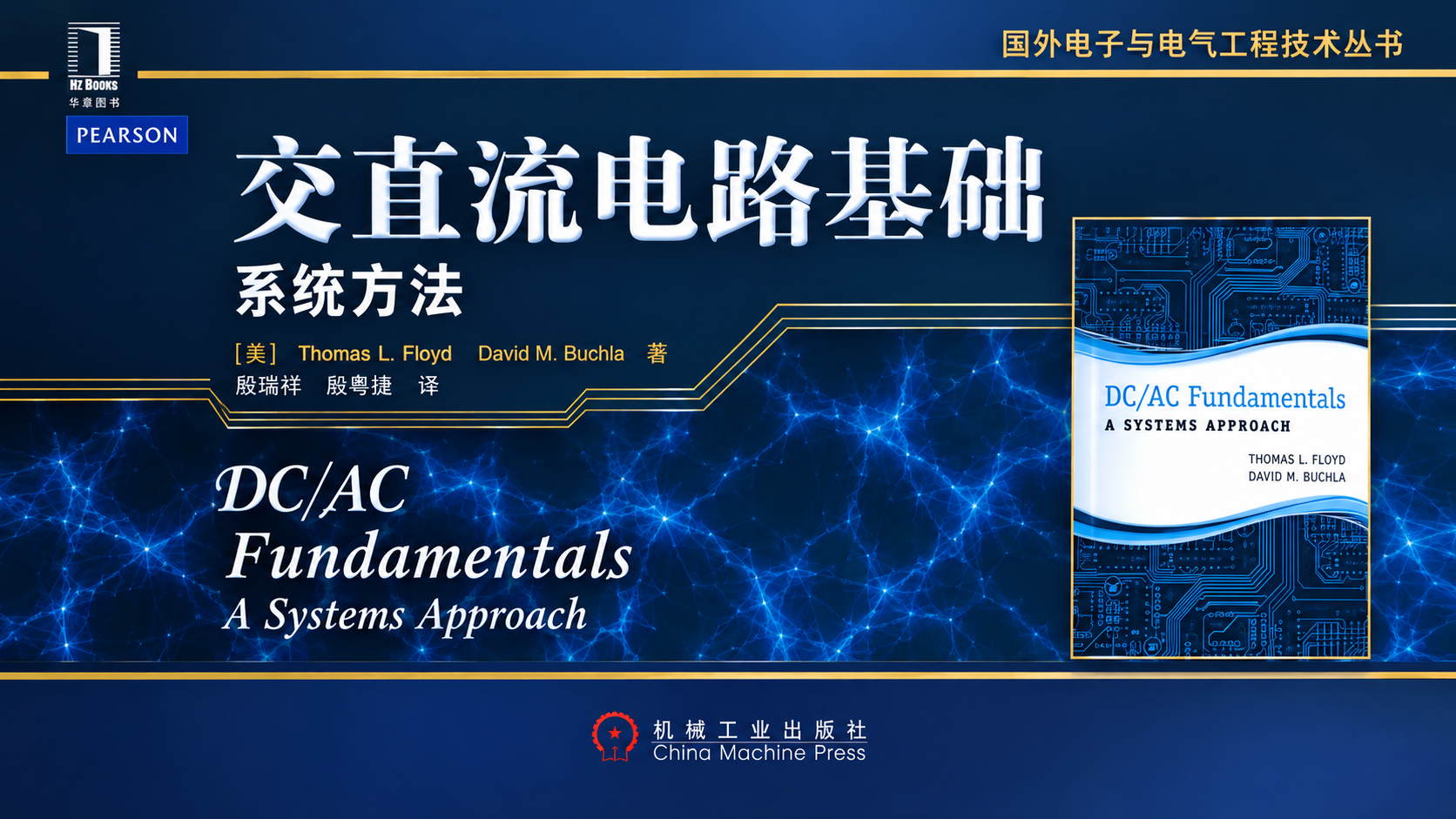
DC/AC Fundamentals: A Systems Approach is a foundational circuit theory textbook by American authors Thomas L. Floyd and David M. Buchla. The Chinese edition was translated by Yin Ruixiang and Yin Yuejie and published by China Machine Press in January 2014 as part of the Foreign Electronics & Electrical Engineering Technology Series.
Rather than presenting circuit theory as a collection of isolated equations, the book organizes its material around a systems approach. Readers learn fundamental electrical quantities and circuit laws while connecting them to system blocks, interfaces, signals, measurements, components, and practical troubleshooting.
The 529-page paperback covers the progression from basic electrical concepts and DC circuits through electromagnetism, AC analysis, capacitors, RC and RL networks, RLC resonance, transformers, and time-domain responses. Practical measurement, fault diagnosis, and Multisim-based simulation are integrated throughout the material.
📘 Book Overview #
| Item | Details |
|---|---|
| English title | DC/AC Fundamentals: A Systems Approach |
| Authors | Thomas L. Floyd, David M. Buchla |
| Chinese translators | Yin Ruixiang, Yin Yuejie |
| Publisher | China Machine Press |
| Publication date | January 2014 |
| Series | Foreign Electronics & Electrical Engineering Technology Series |
| ISBN | 978-7-111-45360-4 |
| Length | 529 pages |
| Format | Paperback |
🔧 A Systems-Based Approach to Circuit Theory #
The central teaching strategy is to connect circuit fundamentals with complete electronic systems.
Instead of learning Ohm’s law, Kirchhoff’s laws, capacitance, inductance, and resonance as disconnected topics, students repeatedly encounter these concepts in the context of:
- System inputs and outputs
- Functional blocks and interfaces
- Electrical measurements
- Signal behavior
- Component characteristics
- Power and energy conversion
- Fault diagnosis
- Practical electronic applications
Each chapter incorporates system examples and system notes that connect theoretical concepts to engineering scenarios.
This approach is particularly useful for beginners because it establishes a relationship between the mathematical model of a circuit and the physical system in which that circuit operates.
⚡ From Electrical Fundamentals to AC Circuit Analysis #
The first six chapters establish the foundation for circuit analysis.
Chapter 1 introduces systems, physical quantities, engineering notation, units, measurement data, and electrical safety. Chapter 2 then develops the fundamental concepts of voltage, current, resistance, electrical charge, conductors, grounding, and basic circuit measurements.
Chapter 3 introduces Ohm’s law together with electrical energy, power, resistor ratings, batteries, power supplies, and introductory troubleshooting.
The next three chapters progressively build DC analysis:
- Chapter 4: Series circuits, voltage dividers, KVL, power, and open/short-circuit troubleshooting
- Chapter 5: Parallel circuits, current dividers, KCL, power, and branch fault diagnosis
- Chapter 6: Series-parallel networks, loaded voltage dividers, Wheatstone bridges, Thevenin’s theorem, maximum power transfer, and superposition
This progression provides a conventional analytical foundation while keeping the discussion connected to measurement and troubleshooting.
🧲 Magnetism, Electromagnetism, and Motors #
Chapter 7 bridges basic circuit theory and electromechanical systems.
It introduces:
- Magnetic fields and magnetic flux
- Magnetic flux density
- Electromagnets
- Solenoids and relays
- Speakers and meter movements
- Hysteresis
- Faraday’s law
- Lenz’s law
- Electromagnetic induction
- DC generators
- DC motors
- Back EMF
- Motor ratings
- Series- and shunt-wound motors
This chapter is important because it shows how electrical energy and magnetic fields interact in practical devices.
The discussion of generators and motors also provides a physical foundation for understanding why inductive behavior, back EMF, and electromagnetic energy conversion matter in real circuits.
🌊 AC Circuits, Waveforms, and Measurement #
Chapter 8 begins the transition from DC to alternating-current analysis.
The book introduces sinusoidal waveforms through their:
- Instantaneous value
- Peak value
- Peak-to-peak value
- RMS value
- Average value
- Period
- Frequency
- Phase
- Angular measurement
It then expands into AC circuit analysis, alternators, AC motors, non-sinusoidal waveforms, harmonics, oscilloscopes, and signal generators.
The oscilloscope material is particularly practical, covering both analog and digital oscilloscopes, their controls, and basic signal-source operation.
This makes the chapter useful not only for mathematical analysis but also for students learning how circuit behavior is actually observed on the bench.
🧮 Capacitors, RC Networks, and Time Constants #
Chapters 9 and 10 focus on capacitors and RC circuits.
Chapter 9 begins with capacitor construction and capacitance before moving into:
- Energy storage
- Voltage ratings
- Temperature coefficients
- Leakage current
- Capacitor types and markings
- Series and parallel combinations
- Charging and discharging
- RC time constants
- Capacitive reactance
- Capacitive voltage dividers
- AC power
- Filtering
- DC blocking and AC coupling
- Decoupling and bypassing
- Timing circuits
Chapter 10 extends these concepts into practical RC network analysis, covering impedance, phase angle, lead and lag circuits, series-parallel configurations, power factor, filters, and phase-shift oscillators.
The progression from physical capacitor behavior to mathematical AC analysis helps establish why capacitors behave differently at different frequencies.
🌀 Inductors and RL Circuit Behavior #
Chapters 11 and 12 provide the corresponding treatment of inductors and RL circuits.
The material covers inductance, winding resistance, winding capacitance, Faraday’s law, Lenz’s law, series and parallel inductors, RL time constants, exponential responses, inductive reactance, phase relationships, power, and quality factor.
Practical applications include:
- Noise suppression
- RF chokes
- Tuned circuits
- Low-pass filters
- High-pass filters
- Cutoff-frequency analysis
The structure mirrors the capacitor chapters, making it easier to compare the complementary behavior of capacitive and inductive components.
📡 RLC Circuits, Resonance, and Filtering #
Chapter 13 combines resistance, capacitance, and inductance into RLC networks and introduces resonance.
Topics include both series and parallel resonance, covering:
- RLC impedance
- Phase angle
- Resonant frequency
- Resonant current
- Bandpass filters
- Band-stop filters
- Bandwidth
- Decibel measurements
- Selectivity
- Quality factor
- Tank circuits
- Tuned amplifiers
- Double-tuned transformer coupling
- Receiver antenna circuits
- Superheterodyne receivers
This chapter connects the behavior of reactive components to frequency-selective circuits, making it an important bridge toward communications and RF applications.
🔌 Transformer Fundamentals and Practical Applications #
Chapter 14 introduces transformers through mutual inductance and the basic transformer model.
The chapter covers:
- Turns ratios
- Winding direction
- Step-up and step-down operation
- DC isolation
- Secondary loading
- Reflected impedance
- Impedance matching
- Transformer ratings
- Tapped transformers
- Multiple-winding transformers
- Autotransformers
- Three-phase transformers
The inclusion of loading and reflected impedance is particularly useful because it moves beyond the ideal transformer model toward practical circuit behavior.
⏱️ Time Response of Reactive Circuits #
Chapter 15 concludes the main sequence by examining the time-domain response of reactive networks.
The chapter covers RC and RL integrators and differentiators, including:
- Capacitor charging and discharging
- Single-pulse response
- Repetitive-pulse response
- Steady-state response
- Time-constant effects
- Pulse shaping
- Timing circuits
- Pulse-to-DC conversion
- Trigger generation
Troubleshooting sections address common failures such as open capacitors, shorted capacitors, and open resistors.
This final chapter reinforces the distinction between steady-state frequency-domain behavior and transient time-domain behavior.
🛠️ Troubleshooting as an Engineering Skill #
One of the book’s practical strengths is its recurring emphasis on troubleshooting.
Rather than treating fault diagnosis as an afterthought, the textbook introduces a general troubleshooting process involving:
- Analysis — understand the circuit and identify possible failure points.
- Planning — determine what measurements can distinguish between hypotheses.
- Measurement — collect voltage, current, or resistance data.
- Comparison — compare measurements against expected circuit behavior.
- Diagnosis — use the evidence to isolate the fault.
Examples include open circuits, short circuits, open branches, defective components, and abnormal power behavior.
The material also introduces thermography and measurement-based methods for locating faults in more complex circuits.
This systems-oriented troubleshooting methodology helps connect theoretical circuit analysis with the practical workflow used by technicians and engineers.
💻 Multisim and Simulation-Based Learning #
Selected examples and exercises incorporate Multisim circuit and system simulations.
Simulation can complement physical measurements by allowing learners to:
- Verify theoretical calculations
- Observe voltage and current relationships
- Examine transient responses
- Experiment with component values
- Investigate circuit faults
- Compare simulated and measured behavior
Used alongside laboratory measurements, this approach can help students understand where ideal circuit models diverge from real-world hardware.
👨🏫 Author Background #
Thomas L. Floyd earned a Bachelor of Science in Electrical Engineering from the University of Florida in 1964 and a Master of Science in Electrical Engineering from Southern Methodist University in 1968.
His professional background included research and development work at Martin Marietta as well as teaching in community-college electronics programs.
Floyd later became associated with electronic technology education and authored Digital Fundamentals, which became one of his best-known textbooks.
David M. Buchla co-authored DC/AC Fundamentals: A Systems Approach, bringing additional expertise to the presentation of foundational electrical and electronic concepts.
📚 Detailed Table of Contents #
Chapter 1 — Systems, Physical Quantities, and Units #
- The electronics industry
- Electronic systems
- System concepts and block diagrams
- Transfer curves
- Components and circuits
- Scientific and engineering notation
- Electrical units and metric prefixes
- Unit conversions
- Measurement error, accuracy, and precision
- Significant figures and rounding
- Electrical safety
Chapter 2 — Voltage, Current, and Resistance #
- Atomic structure and valence electrons
- Electrical charge
- Voltage and DC voltage sources
- Current and current sources
- Resistance and resistors
- Conductors, wires, and grounding
- Current control and circuit protection
- Basic circuit measurements
- Digital and analog multimeters
Chapter 3 — Ohm’s Law, Energy, and Power #
- Ohm’s law
- Voltage, current, and resistance calculations
- Electrical energy
- Electrical power
- Resistor power ratings
- Energy conversion and voltage drops
- Power supplies and batteries
- Power-supply efficiency
- Battery ampere-hour ratings
- Introduction to troubleshooting
Chapter 4 — Series Circuits #
- Series resistors
- Total series resistance
- Current in series circuits
- Voltage sources in series
- Kirchhoff’s Voltage Law
- Voltage dividers
- Potentiometers
- Power in series circuits
- Voltage measurements
- Open- and short-circuit troubleshooting
Chapter 5 — Parallel Circuits #
- Parallel resistors
- Total parallel resistance
- Voltage relationships
- Kirchhoff’s Current Law
- Current dividers
- Power in parallel circuits
- Open and shorted branches
- Current-based fault diagnosis
- Thermography
Chapter 6 — Series-Parallel Circuits #
- Series-parallel relationships
- Total resistance and current
- Branch currents
- Voltage relationships
- Loaded voltage dividers
- Voltmeter loading
- Wheatstone bridges
- Thevenin’s theorem
- Maximum power transfer
- Superposition
- Troubleshooting
Chapter 7 — Magnetism and Electromagnetism #
- Magnetic fields and flux
- Electromagnetism
- Electromagnetic devices
- Hysteresis
- Electromagnetic induction
- Faraday’s law
- Lenz’s law
- DC generators
- DC motors
- Back EMF
- Motor ratings and winding configurations
Chapter 8 — Introduction to Alternating Current and Voltage #
- Sinusoidal waveforms
- Period and frequency
- RMS and average values
- Phase and angular measurement
- AC circuit analysis
- Alternators
- AC motors
- Non-sinusoidal waveforms
- Harmonics
- Oscilloscopes
- Signal generators
Chapter 9 — Capacitors #
- Capacitor construction and capacitance
- Energy storage
- Voltage ratings
- Capacitor types and markings
- Series and parallel capacitors
- Charging and discharging
- RC time constants
- Capacitive reactance
- Capacitive voltage dividers
- Filtering and coupling
- Timing circuits
Chapter 10 — RC Circuits #
- Series RC response
- Impedance and phase angle
- RC lead and lag circuits
- Parallel RC circuits
- Series-parallel RC networks
- Power factor
- Apparent power
- Phase-shift oscillators
- RC filters
- AC coupling
- Troubleshooting
Chapter 11 — Inductors #
- Inductance
- Physical characteristics
- Winding resistance and capacitance
- Faraday’s and Lenz’s laws
- Inductor types
- Series and parallel inductors
- RL time constants
- Exponential responses
- Inductive reactance
- Power and quality factor
- Noise suppression
- RF chokes
- Tuned circuits
Chapter 12 — RL Circuits #
- RL sinusoidal response
- Impedance and phase angle
- Series and parallel RL analysis
- RL lead and lag circuits
- Power in RL circuits
- Low-pass and high-pass RL filters
- Cutoff frequency
- Troubleshooting
Chapter 13 — RLC Circuits and Resonance #
- Series RLC analysis
- Series resonance
- Resonant frequency
- Resonant impedance and current
- Bandpass filters
- Bandwidth and selectivity
- Decibel measurements
- Quality factor
- Band-stop filters
- Parallel RLC circuits
- Parallel resonance
- Tank circuits
- Resonant filters
- Tuned amplifiers
- Receiver applications
Chapter 14 — Transformers #
- Mutual inductance
- Basic transformer operation
- Turns ratios
- Winding direction
- Step-up and step-down transformers
- DC isolation
- Secondary loading
- Reflected load
- Impedance matching
- Transformer ratings
- Tapped and multiple-winding transformers
- Autotransformers
- Three-phase transformers
- Troubleshooting
Chapter 15 — Time Response of Reactive Circuits #
- RC integrators
- Capacitor charging and discharging
- Single- and repetitive-pulse responses
- RC differentiators
- RL integrators and differentiators
- Timing circuits
- Pulse-to-DC converters
- Trigger generators
- Waveform shaping
- Troubleshooting reactive circuits
🎯 Who Should Read This Book? #
DC/AC Fundamentals: A Systems Approach is primarily suited to readers building a foundation in electrical and electronic engineering.
It can serve as:
- An introductory undergraduate circuit-theory textbook
- A learning resource for vocational and technical-school students
- A reference for electronics technicians
- A refresher for engineers reviewing fundamental circuit concepts
- A practical introduction to circuit troubleshooting and measurement
Its strongest emphasis is on understanding how circuits behave as parts of larger systems, rather than treating circuit equations as purely mathematical exercises.
📝 Final Assessment #
DC/AC Fundamentals: A Systems Approach provides a broad introduction to DC and AC circuit fundamentals while maintaining a consistent connection between theory, physical components, measurements, systems, and troubleshooting.
Its 15-chapter structure progresses from voltage, current, resistance, and Ohm’s law through DC network analysis, electromagnetism, AC circuits, reactive components, resonance, transformers, and transient response. The inclusion of measurement techniques, fault diagnosis, engineering applications, and Multisim exercises gives the material a practical dimension beyond conventional circuit-law instruction.
For learners who need a structured foundation before moving into electronics, electrical machines, analog circuits, digital systems, communications, or more advanced electrical engineering topics, the book provides a comprehensive starting point.