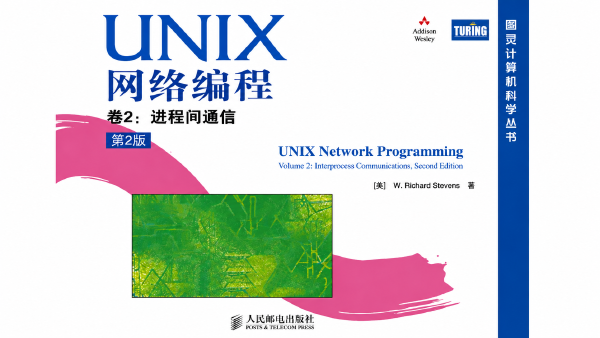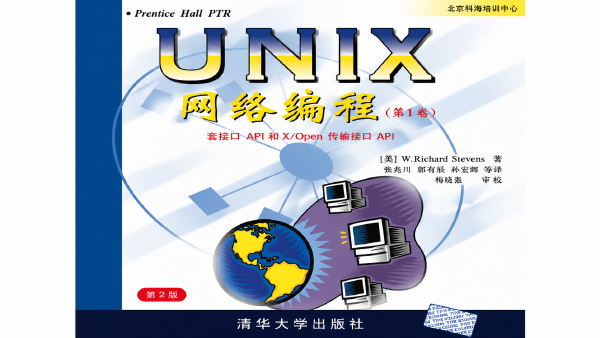
TCP/IP Illustrated Volume 3: TCP for Transactions, HTTP, NNTP and the UNIX Domain Protocols
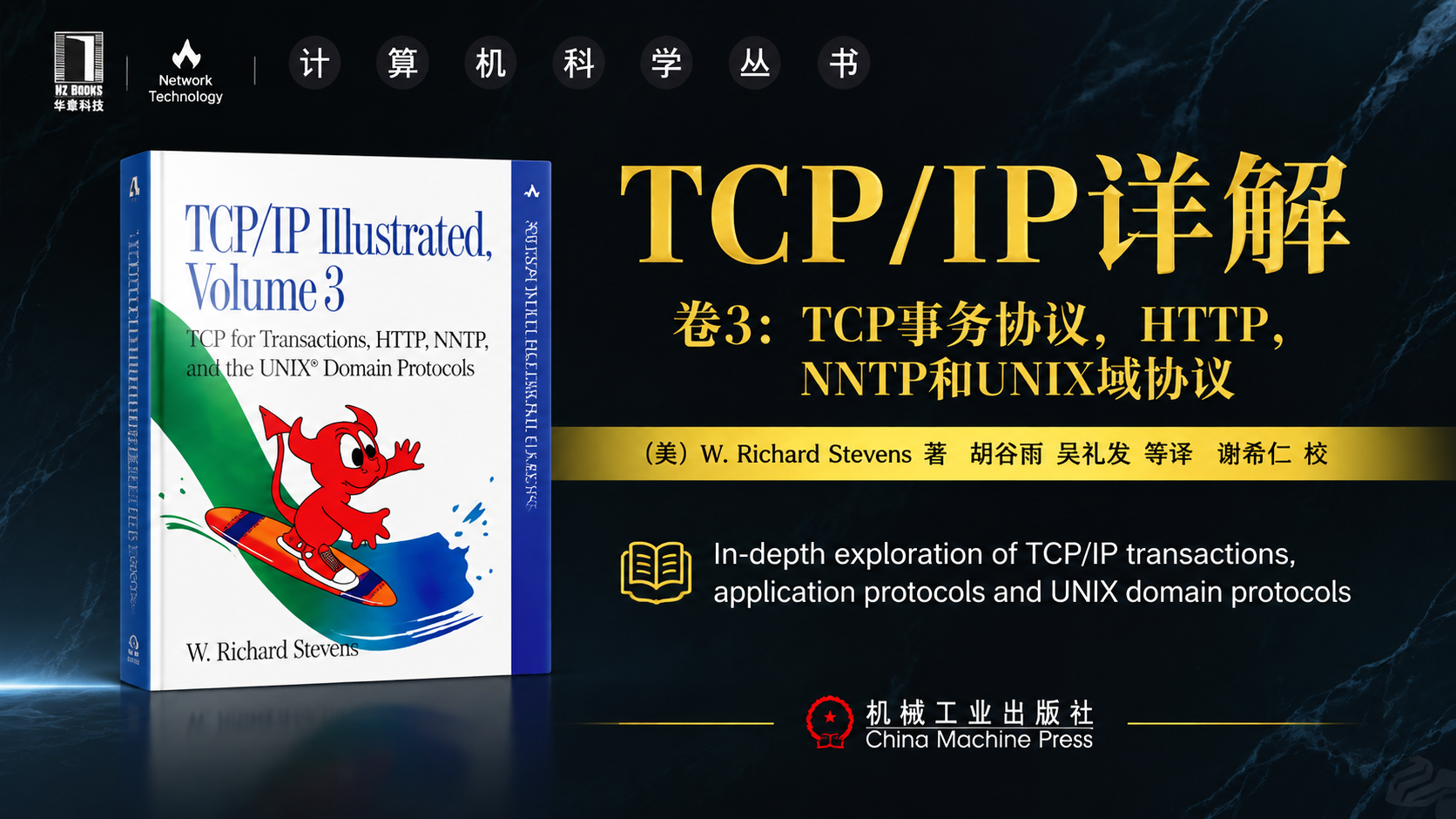
TCP/IP Illustrated, Volume 3: TCP for Transactions, HTTP, NNTP, and the UNIX Domain Protocols is the third and final volume completed by W. Richard Stevens in the TCP/IP Illustrated series. First published in 2000, the book examines advanced TCP extensions, application-layer protocols, and UNIX domain communication through detailed protocol and implementation analysis.
Building on the networking foundations established in the earlier volumes, this volume moves closer to the operating-system implementation. It examines TCP for Transactions (T/TCP), HTTP, NNTP, and UNIX domain protocols while connecting packet-level behavior with BSD networking source code.
The book is particularly valuable for developers and systems engineers who want to understand not only what a networking protocol does, but also how protocol state, kernel data structures, socket interfaces, and packet processing interact inside a real TCP/IP implementation.
📚 Book Overview #
Bibliographic and technical scope #
| Parameter | Specification |
|---|---|
| Title | TCP/IP Illustrated, Volume 3: TCP for Transactions, HTTP, NNTP, and the UNIX Domain Protocols |
| Author | W. Richard Stevens |
| Chinese Translation | Hu Guyu et al. |
| Publisher | China Machine Press |
| First Chinese Edition | September 2000 |
| Series | TCP/IP Illustrated |
| Implementation Reference | 4.4BSD-Lite networking code |
| Primary Topics | T/TCP, HTTP, NNTP, UNIX domain protocols, BSD networking |
| Target Audience | Network programmers, systems developers, and network administrators |
The book combines protocol specifications, packet traces, implementation discussions, and BSD source-code examples. This makes it less of a conventional application-development manual and more of a networking implementation reference.
⚡ Part 1: TCP for Transactions #
The first major section focuses on TCP for Transactions, commonly abbreviated as T/TCP.
Why T/TCP was proposed #
Traditional TCP is optimized for persistent streams rather than extremely short client-server transactions. A small transaction can incur substantial protocol overhead because a conventional TCP connection typically requires connection establishment before application data can be exchanged.
T/TCP was designed to reduce this overhead by extending TCP with mechanisms intended to make short transactions faster while preserving TCP’s reliability model.
The central engineering problem is therefore:
Traditional TCP transaction

Client                    Server
  |                         |
  | ---- SYN ------------> |
  | <--- SYN + ACK -------- |
  | ---- ACK ------------> |
  | ---- Request --------> |
  | <--- Response -------- |
  | ---- FIN ------------> |
  | <--- FIN + ACK -------- |
For transaction-oriented workloads, the cost of establishing and closing a connection can become significant compared with the amount of application data being exchanged.
T/TCP protocol mechanisms #
The book examines the protocol extensions used by T/TCP and explains how they modify normal TCP connection behavior.
The discussion covers the protocol state, packet exchange, transaction-oriented communication, and the implementation structures required inside a TCP/IP stack.
This provides an important case study in protocol evolution: improving application latency sometimes requires modifications not only to application protocols but also to transport-layer behavior.
T/TCP implementation and examples #
The T/TCP section progresses from protocol concepts to practical examples and BSD implementation details.
By examining source code and packet exchanges together, the book demonstrates how transport-level extensions propagate through the socket layer, TCP control structures, and packet-processing paths.
The included examples are particularly useful for developers interested in understanding the relationship between TCP state machines and kernel-level implementation.
🌐 Part 2: HTTP and Other TCP Applications #
The second part moves upward in the networking stack to application-layer protocols that operate over TCP.
HTTP protocol analysis #
The HTTP chapter examines the Hypertext Transfer Protocol from a networking perspective rather than treating it simply as an application API.
The focus includes the relationship between HTTP operations and underlying TCP connections, request and response transmission, packet boundaries, and server-side processing.
This approach is useful because HTTP messages do not inherently correspond one-to-one with TCP segments. Understanding the distinction between application-layer messages and transport-layer byte streams is essential when debugging network applications.
HTTP packet analysis #
A dedicated chapter examines packets observed while communicating with an HTTP server.
The analysis connects:
HTTP request
      ↓
TCP byte stream
      ↓
TCP segments
      ↓
IP packets
      ↓
Ethernet frames
This layered perspective helps explain how application data becomes network traffic and how packet captures can be used to diagnose application and transport behavior.
Packet-level analysis is particularly valuable when investigating connection establishment, retransmissions, delayed responses, segmentation, acknowledgments, and connection teardown.
NNTP #
The book also examines NNTP, the Network News Transfer Protocol.
NNTP provides a useful example of a stateful application protocol operating over TCP. Its inclusion demonstrates how application-layer protocol semantics map onto a reliable byte-stream transport.
Studying NNTP alongside HTTP also highlights differences between application protocols even when they share the same underlying TCP transport.
🔗 Part 3: UNIX Domain Protocols #
The third part focuses on UNIX domain protocols, which provide local inter-process communication between processes running on the same host.
UNIX domain communication #
Unlike TCP/IP sockets, UNIX domain sockets do not require communication to traverse the network protocol stack for local processes.
A simplified comparison is:
TCP/IP socket

Process
  ↓
Socket API
  ↓
TCP
  ↓
IP
  ↓
Network interface / kernel networking path
  ↓
Peer process


UNIX domain socket

Process
  ↓
Socket API
  ↓
UNIX domain protocol
  ↓
Peer process
By eliminating unnecessary network-layer processing, UNIX domain communication can provide substantially lower overhead for local IPC.
The book discusses UNIX domain protocols as an important alternative when both communicating processes reside on the same machine.
UNIX domain implementation #
The implementation discussion examines how UNIX domain communication is integrated into the BSD socket architecture.
This provides an opportunity to compare local IPC with Internet-domain sockets and understand how different protocol families can share common socket-layer abstractions while implementing substantially different underlying communication mechanisms.
I/O and descriptor passing #
One of the most important capabilities discussed is passing file descriptors between processes.
Descriptor passing enables one process to transfer access to an already-open file or socket to another process without requiring the second process to independently open the underlying resource.
This mechanism is particularly useful in advanced UNIX server architectures, including process supervision, worker processes, privilege separation, and multi-process connection handling.
🧠 BSD Networking Implementation #
A major strength of the book is its emphasis on implementation rather than protocol descriptions alone.
The analysis references BSD networking structures and source code, including components such as:
- Routing tables
- Protocol control blocks
- Socket-layer structures
- TCP state management
- TCP I/O functions
- UNIX domain protocol implementation
- File-descriptor handling
These implementation details help bridge the gap between abstract protocol specifications and the actual data structures and control paths used by an operating system.
Protocol control blocks #
Protocol control blocks are particularly important because they provide kernel-side state associated with network connections.
Understanding how connection state is represented internally helps explain why operations such as connection establishment, teardown, retransmission, and socket I/O have specific system-level behaviors.
Socket-layer integration #
The socket layer provides the application-facing abstraction through which processes interact with network protocols.
The book’s implementation-oriented approach demonstrates how application calls ultimately reach protocol-specific code, providing useful insight into the path from functions such as socket(), connect(), accept(), read(), and write() to the underlying networking subsystem.
🔬 Network Timing and Measurement #
Appendix A focuses on measuring network times, providing a practical foundation for analyzing protocol performance.
Timing analysis is essential when evaluating networking systems because application latency can originate from multiple sources:
- Connection establishment
- DNS resolution
- TCP retransmission
- Server processing
- Network propagation
- Packet queuing
- Protocol-level delays
- Connection teardown
Separating these components allows engineers to determine whether a performance problem originates in the application, transport protocol, operating system, or network.
💻 T/TCP Application Development #
Appendix B provides additional implementation material for coding a T/TCP application.
The example-oriented approach complements the protocol analysis in the main chapters by demonstrating how a specialized transport mechanism can be exposed through application-level interfaces.
For systems programmers, this makes the book useful as both a conceptual reference and a historical example of how experimental transport-layer capabilities can be integrated into real software.
🧩 Key Engineering Lessons #
Several broader networking concepts emerge from the book’s coverage.
Application protocols depend on transport semantics #
HTTP and NNTP are application-layer protocols, but their behavior is strongly influenced by TCP’s connection model, byte-stream semantics, retransmission behavior, and congestion control.
Understanding application protocols therefore requires understanding the transport layer underneath them.
Packet captures reveal implementation behavior #
Packet traces provide a practical way to observe protocol state transitions and timing.
When combined with source-code analysis, packet captures can reveal why a particular implementation sends specific packets, enters particular TCP states, retransmits data, or delays responses.
Local IPC does not require TCP/IP #
UNIX domain protocols demonstrate that the socket programming model does not inherently require IP networking.
When communication remains within one host, a specialized protocol family can eliminate network-layer overhead while preserving much of the familiar socket abstraction.
Protocol optimization requires end-to-end analysis #
T/TCP illustrates an important systems principle: reducing latency in a transaction-oriented workload may require examining the entire path from application semantics through transport state machines and kernel implementation.
Optimizing only the application layer may leave substantial protocol overhead untouched.
📖 Historical and Technical Relevance #
Some of the technologies covered by the book are historically significant rather than recommended choices for modern systems. T/TCP, in particular, did not become a mainstream replacement for conventional TCP and is not representative of current Internet transport practice.
Its technical value nevertheless remains substantial because it demonstrates how transport protocols can be modified to optimize specific workload characteristics.
The BSD implementation material is similarly valuable as a systems-programming case study. Modern Linux networking has evolved considerably, but the fundamental concepts of sockets, protocol state, packet processing, local IPC, and transport-layer behavior remain central to systems engineering.
🛠️ Practical Value for Network Developers #
TCP/IP Illustrated, Volume 3 is especially useful for developers who need to reason across multiple layers of a networking stack.
It provides a foundation for understanding:
- TCP connection behavior
- Transaction-oriented transport optimization
- HTTP packet flows
- NNTP communication
- UNIX domain sockets
- Local inter-process communication
- File-descriptor passing
- BSD socket implementation
- Protocol control structures
- Packet-level debugging
- Network performance measurement
For experienced developers, the book is best viewed as an implementation-oriented companion to the broader TCP/IP Illustrated series. Its greatest value lies in connecting protocol specifications, packet traces, socket APIs, kernel data structures, and real networking source code into one coherent model of how TCP/IP software actually operates.