
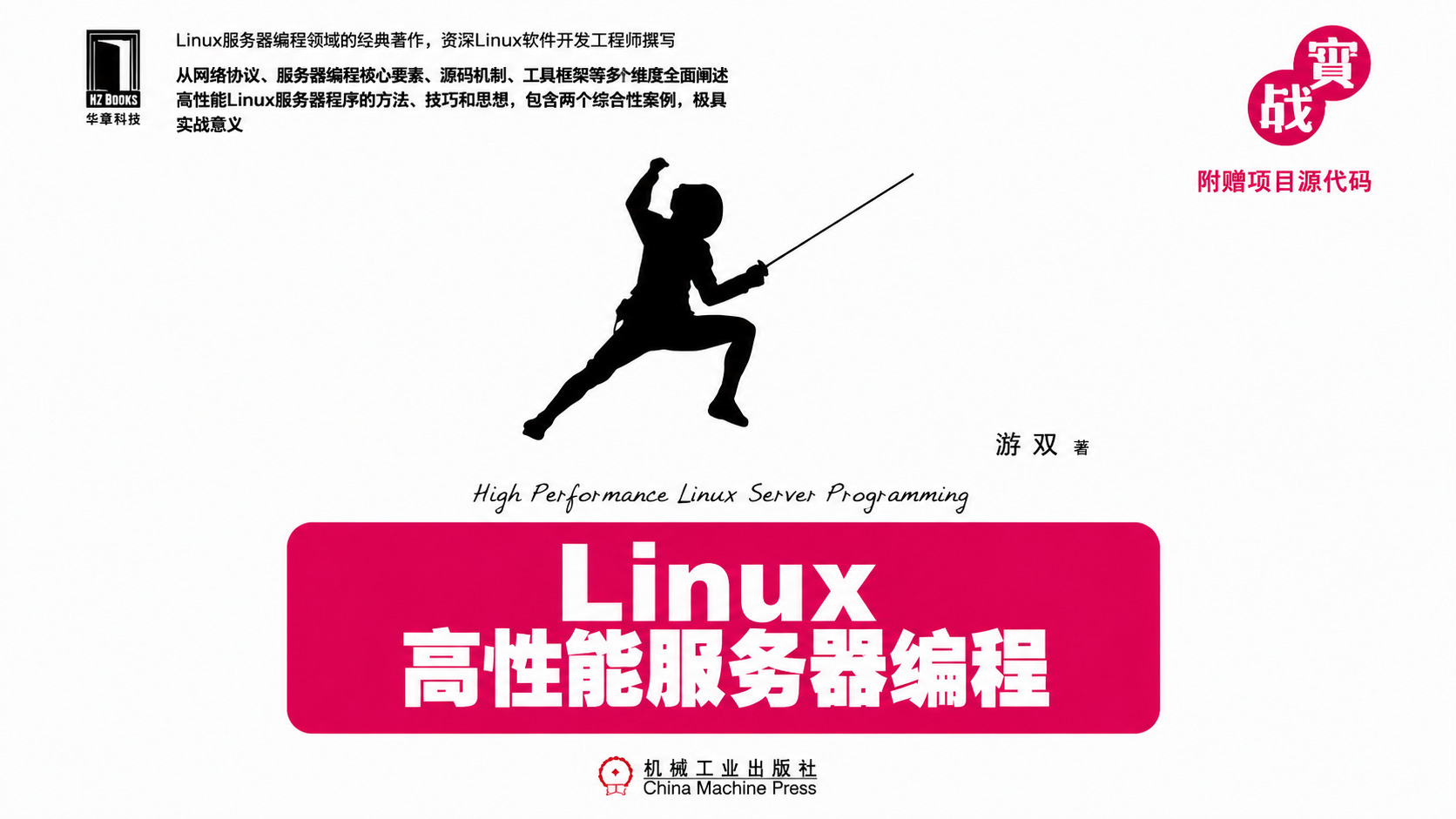
Linux High-Performance Server Programming
Linux High-Performance Server Programming Source Code
Book Overview #
This book is a comprehensive reference for building high-performance Linux server systems, written from the perspective of a seasoned Linux systems engineer. It bridges theoretical networking foundations with practical server-side engineering, focusing on how to design scalable, low-latency, production-grade services.
The content spans network fundamentals, server architecture design patterns, system-level optimization, and real-world debugging and monitoring techniques. Two end-to-end case studies demonstrate how these concepts are applied in real production environments.
The book is organized into three major parts:
- Part I: TCP/IP Protocol Foundations — A deep technical exploration of packet-level networking, protocol behavior, and Linux socket communication internals.
- Part II: High-Performance Server Architecture — Core patterns for scalable systems including event-driven models, concurrency frameworks, and I/O optimization strategies.
- Part III: Optimization, Debugging & Monitoring — Practical techniques for tuning kernel parameters, stress testing, and diagnosing production systems.
About the Author #
You Shuang is a senior Linux software engineer with extensive experience in network stack optimization and large-scale server architecture design. He previously worked as a Senior Linux Software Engineer at Motorola and has deep expertise in C++, Linux networking internals, Android system development, and Qt-based application frameworks.
He is also an active contributor to technical communities such as ChinaUnix, where his detailed analyses of Linux internals and server performance tuning have been widely referenced by practitioners in the field.
Part I: TCP/IP Protocol Suite Foundations #
Chapter 1: TCP/IP Architecture Fundamentals #
The TCP/IP model is broken down into layered abstractions:
- Data Link Layer
- Network Layer
- Transport Layer
- Application Layer
Key mechanisms include encapsulation, demultiplexing, and protocol-layer interaction. Practical network testing setups and packet-level inspection using tools like tcpdump are used to illustrate real-world behavior.
ARP and DNS Internals #
The book provides deep packet-level analysis of:
- ARP request/reply lifecycle and cache behavior
- DNS query/response structure and resolution flow
- Linux-based inspection and modification of ARP caches
- Real-time traffic tracing using
tcpdump
These sections connect theoretical protocol design with observable runtime behavior in Linux systems.
Chapter 2: IP Protocol Mechanics #
This chapter details IPv4 and IPv6 structures, routing logic, and fragmentation behavior.
Key topics include:
- IPv4 header layout and field interpretation
- IP routing table updates and forwarding logic
- ICMP-based redirection mechanisms
- IPv6 extension headers and modern protocol design
The focus is on how Linux processes and forwards IP packets under different routing and fragmentation scenarios.
Chapter 3: TCP Protocol Deep Dive #
TCP behavior is analyzed from both structural and lifecycle perspectives:
- TCP header fields and option parsing
- Three-way handshake and connection teardown
TIME_WAITand state transition handling- RST packet behavior and abnormal connection handling
- Flow control, congestion control, and retransmission strategies
Special attention is given to kernel-level TCP state transitions and their implications for high-concurrency server design.
Chapter 4: Internet Communication Case Study #
A full-stack example demonstrates how a client interacts with a web server:
- DNS resolution workflow
- Proxy deployment using Squid
- Packet capture analysis using
tcpdump - HTTP request/response lifecycle
- End-to-end communication tracing across network layers
This case study ties together protocol theory with real-world network debugging.
Part II: High-Performance Server Architecture #
Chapter 5: Linux Network Programming APIs #
Core socket APIs are covered in detail:
socket,bind,listen,accept,connect- TCP/UDP data transmission APIs
- Address resolution functions (
getaddrinfo, etc.) - Socket options for buffer tuning and reuse
The emphasis is on how these primitives map to kernel-level networking behavior.
Chapter 6: Advanced I/O Mechanisms #
Linux provides multiple high-performance I/O primitives:
readv/writev(scatter-gather I/O)sendfile(zero-copy transmission)mmap/munmap(memory mapping)splice/tee(kernel-level data movement)fcntl(file descriptor control)
These mechanisms reduce context switching and memory copying overhead.
Chapter 7: Server Programming Conventions #
This section focuses on production-grade system design:
- Logging infrastructure via
syslog - Privilege management (UID/GID handling)
- Process groups and session control
- Resource limits (
rlimit) - Daemonization techniques
- Filesystem isolation via
chroot
Chapter 8: High-Performance Server Design Models #
Architectural patterns for scalable servers include:
- Client-server and P2P models
- Blocking vs non-blocking I/O strategies
- Reactor and Proactor event-driven patterns
- Half-sync / Half-async concurrency model
- Leader-follower model
- Resource pooling strategies
- Context switching and lock reduction techniques
These models form the foundation of modern high-concurrency server systems.
Chapter 9: I/O Multiplexing #
Three major multiplexing mechanisms are analyzed:
selectpollepoll
Key topics:
- Edge-triggered vs level-triggered behavior
- Event-driven architecture design
- Non-blocking connection patterns
- High-concurrency chat server implementation
- Unified TCP/UDP service models
The chapter also examines xinetd as a service orchestration mechanism.
Chapter 10: Signal Handling #
Linux signal mechanisms are used for event control and fault handling:
- Signal sending and handling (
kill,sigaction) - Signal masks and pending signals
EINTRhandling in system calls- Key network-related signals such as
SIGPIPEandSIGHUP
Chapter 11: Timer Systems #
High-performance timing strategies include:
- Socket timeout configuration
- Signal-based timers (
SIGALRM) - Linked-list timer implementations
- Time wheel and heap-based timers
These are essential for managing connection lifecycles in servers.
Chapter 12: Libevent Framework #
This chapter analyzes the libevent architecture:
- Event loop design (
event_base) - Event registration and dispatch
- Cross-platform event abstraction layers
- Internal queue and callback mechanisms
It demonstrates how event-driven frameworks are built at scale.
Chapter 13: Multi-Process Programming #
Topics include:
forkandexeclifecycle- Zombie process handling
- System V IPC mechanisms
- Shared memory and message queues
- File descriptor passing between processes
This section focuses on IPC mechanisms for scalable server design.
Chapter 14: Multi-Threaded Programming #
Concurrency fundamentals include:
- POSIX threads and NPTL implementation
- Mutexes, semaphores, and condition variables
- Deadlock prevention strategies
- Thread-safe vs reentrant functions
- Signal handling in multi-threaded contexts
Chapter 15: Thread and Process Pools #
This chapter presents production-ready concurrency models:
- Process pool architectures
- Thread pool implementations
- Half-sync / Half-reactor designs
- High-performance HTTP server architecture
These patterns are widely used in scalable web systems.
Part III: Optimization, Debugging & Monitoring #
Chapter 16: Kernel Tuning and Optimization #
System-level tuning includes:
- File descriptor limits (
ulimit) /proc/sys/netand/proc/sys/fstuning- Advanced debugging with GDB
- Multi-process debugging strategies
- Load testing methodologies
Chapter 17: Monitoring and Diagnostics Tools #
Essential Linux performance tools:
tcpdumpfor packet analysislsoffor file descriptor trackingstracefor syscall tracingnetstatfor network state inspectionvmstat,mpstat,ifstatfor system metrics
These tools provide visibility into production system behavior.
Conclusion #
Linux high-performance server programming relies on a combination of deep protocol understanding, efficient system call usage, and carefully designed concurrency models. By integrating kernel-level optimizations with scalable architectural patterns, developers can build systems capable of handling modern high-throughput, low-latency workloads in production environments.