
UNIX Network Programming Volume 1: Networking APIs, Sockets, and XTI
Overview #
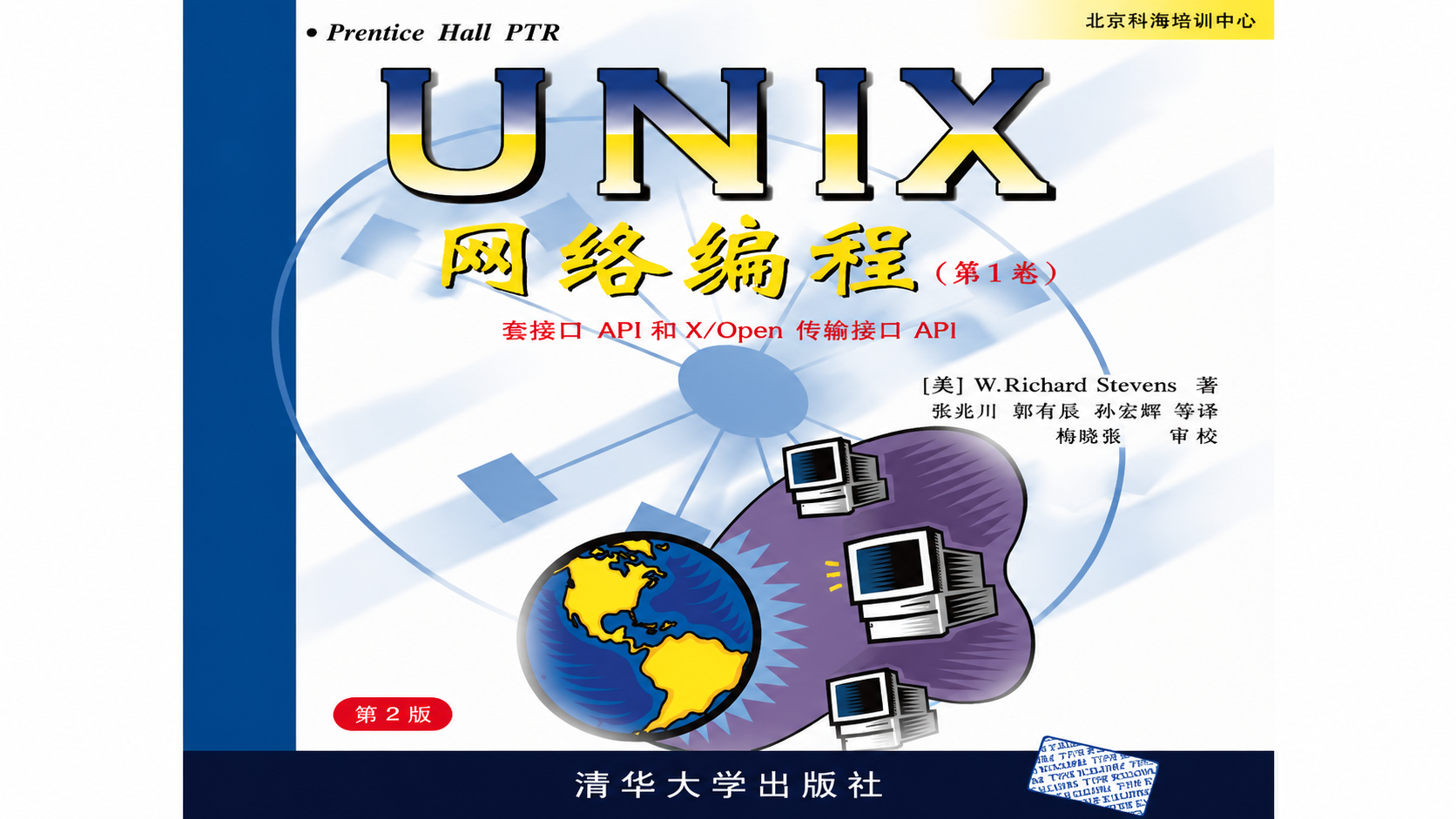
UNIX Network Programming, Volume 1: Networking APIs, Sockets and XTI (Second Edition) by W. Richard Stevens is widely regarded as the definitive reference for network programming on UNIX and Linux systems. For decades, it has served as the gold standard for software engineers seeking a deep understanding of socket programming, TCP/IP networking, and the design of scalable networked applications.
The book begins with the fundamentals of TCP/IP communication and the Berkeley Socket API before progressively advancing into sophisticated networking techniques used in production-grade systems. Topics include IPv4 and IPv6 interoperability, UNIX domain sockets, non-blocking I/O, routing sockets, multicasting, broadcasting, signal-driven networking, raw sockets, multithreaded servers, and client-server architecture patterns.
Unlike many networking books that focus solely on theory, this work emphasizes practical implementation. Each concept is reinforced through carefully designed examples that demonstrate how real-world network applications are built, debugged, and optimized.
Why This Book Matters #
This volume remains one of the most influential networking texts ever written because it bridges protocol theory and software implementation. Readers learn not only how networking APIs function but also why specific design decisions affect performance, scalability, reliability, and portability.
Key strengths include:
- Comprehensive coverage of TCP/IP networking fundamentals.
- Detailed explanations of the Berkeley Socket API.
- Production-quality client-server examples.
- Extensive IPv4 and IPv6 interoperability discussions.
- Advanced I/O and concurrency techniques.
- Practical guidance for building scalable network services.
- Deep exploration of UNIX networking internals.
The material is particularly valuable for engineers developing:
- Network servers and daemons
- Distributed systems
- Microservices infrastructure
- High-performance backend services
- Network monitoring and diagnostic tools
- Communication middleware
- Embedded network applications
Technical Metadata #
| Attribute | Details |
|---|---|
| Title | UNIX Network Programming, Volume 1: Networking APIs, Sockets and XTI (Second Edition) |
| Author | W. Richard Stevens |
| Publication Date | September 1, 2001 |
| Original Publisher | Prentice Hall |
| Primary Topics | Socket Programming, TCP/IP, IPv4, IPv6, UNIX Networking |
| Platforms | UNIX, Linux, BSD Systems |
| Audience | Network Engineers, Systems Programmers, Software Architects |
About the Author #
W. Richard Stevens #
W. Richard Stevens was one of the most respected authorities in UNIX systems, networking, and protocol engineering. His books have educated generations of programmers and remain foundational references throughout the software industry.
His most influential works include:
- UNIX Network Programming (Volumes 1–3)
- TCP/IP Illustrated (Volumes 1–3)
- Advanced Programming in the UNIX Environment (APUE)
Stevens was known for transforming highly complex networking concepts into clear, practical explanations backed by working source code and protocol analysis.
Book Structure #
The book is divided into five major sections that gradually build from networking fundamentals to advanced API design and transport interface programming.
Part I: Introduction and TCP/IP Fundamentals #
The opening section introduces core networking concepts and establishes the foundation necessary for understanding socket-based communication.
Key topics include:
- Client-server architecture
- TCP and UDP fundamentals
- Connection establishment and termination
- Port management
- Protocol layering
- OSI and TCP/IP models
- Network standards and portability concerns
Readers gain a solid understanding of how applications communicate across networks before diving into implementation details.
Part II: Elementary Socket Programming #
This section introduces the Berkeley Socket API and demonstrates how network applications are constructed.
Topics include:
- Socket address structures
- Byte-order conversion
- TCP client and server development
- UDP communication
- Name resolution
- Socket options
- I/O multiplexing with
selectandpoll
Through progressively refined client-server examples, readers learn how robust network software is developed and maintained.
Part III: Advanced Socket Programming #
The largest section of the book focuses on advanced networking mechanisms used in production environments.
Major subjects include:
IPv4 and IPv6 Interoperability #
Coverage includes:
- Dual-stack applications
- Address conversion
- Protocol-independent APIs
- IPv6 migration strategies
Advanced Name Resolution #
Detailed explanations of:
getaddrinfogetnameinfo- Reentrant DNS interfaces
- Portable address handling
Daemons and Network Services #
Topics include:
- Service initialization
- Logging infrastructure
- Integration with
inetd - Background service management
Advanced I/O Techniques #
Readers learn:
- Socket timeouts
- Scatter-gather I/O
- Ancillary data
- Message-oriented interfaces
- High-performance communication strategies
UNIX Domain Sockets #
Coverage includes:
- Local IPC mechanisms
- Descriptor passing
- Credential exchange
- Stream and datagram communication
Non-Blocking Networking #
Important concepts include:
- Non-blocking
connect - Asynchronous communication
- Event-driven architectures
- Concurrent connection handling
Multicasting and Broadcasting #
The book explains:
- Broadcast communication
- IP multicast protocols
- Group membership management
- Wide-area multicast deployment
Raw Sockets #
Advanced chapters demonstrate:
- ICMP implementations
- Custom protocol development
- Packet generation
- Diagnostic tools such as
pingandtraceroute
Multithreaded Networking #
Topics include:
- Thread-based server architectures
- Synchronization techniques
- Thread-specific data
- Concurrent web clients
Client-Server Design Patterns #
The final networking chapters compare multiple server models:
- Iterative servers
- Fork-per-client servers
- Preforked servers
- Thread-per-client servers
- Prethreaded architectures
- Descriptor-passing designs
These comparisons provide valuable insight into scalability tradeoffs and performance optimization.
Part IV: XTI Programming #
The fourth section covers the X/Open Transport Interface (XTI) and STREAMS architecture.
Topics include:
- XTI client and server development
- Transport providers
- Network configuration APIs
- XTI options management
- STREAMS programming
- Transport Provider Interface (TPI)
Although less commonly used today than Berkeley sockets, XTI remains important for understanding historical UNIX networking architectures.
Part V: Appendices and Reference Material #
The appendices provide practical reference information, including:
- IPv4 and IPv6 protocol summaries
- Virtual networking concepts
- Debugging methodologies
- Utility source code
- Exercise solutions
- Networking glossary
Major Learning Outcomes #
After completing this book, readers will understand how to:
- Design TCP and UDP network applications.
- Implement portable socket-based software.
- Build scalable concurrent servers.
- Develop IPv4 and IPv6 compatible applications.
- Use advanced socket options and networking APIs.
- Implement event-driven network architectures.
- Create multithreaded network services.
- Utilize multicasting and broadcasting.
- Develop low-level networking tools with raw sockets.
- Analyze and troubleshoot network communication issues.
Recommended Audience #
This book is best suited for:
Students #
- Senior undergraduate computer science students
- Graduate students studying operating systems or networking
- Researchers exploring distributed systems
Software Engineers #
- Backend developers
- Network application developers
- Systems programmers
- Infrastructure engineers
Advanced Practitioners #
- Linux kernel enthusiasts
- Network architects
- Performance engineers
- Security researchers
- Protocol developers
Conclusion #
UNIX Network Programming, Volume 1 remains one of the most authoritative and comprehensive resources ever written on network software development. Its combination of protocol theory, API design, implementation details, and production-quality examples makes it an essential reference for anyone serious about mastering network programming.
Even decades after publication, the principles, architectures, and engineering practices presented in this volume continue to underpin modern distributed systems, cloud infrastructure, and high-performance network services. For developers seeking a deep and lasting understanding of socket programming and TCP/IP networking, few resources match the depth and influence of this classic work.