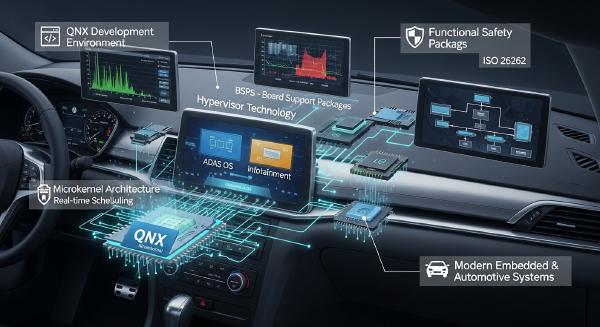
QNX vs Linux for Smart Vehicles: Safety, Real-Time Performance, and SDV Architecture
As the automotive industry transitions toward software-defined vehicles (SDVs), the operating system has become one of the most critical components within the vehicle architecture. Whether powering autonomous driving systems, digital cockpits, powertrain controllers, or vehicle domain controllers, the underlying OS directly influences safety, performance, reliability, and scalability.
Among the leading contenders, QNX and Linux represent two fundamentally different approaches to automotive software design. QNX is widely recognized for deterministic real-time performance and safety certification, while Linux dominates through its open-source ecosystem, flexibility, and developer adoption.
The debate is no longer simply about which platform is faster. Instead, it centers on architectural trade-offs that affect how modern vehicles balance safety-critical execution with rapid software innovation.
⚙️ Architectural Foundations: Microkernel vs Monolithic Kernel #
Microkernel Design in QNX #
QNX is built around a true microkernel architecture. The kernel itself contains only the most essential operating system functions, including:
- Thread scheduling
- Interrupt handling
- Signal management
- Timers
- Inter-process communication (IPC)
Most services traditionally associated with an operating system—including device drivers, file systems, and networking stacks—operate as isolated user-space processes.
This design provides strong fault isolation. If a driver or service fails, the failure is typically contained within that component rather than bringing down the entire system.
Key benefits include:
- Deterministic behavior
- Fault containment
- Smaller trusted computing base
- Enhanced system reliability
- Easier safety certification
Monolithic Kernel Design in Linux #
Linux follows a monolithic kernel model where most operating system services execute within kernel space.
This includes:
- Device drivers
- Network subsystems
- File systems
- Memory management
- Process management
Because these components operate within the same address space, communication overhead is reduced, often resulting in excellent throughput and general-purpose performance.
However, this design introduces challenges for safety-critical environments. A fault within a kernel component can potentially impact the entire system.
Architectural Trade-Offs #
The fundamental distinction can be summarized as:
- Linux: High-performance, feature-rich, ecosystem-driven platform
- QNX: Deterministic, safety-oriented, highly controlled execution environment
For automotive systems requiring strict timing guarantees, the architectural differences have significant implications.
⏱️ Scheduling and Priority Management #
QNX Scheduling Architecture #
QNX employs a strictly priority-based preemptive scheduler designed specifically for real-time workloads.
Key capabilities include:
- 256 priority levels (0–255)
- Deterministic task execution
- Priority inheritance
- Priority ceiling protocols
- Adaptive Partitioning Scheduling (APS)
Priority inheritance is particularly important in automotive systems. When a high-priority task is blocked by a lower-priority task holding a shared resource, the operating system temporarily elevates the lower-priority task’s priority, minimizing blocking delays.
This mechanism significantly reduces priority inversion issues that could otherwise impact safety-critical execution.
Linux Scheduling Architecture #
Linux supports multiple scheduling classes, including:
- Completely Fair Scheduler (CFS)
- FIFO real-time scheduling
- Round-robin scheduling
However, the default Linux scheduler was designed primarily for:
- Fairness
- Throughput
- General-purpose computing
Although Linux supports real-time extensions, deterministic execution is not its original design objective.
To improve latency characteristics, automotive deployments often rely on:
- PREEMPT_RT
- Xenomai
- Custom kernel optimizations
Even with these enhancements, achieving strict real-time guarantees remains more challenging than on a purpose-built RTOS.
🔄 Memory Protection and Inter-Process Communication #
QNX Message-Passing Architecture #
A defining feature of QNX is its message-based communication model.
Each process operates within its own protected memory space, preventing unauthorized memory access between applications.
Communication occurs through a synchronous Send–Receive–Reply mechanism that provides:
- Type-safe communication
- Security validation
- Scheduling awareness
- Priority inheritance support
- Auditable interactions
Because IPC is deeply integrated into the operating system architecture, QNX can maintain deterministic behavior even under heavy system loads.
Linux Communication Model #
Linux applications typically interact through:
- System calls
- Shared memory
- Pipes
- Sockets
- Kernel services
These mechanisms are highly efficient for many workloads but often require frequent transitions between user space and kernel space.
For hard real-time applications, this additional complexity can contribute to latency variability and reduced predictability.
⚡ Interrupt Handling and Determinism #
Interrupt latency is one of the most important metrics for safety-critical automotive systems.
QNX Interrupt Architecture #
QNX is optimized to minimize interrupt handling delays through:
- Extremely short interrupt-disable periods
- Nested interrupt support
- Threaded interrupt processing
- Deterministic execution paths
These design choices enable microsecond-level response times and highly predictable behavior under load.
Linux Interrupt Processing #
Linux has significantly improved real-time responsiveness through PREEMPT_RT and related technologies.
Nevertheless, the complexity of a monolithic kernel introduces greater variability compared with microkernel-based RTOS platforms.
For workloads requiring guaranteed response times, worst-case latency remains a critical consideration.
📊 Real-Time Performance Comparison #
Scheduling Latency #
QNX consistently delivers microsecond-level scheduling performance:
- Thread scheduling latency typically below 20 μs
- Task switching around 12 μs
Linux performance varies significantly depending on configuration:
| Linux Configuration | Typical Latency Range |
|---|---|
| Standard Kernel | Tens to hundreds of milliseconds under load |
| PREEMPT_RT | 10–100 μs |
| Highly Tuned PREEMPT_RT | ~80–95 μs worst-case |
| Xenomai Dual Kernel | 10–30 μs |
The key distinction is not average performance but predictability under worst-case conditions.
Latency Jitter #
For automotive control systems, latency consistency often matters more than absolute speed.
QNX typically maintains extremely low jitter due to:
- Deterministic scheduling algorithms
- Minimal non-preemptible code paths
- Integrated priority inheritance mechanisms
Linux systems can achieve excellent average latency but generally exhibit wider latency variation under heavy workloads.
In real-time systems, predictable execution is frequently more valuable than peak performance.
Context Switching and Memory Access #
QNX’s lightweight architecture enables highly efficient context switching and memory operations.
Advantages include:
- Faster process transitions
- Reduced IPC overhead
- Efficient zero-copy communication
- Predictable cache behavior
These characteristics contribute directly to system responsiveness in safety-critical workloads.
🚗 Automotive Use Cases and OS Selection #
ADAS and Autonomous Driving #
Advanced Driver Assistance Systems (ADAS) impose strict real-time requirements.
Examples include:
- Autonomous Emergency Braking (AEB)
- Lane Keeping Assistance
- Adaptive Cruise Control
- Collision Avoidance Systems
A delay of only a few milliseconds can materially affect vehicle response at highway speeds.
Typical requirements include:
- Sensor fusion processing
- Millisecond-level decision making
- Deterministic control execution
- Reliable fail-safe behavior
For these workloads, QNX’s deterministic architecture offers significant advantages.
However, autonomous driving stacks increasingly combine multiple operating environments.
A common architecture includes:
- QNX for safety-critical control
- Linux for perception and AI workloads
- Dedicated AI accelerators for neural network inference
In-Vehicle Infotainment (IVI) #
Infotainment systems prioritize user experience over hard real-time determinism.
Key requirements include:
- Responsive touch interfaces
- Multimedia playback
- Voice assistants
- Third-party applications
- Connectivity services
Linux and Android Automotive dominate this domain because of:
- Massive developer ecosystems
- Extensive software libraries
- Rich application support
- Faster feature development
Although QNX can power infotainment systems, ecosystem depth generally favors Linux-based platforms.
Powertrain and Chassis Control #
Powertrain and chassis systems represent some of the most demanding real-time environments within a vehicle.
Examples include:
- Engine control units (ECUs)
- Brake systems
- Electronic Stability Control (ESC)
- Anti-lock Braking Systems (ABS)
- Airbag controllers
These systems often require:
- Microsecond-level timing precision
- Functional safety certification
- Deterministic fault handling
- Guaranteed response windows
This remains one of QNX’s strongest application domains.
🛡️ Functional Safety and ISO 26262 #
Why Safety Certification Matters #
Automotive systems increasingly fall under stringent safety requirements defined by ISO 26262.
The highest classification, ASIL D, applies to systems where failure could result in severe injury or loss of life.
Safety certification requires:
- Traceable development processes
- Deterministic behavior
- Fault management mechanisms
- Extensive validation and verification
QNX Safety Certification Advantages #
QNX OS for Safety is specifically engineered for safety-critical applications and has been widely adopted across production vehicle programs.
Its architecture supports:
- Safety certification workflows
- Fault isolation
- Predictable execution
- Reduced certification complexity
These attributes significantly reduce the effort required for ASIL D compliance.
Linux Certification Challenges #
Linux was not originally developed with safety certification as a primary objective.
Challenges include:
- Large codebase complexity
- Frequent upstream changes
- Extensive third-party dependencies
- Higher certification costs
Although safety-certified Linux initiatives exist, achieving ASIL D compliance generally requires significant architectural isolation and additional validation efforts.
🔧 How Linux Remains Competitive #
Despite QNX’s advantages in deterministic execution, Linux continues to gain ground within automotive platforms.
Its strengths include:
- Zero licensing costs
- Vast developer community
- Rapid innovation cycles
- Native AI framework support
- Strong cloud integration
- ROS 2 compatibility
- Extensive hardware support
Technologies such as PREEMPT_RT and Xenomai have substantially improved Linux’s real-time capabilities, making it increasingly viable for many automotive workloads.
However, Linux’s greatest strength remains its ecosystem rather than strict real-time determinism.
🚀 The Rise of Hybrid Automotive Architectures #
The future of automotive software is increasingly moving toward mixed-criticality systems rather than single-OS deployments.
Modern vehicle architectures frequently combine:
| Domain | Preferred Platform |
|---|---|
| Powertrain & Safety Systems | QNX |
| Chassis Control | QNX |
| ADAS Control Functions | QNX |
| AI Perception Workloads | Linux |
| Infotainment & Cockpit | Linux / Android Automotive |
| Connectivity Services | Linux |
Hypervisors and virtualization technologies allow multiple operating systems to coexist on shared hardware while maintaining strict safety boundaries.
This approach enables manufacturers to combine:
- QNX’s safety and determinism
- Linux’s flexibility and innovation ecosystem
without sacrificing either objective.
🎯 Conclusion #
The QNX versus Linux debate reflects a broader challenge facing the automotive industry: balancing uncompromising safety requirements with the rapid pace of software innovation.
QNX continues to set the benchmark for deterministic real-time performance, fault isolation, and safety certification. Linux, meanwhile, drives innovation through its massive ecosystem, AI capabilities, and software development agility.
As vehicles evolve into centralized computing platforms, the question is no longer which operating system should dominate the entire vehicle.
Instead, the industry is increasingly embracing a hybrid architecture model where each platform operates within the domains it serves best.
The emerging blueprint for software-defined vehicles is clear: use QNX where safety and deterministic execution are non-negotiable, and leverage Linux where ecosystem scale, AI acceleration, and user-facing innovation provide the greatest value.
In the next generation of intelligent vehicles, success will not come from choosing one platform over the other. It will come from integrating both into a unified automotive computing architecture that delivers safety, performance, and innovation simultaneously.