
QNX Automotive Strategy: Powering Global Intelligent Vehicles and Robotics
🚗 Overview #
At the 9th Intelligent Driving and Global Export Conference in June 2026, QNX outlined its vision for the future of intelligent transportation and industrial automation. As automotive architectures evolve from isolated electronic control domains toward highly integrated computing platforms, QNX is positioning itself as the foundational operating system for safety-critical, software-defined systems.
The company’s strategy extends beyond traditional automotive deployments. Leveraging its expertise in hard real-time operating systems (RTOS), safety certification, and secure microkernel architecture, QNX is expanding into robotics, medical systems, industrial automation, and edge AI infrastructure.
With growing demand for globally compliant vehicle platforms, QNX is increasingly serving as the software bridge between rapidly evolving Chinese automotive innovation and the stringent safety and cybersecurity requirements of international markets.
⚙️ Core Platform Portfolio #
QNX’s current software ecosystem centers around three flagship platforms:
| Platform | Primary Purpose |
|---|---|
| QNX SDP 8.0 | General-purpose embedded software development platform |
| QNX OS for Safety 8.0 | Functional safety-certified operating system |
| QNX Hypervisor 8.0 | Mixed-criticality workload consolidation and virtualization |
These products are designed to support next-generation Electronic/Electrical (E/E) architectures where multiple vehicle domains coexist on consolidated compute platforms.
Key Certifications #
QNX maintains certifications critical for modern automotive and industrial deployments:
- ISO 26262 ASIL D functional safety
- ISO/SAE 21434 automotive cybersecurity
- IEC 62304 medical device software compliance
- TÜV Rheinland safety validation
These certifications significantly reduce the compliance burden for OEMs and system integrators developing safety-critical products.
🚀 Performance Advancements in QNX SDP 8.0 #
QNX SDP 8.0 introduces substantial performance improvements over previous generations.
According to platform benchmarks, core operating system components deliver performance gains ranging from 20% to 40% compared with QNX 7.0.
Areas of Optimization #
Memory Management #
Enhanced allocation mechanisms improve deterministic behavior while reducing memory overhead under high-concurrency workloads.
Scheduling Efficiency #
Optimized scheduling algorithms reduce latency and improve responsiveness for mixed-criticality applications.
Interrupt Processing #
Lower interrupt response times improve system determinism and support increasingly demanding sensor workloads.
File System Throughput #
Storage performance enhancements benefit data-intensive applications such as autonomous driving systems and industrial edge analytics.
🛡️ Functional Safety Through Microkernel Isolation #
The foundation of QNX’s safety architecture remains its microkernel design.
Unlike monolithic operating systems, QNX isolates critical services and applications into separate protection domains, reducing fault propagation and improving system resilience.
Four Pillars of Safety Isolation #
Spatial Isolation #
Memory regions, CPU cores, peripherals, and interrupts are partitioned to prevent unauthorized access between workloads.
This ensures that failures in infotainment or user applications cannot compromise safety-critical control systems.
Temporal Isolation #
Deterministic scheduling mechanisms guarantee that critical processes receive required compute resources regardless of other system activity.
This prevents resource starvation and protects real-time workloads.
Controlled Communication #
All inter-process communication (IPC) flows through rigorously controlled messaging channels, enabling validation and monitoring of interactions between domains.
End-to-End Traceability #
Every communication path and system event can be audited, supporting safety certification, debugging, and regulatory compliance.
🔄 Cross-Domain Vehicle Architectures #
The Shift from Domain Controllers to Centralized Computing #
Modern vehicles are undergoing a major architectural transition.
Traditional designs relied on separate control units for:
- Infotainment
- Advanced Driver Assistance Systems (ADAS)
- Body control
- Connectivity
- Powertrain management
New vehicle platforms increasingly consolidate these functions onto centralized high-performance computing systems.
This trend creates significant challenges around safety isolation, resource management, and certification—areas where QNX’s architecture provides a strong competitive advantage.
🌍 Enabling Global Vehicle Exports #
Linux for Speed, QNX for Compliance #
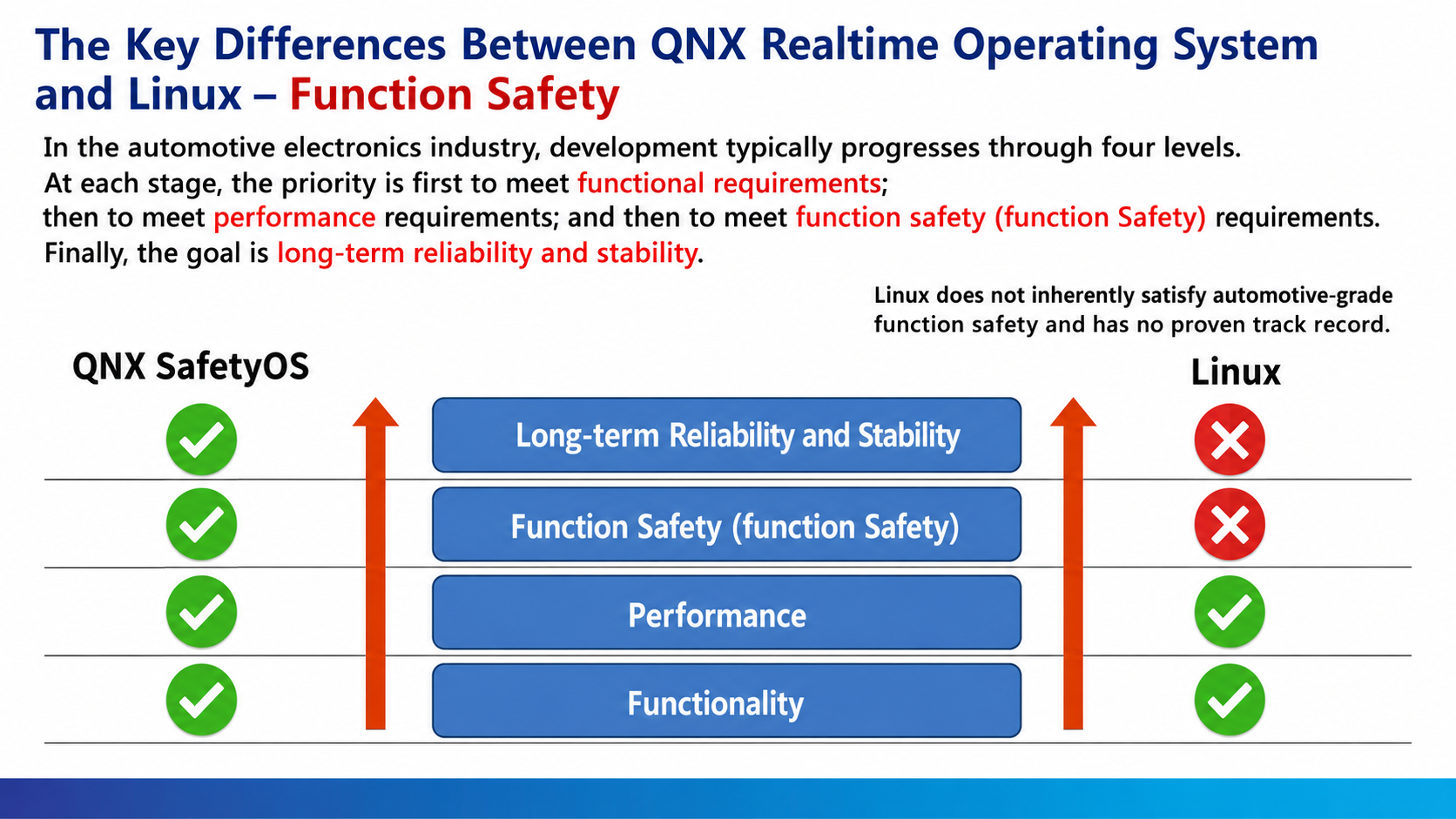
A notable trend has emerged among automotive manufacturers targeting international markets.
For rapid domestic development cycles, many projects initially utilize Linux-based platforms due to their flexibility and extensive ecosystem support.
However, vehicles destined for highly regulated markets often require more stringent safety and cybersecurity guarantees.
As a result, manufacturers increasingly adopt QNX during production programs intended for:
- Europe
- Japan
- North America
- Other safety-regulated regions
The primary drivers include:
- Functional safety compliance
- Cybersecurity certification
- Long-term support requirements
- Regulatory validation processes
Bridging Regional Development Models #
This positioning allows QNX to function as a critical software layer connecting:
- Fast-moving domestic innovation cycles
- Global certification requirements
- International production standards
As Chinese OEMs expand internationally, this role becomes increasingly valuable.
🚘 Major Automotive Deployments #
Leapmotor Cross-Domain Platforms #
Leapmotor’s next-generation vehicle platforms leverage:
- Qualcomm automotive processors
- QNX SDP 8.0
- QNX Hypervisor 8.0
These architectures combine cockpit systems and intelligent driving functions within a unified compute environment while maintaining strict isolation between safety domains.
The platforms are also designed to support emerging AI workloads, including:
- Vision-Language Models (VLM)
- Vision-Language-Action (VLA) systems
- Advanced driver interaction frameworks
BMW Next-Generation Vehicle Programs #
BMW continues to deploy QNX within advanced autonomous driving and vehicle computing systems.
The company’s latest platform strategy emphasizes:
- Accelerated development cycles
- High-performance compute consolidation
- Global software consistency
- Advanced driver assistance integration
This reinforces QNX’s longstanding position within premium automotive programs.
🧩 Deep Integration with Semiconductor Ecosystems #
A critical element of QNX’s strategy is broad hardware enablement.
Global Semiconductor Partnerships #
QNX maintains close integration with:
- NVIDIA
- Qualcomm
- Horizon Robotics
- Axera
These partnerships ensure optimized support for emerging automotive and industrial AI workloads.
Localization and Globalization #
By supporting both international and domestic semiconductor vendors, QNX enables manufacturers to:
- Reduce development complexity
- Accelerate product deployment
- Maintain export readiness
- Support multiple supply-chain strategies
🤖 Expansion Beyond Automotive #
While automotive remains its largest market, QNX is increasingly targeting adjacent sectors that require deterministic computing and safety certification.
Robotics #
Industrial and autonomous robots demand:
- Predictable response times
- Fault isolation
- High reliability
- Safety certification support
QNX’s real-time architecture aligns naturally with these requirements.
Medical Systems #
Medical devices face some of the strictest software validation requirements in any industry.
QNX has established a strong presence in:
- Surgical robotics
- Diagnostic equipment
- Clinical automation platforms
- Medical edge computing
Compliance with IEC 62304 further strengthens its position in healthcare environments.
🏭 NVIDIA IGX and Industrial Edge Computing #
One of the most significant growth opportunities lies in industrial edge AI.
QNX OS for Safety 8.0 has been validated on NVIDIA’s IGX platform, enabling deployment across:
- Industrial automation
- Smart factories
- Medical systems
- Edge AI infrastructure
- Mission-critical computing environments
This partnership expands QNX beyond traditional embedded deployments into emerging AI-driven operational technology markets.
🔧 The Role of Alloy Kore and Adaptive AUTOSAR #
QNX has also strengthened its ecosystem through collaboration with Vector.
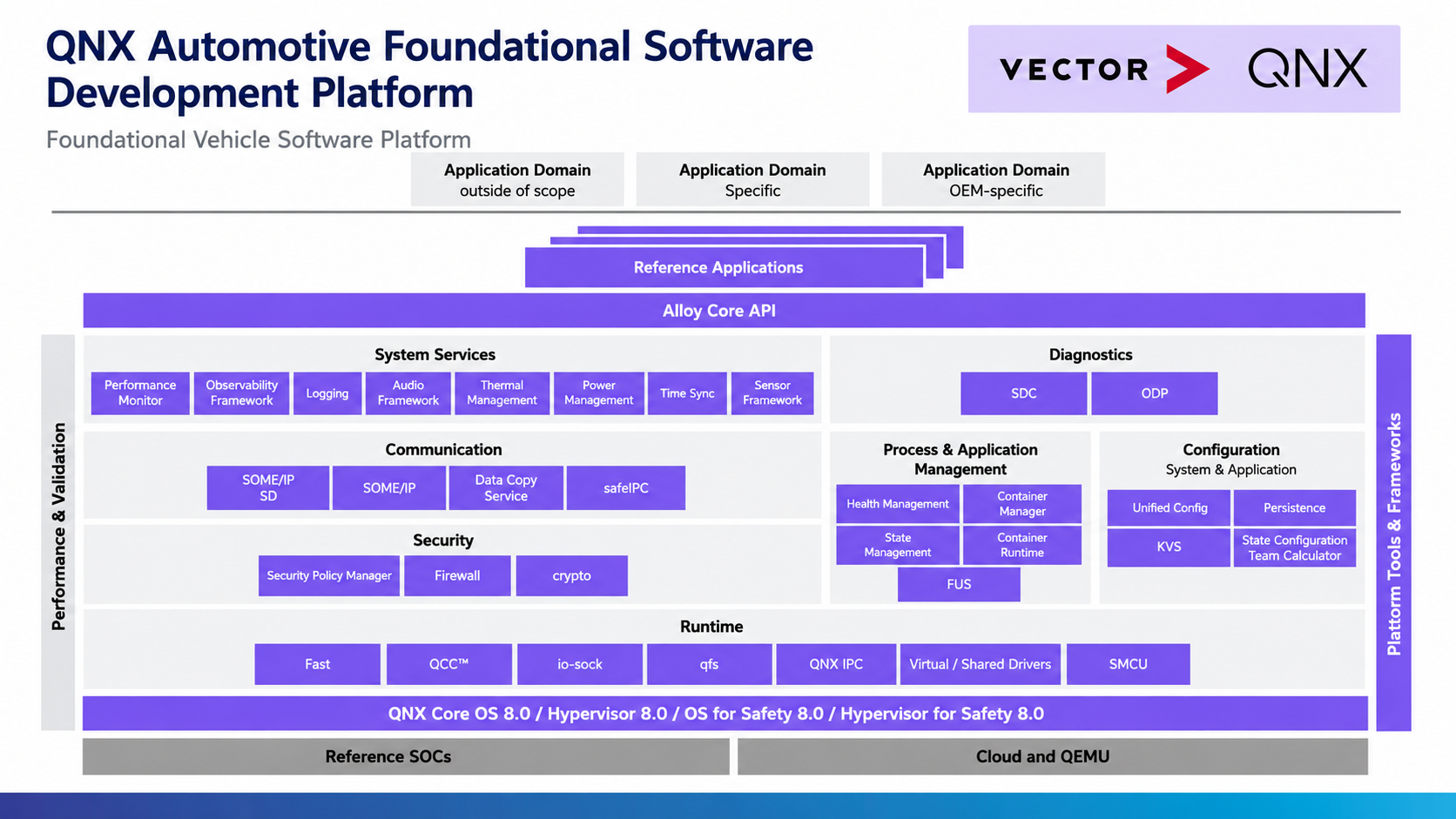
The Alloy Kore platform combines:
- QNX real-time operating system capabilities
- Adaptive AUTOSAR middleware
- Automotive software integration tools
This pre-integrated environment simplifies development for OEMs and Tier-1 suppliers building next-generation software-defined vehicles.
The result is faster deployment of complex automotive applications while preserving safety and certification requirements.
📈 The RTOS Migration Trend #
Industry data increasingly suggests that Linux and RTOS platforms are not direct competitors but rather sequential technologies within a product lifecycle.
A common pattern is emerging:
- Initial prototyping on Linux.
- Functional validation and feature development.
- Scaling toward production deployment.
- Migration to certified RTOS platforms.
As systems become commercially deployed, requirements around determinism, certification, and reliability become significantly more important.
For robotics, autonomous systems, medical devices, and intelligent vehicles, this migration trend increasingly favors platforms such as QNX.
🔚 Conclusion #
QNX’s strategy reflects a broader transformation occurring across automotive and industrial computing. As intelligent systems become more complex and increasingly safety-critical, operating systems must deliver far more than basic scheduling and hardware abstraction.
Through its microkernel architecture, safety certifications, virtualization technologies, and deep semiconductor partnerships, QNX is positioning itself as foundational infrastructure for software-defined vehicles, robotics, medical platforms, and industrial edge AI systems.
As cross-domain vehicle architectures become mainstream and autonomous systems move toward mass deployment, the demand for deterministic, certifiable, and highly secure operating systems is expected to grow substantially. QNX’s expansion beyond automotive into robotics and industrial computing suggests that its future growth will be driven not only by vehicle production volumes, but by the broader convergence of real-time computing and artificial intelligence at the edge.