QNX: The Trusted Software Foundation for Intelligent Mobility
The automotive industry is undergoing one of its most significant technology transitions in more than a century.
The vehicle is evolving from a primarily mechanical product into a software-defined platform, where software increasingly determines user experience, safety functions, connectivity, computing architecture, and long-term customer value.
Artificial intelligence, advanced semiconductors, autonomous driving, and cloud connectivity are all important components of this transformation. But none of them can operate reliably at scale without a software foundation capable of managing real-time workloads, isolating failures, enforcing security boundaries, and meeting stringent functional-safety requirements.
This is where QNX occupies a strategically important position.
With decades of experience in real-time operating systems, embedded computing, functional safety, and cybersecurity, QNX has established itself as a software technology provider for automotive and other mission-critical applications.
Its long-term opportunity extends beyond supplying an operating system. The broader opportunity is to become a trusted software foundation for intelligent machines operating in the physical world.
🚗 The Automotive Industry Is Becoming Software-Defined #
For most of automotive history, competitive differentiation was dominated by mechanical and manufacturing capabilities:
- Engine performance
- Vehicle dynamics
- Manufacturing scale
- Supply-chain efficiency
- Mechanical engineering
- Materials and component technology
That competitive model is changing rapidly.
Future differentiation will increasingly depend on:
- Software architecture
- Artificial intelligence
- Digital services
- Vehicle data platforms
- Over-the-air software updates
- In-vehicle computing
- Connected services
- Continuous software improvement
As computing becomes more centralized and software becomes responsible for an increasing number of vehicle functions, the modern automobile begins to resemble a distributed computing platform with wheels.
This transformation creates a fundamental engineering challenge:
How can automakers accelerate software innovation without compromising automotive-grade safety, security, reliability, and determinism?
A software-defined vehicle needs both innovation and control. The underlying platform must allow developers to introduce increasingly sophisticated applications while maintaining predictable behavior in functions where software failure can have physical consequences.
That tension creates an important market opportunity for QNX.
🛡️ QNX’s Strategic Position as a Trusted Software Layer #
Infrastructure software often becomes strategically valuable precisely because end users rarely see it.
Operating systems, cloud infrastructure, processor architectures, and virtualization layers provide the foundation upon which higher-level applications are built.
QNX occupies a comparable position within embedded and automotive computing.
Its core value proposition can be organized around four areas.
Safety #
Automotive systems cannot simply tolerate unpredictable software behavior.
Functions associated with vehicle control and other safety-critical workloads require architectures that can support rigorous safety engineering, isolation, verification, and certification processes.
QNX’s long-standing focus on safety-critical embedded systems provides a foundation for these requirements.
Security #
Connected vehicles dramatically expand the attack surface of automotive systems.
Vehicles increasingly communicate with smartphones, cloud services, charging infrastructure, other vehicles, and external networks. Security therefore has to extend beyond individual applications to the underlying software platform.
A trusted foundation must provide mechanisms for isolation, secure execution, controlled communication, and lifecycle security.
Real-Time Performance #
Some automotive workloads require deterministic response characteristics rather than simply high average performance.
A system controlling or coordinating safety-relevant functions cannot depend entirely on best-effort scheduling behavior.
Real-time operating-system architecture provides mechanisms for managing timing requirements and ensuring that critical workloads receive predictable execution behavior.
Long-Term Support #
Automotive software has a fundamentally different lifecycle from consumer applications.
Vehicle programs can remain in production for many years, and software platforms must support lengthy development, validation, production, maintenance, and service periods.
This makes long-term platform stability an important purchasing criterion for automakers.
💻 The Software-Defined Vehicle Opportunity #
The software content of modern vehicles has increased dramatically, while computing architectures are becoming increasingly centralized.
Instead of distributing relatively simple functions across numerous independent electronic control units, next-generation architectures increasingly consolidate workloads onto high-performance computing platforms.
These systems require:
- High-performance vehicle computing
- Virtualized execution environments
- Secure operating systems
- Real-time processing
- Software update infrastructure
- AI acceleration
- Vehicle-to-cloud connectivity
- Hardware and software isolation
This architectural transition is also changing the economics of automotive technology.
The traditional model was largely component-oriented:
Automaker → Component Supplier → Vehicle
The emerging model is increasingly platform-oriented:
Automaker → Software and Computing Ecosystem → Continuously Updated Vehicle
Once software becomes central to the vehicle’s identity, the underlying platform can become a long-term strategic dependency rather than a replaceable component.
This creates opportunities for software providers that can establish themselves early in the vehicle development lifecycle.
📈 Moving Up the Automotive Software Stack #
One of the most important strategic opportunities for QNX is the ability to participate in more layers of the software-defined vehicle stack.
The traditional embedded software architecture could be simplified as:
Hardware
    ↓
Operating System
    ↓
Application
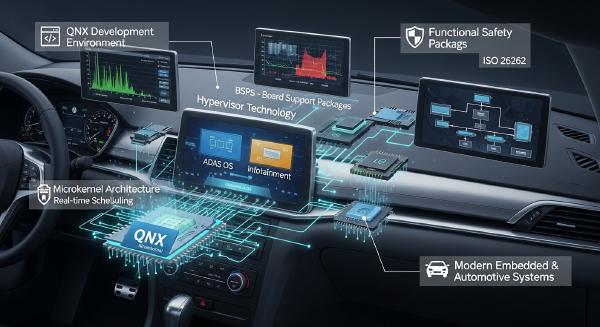
A modern software-defined vehicle is considerably more complex:
Hardware
    ↓
Hypervisor / Operating System
    ↓
Middleware
    ↓
Vehicle Services
    ↓
Applications
    ↓
AI-Driven Experiences
    ↓
Cloud Services
This layered architecture creates opportunities beyond the traditional RTOS market.
A platform provider that can support virtualization, middleware, system services, safety isolation, security, and application frameworks can potentially capture more value from each vehicle program.
It can also become more deeply integrated into the engineering workflow of automakers and Tier 1 suppliers.
That integration matters because software foundations are difficult to replace once a vehicle architecture has entered advanced development and certification.
🔄 Automotive Lifecycles Create Structural Advantages #
Automotive software differs significantly from consumer software because vehicle programs operate on long timelines.
Typical automotive platforms involve:
- Long development cycles
- Extensive validation
- Formal certification
- Multi-year production
- Long service lifetimes
- High engineering costs when architectures change
Consequently, software-platform selection can have significant downstream implications.
Once an automaker has integrated an operating system or software platform into its architecture, replacing it may require substantial redevelopment, testing, hardware adaptation, safety validation, and certification.
This creates potential advantages for established suppliers:
- Recurring software licensing
- Long-term customer relationships
- Platform expansion across vehicle programs
- Increased software adoption within existing customers
- Higher switching costs after integration
The resulting relationship is fundamentally different from a conventional component transaction.
The software provider becomes part of the vehicle’s engineering foundation.
🤖 Beyond Automotive: Intelligent Machines #
Although automotive applications remain central to QNX’s positioning, the underlying technology requirements extend well beyond vehicles.
The same fundamental problem appears whenever software must control intelligent machines operating in the physical world.
Robotics #
Autonomous and collaborative robots require predictable real-time control while processing increasingly sophisticated perception and AI workloads.
Industrial Automation #
Modern factories depend on machines that must operate continuously while maintaining deterministic control, fault isolation, and cybersecurity.
Medical Technology #
Medical equipment can require extremely high levels of reliability and predictable behavior because software faults can directly affect physical systems and clinical workflows.
Aerospace and Mission-Critical Systems #
Aerospace and other mission-critical applications place strong emphasis on determinism, reliability, security, verification, and long operational lifecycles.
The common denominator is not the industry itself.
It is the requirement for trusted computing in systems where software interacts directly with the physical world.
That broadens the strategic narrative around QNX from automotive software toward intelligent-machine infrastructure.
⚔️ The Competitive Landscape #
The automotive software market is becoming increasingly diverse.
Potential technology alternatives include:
- Linux-based automotive platforms
- Android Automotive
- AUTOSAR-based ecosystems
- Proprietary operating environments
- Specialized real-time operating systems
Different platforms will continue to serve different workload classes.
General-purpose operating systems can provide extensive application ecosystems and developer familiarity, while specialized real-time platforms can address workloads where deterministic execution, safety isolation, certification, and reliability are central requirements.
QNX’s differentiation therefore rests less on attempting to replace every operating-system category and more on serving workloads where predictability, safety, security, and long-term reliability carry significant engineering value.
| Capability | Strategic Value |
|---|---|
| Safety-oriented architecture | Supports mission-critical workloads and certification requirements |
| Real-time operation | Enables deterministic behavior for timing-sensitive workloads |
| Automotive experience | Reduces platform and integration risk |
| Security capabilities | Addresses increasingly connected vehicle attack surfaces |
| Long lifecycle support | Aligns with multi-year automotive development and production |
| Embedded expertise | Extends beyond vehicles into intelligent machines |
The market will likely remain heterogeneous, with multiple operating environments coexisting within future vehicle architectures.
The strategic question is therefore not whether one operating system will dominate every workload, but which platforms will control the most critical layers.
📊 Why QNX Matters From a Strategic Perspective #
QNX sits at the intersection of several long-term technology trends.
Software-Defined Everything #
Vehicles, factories, robots, medical systems, and other physical products are increasingly becoming software-defined platforms.
As software becomes responsible for more system functionality, foundational software becomes more strategically important.
AI Moving Into the Physical World #
AI is moving beyond cloud applications into vehicles, robots, industrial machines, and edge devices.
These systems require more than inference performance. They also need reliable scheduling, hardware access, security, isolation, and predictable system behavior.
Cybersecurity Becoming Infrastructure #
As physical machines become connected, cybersecurity can no longer be treated solely as an application-level feature.
The operating system, hypervisor, middleware, update mechanisms, and hardware security architecture all contribute to the system’s security posture.
Embedded Intelligence #
Computing is moving from centralized cloud infrastructure toward distributed edge systems.
This creates demand for software platforms capable of combining conventional embedded workloads with increasingly sophisticated AI and data-processing applications.
QNX is positioned directly within this convergence.
🎯 The Strategic Question #
The most important question for the next decade is not simply:
Will machines become intelligent?
They will.
The more consequential question is:
Who will provide the trusted software foundation that allows intelligent machines to operate safely and reliably at global scale?
That question moves the discussion beyond AI models and semiconductor performance.
A highly capable AI model is only one component of an intelligent physical system. The surrounding software must still manage timing, memory, hardware resources, security boundaries, communications, failures, updates, and safety constraints.
The infrastructure underneath the intelligence therefore becomes increasingly important.
This is the strategic opportunity QNX is positioned to pursue.
🏁 The Infrastructure Behind the Intelligent Machine Era #
Technology transitions often create substantial value not only for the companies building visible products, but also for the infrastructure providers operating underneath them.
QNX has spent decades developing software for environments where reliability and predictable behavior are critical.
As vehicles become software-defined and intelligent systems increasingly interact with the physical world, those characteristics become more valuable rather than less.
The future of mobility will not be defined solely by smarter vehicles, larger AI models, or faster processors.
It will also depend on the software foundation that makes those technologies safe, secure, deterministic, and deployable at scale.
That is ultimately the strategic role QNX is positioned to play: not merely as an operating system, but as part of the trusted infrastructure supporting the next generation of intelligent machines.