QNX and AutoCore Build Full-Stack SDV Platform for China
The software-defined vehicle (SDV) is forcing automakers to rethink the traditional automotive software stack.
Instead of developing isolated software for individual ECUs, modern vehicles increasingly require centralized computing, virtualization, zonal architectures, reusable middleware, functional safety, cybersecurity, and continuous software updates.
On September 2, 2026, QNX, a business unit of BlackBerry, and AutoCore announced an expanded partnership to address exactly this challenge.
The two companies are jointly developing a full-stack SDV software platform for the Chinese automotive market, combining:
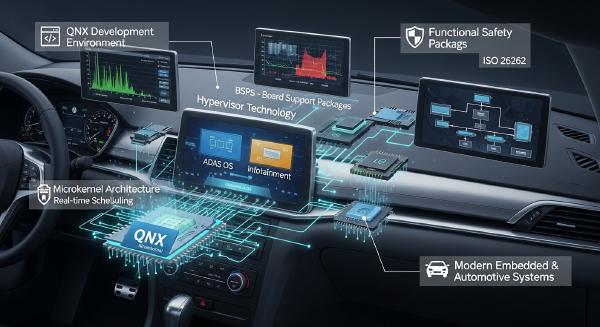
- QNX OS for Safety
- QNX Hypervisor
- AutoCore.OS
- AutoCore’s safety- and cybersecurity-certified middleware
- Support for domain controllers
- High-performance computing (HPC) platforms
- Zonal controllers
The objective is straightforward: give OEMs and Tier 1 suppliers a pre-integrated software foundation that reduces development complexity while providing the safety, security, virtualization, and scalability required by next-generation vehicle architectures.
🚗 From ECU Software to Software-Defined Vehicles #
Traditional automotive architectures are built around numerous dedicated ECUs, with each controller handling a relatively narrow function.
SDV architectures move toward fewer, more powerful computing platforms capable of running multiple workloads simultaneously.
Traditional Vehicle

ECU ── Infotainment
ECU ── ADAS
ECU ── Body Control
ECU ── Gateway
ECU ── Powertrain
ECU ── Connectivity
        │
        ▼
Many independent software stacks


SDV Architecture

        ┌─────────────────────────┐
        │ Central / Domain / Zone  │
        │       Controller        │
        └────────────┬────────────┘
                     │
              Virtualization
                     │
       ┌─────────────┼─────────────┐
       ▼             ▼             ▼
   Safety OS      Middleware     Apps
       │             │             │
       └─────────────┼─────────────┘
                     ▼
              Vehicle Hardware
This consolidation creates major engineering benefits, but it also creates a difficult software problem.
A single computing platform may simultaneously host safety-critical control functions, infotainment, connectivity, diagnostics, and third-party applications.
These workloads cannot simply share resources without isolation.
They need controlled execution environments, predictable behavior, security boundaries, and clearly defined interfaces.
That is where the QNX-AutoCore platform is positioned.
🧩 QNX and AutoCore Combine Their Software Layers #
The partnership brings together complementary parts of the automotive software stack.
QNX contributes its operating system and virtualization technologies, while AutoCore provides its broader vehicle software platform and middleware layer.
At a high level, the architecture can be viewed as:
┌─────────────────────────────────────────────┐
│              Vehicle Applications           │
│ ADAS │ Cockpit │ Body │ Connectivity │ Apps │
├─────────────────────────────────────────────┤
│              AutoCore.OS / Middleware       │
│ APIs │ Services │ Communication │ Abstraction│
├─────────────────────────────────────────────┤
│        QNX Hypervisor / Isolation Layer     │
├─────────────────────────────────────────────┤
│              QNX OS for Safety              │
├─────────────────────────────────────────────┤
│              Vehicle SoC / Hardware         │
└─────────────────────────────────────────────┘
The exact implementation can vary by vehicle architecture, but the key idea is pre-integration.
Instead of forcing an OEM to assemble an operating system, hypervisor, middleware framework, safety mechanisms, and cybersecurity components independently, the joint platform provides a common foundation.
That can significantly reduce integration work as vehicle software becomes more complex.
🛡️ Functional Safety and Cybersecurity Become Core Infrastructure #
Modern vehicles are no longer isolated machines.
They contain high-performance processors, wireless connectivity, external communications, cloud services, over-the-air updates, cameras, radar, sensors, and increasingly sophisticated software.
That expands the attack surface while simultaneously increasing the consequences of software failures.
For an SDV platform, therefore, functional safety and cybersecurity cannot be treated as optional application features.
They need to exist throughout the software stack.
The QNX-AutoCore solution combines QNX’s safety-oriented operating system with AutoCore’s middleware and platform components that have been developed around automotive safety and cybersecurity requirements.
Conceptually:
             SDV Software
                  │
      ┌───────────┴───────────┐
      │                       │
Functional Safety       Cybersecurity
      │                       │
Isolation               Secure interfaces
Determinism             Access control
Certification           Threat mitigation
      │                       │
      └───────────┬───────────┘
                  ▼
          Vehicle Foundation
This is particularly important as multiple vehicle functions migrate onto common compute platforms.
The more functions that share hardware, the more important software isolation becomes.
🖥️ Virtualization Enables Mixed-Criticality Workloads #
One of the most important components of the stack is QNX Hypervisor.
A centralized vehicle computer may need to execute workloads with very different safety requirements.
For example:
High-Criticality
┌──────────────────────┐
│ Safety-Critical Apps │
│ ADAS / Control       │
└──────────────────────┘

        │ Isolation

Medium-Criticality
┌──────────────────────┐
│ Vehicle Services     │
│ Diagnostics / Gateway│
└──────────────────────┘

        │ Isolation

General-Purpose
┌──────────────────────┐
│ Cockpit / Apps       │
│ Connectivity         │
└──────────────────────┘
Virtualization allows different environments to coexist while maintaining stronger isolation between workloads.
This becomes increasingly important as automakers consolidate dozens of previously independent ECUs into domain and zonal controllers.
Rather than simply adding more compute, the architecture needs to ensure that one workload cannot destabilize another.
⚙️ One Foundation for Domain, HPC, and Zonal Architectures #
The joint platform is designed to span several major SDV architectures.
Domain Controllers #
Domain controllers consolidate functions belonging to areas such as:
- Cockpit
- ADAS
- Body electronics
- Connectivity
- Powertrain
This reduces the number of independent computing units and simplifies communication between related functions.
High-Performance Computing #
HPC platforms take consolidation even further by providing large amounts of compute for demanding workloads.
These systems can host multiple applications and operating environments simultaneously, making virtualization and middleware increasingly important.
Zonal Controllers #
Zonal architectures reorganize the vehicle around physical locations rather than traditional functional domains.
              Central Compute
                    │
       ┌────────────┼────────────┐
       ▼            ▼            ▼
   Front Zone    Center Zone    Rear Zone
       │            │            │
    Sensors       Body I/O      Actuators
    Lights        Doors         Power
    Cameras       Seats         Motors
Zonal architectures can reduce wiring complexity and improve scalability, but they also demand sophisticated software abstraction between physical hardware and vehicle applications.
A reusable platform such as the QNX-AutoCore stack is intended to make that transition easier.
💰 Lower Software Cost, Not Just Hardware Cost #
The business case extends beyond technical architecture.
Vehicle software development has become one of the largest engineering challenges for modern automakers.
Each new vehicle platform can require substantial investment in:
- Software integration
- Hardware abstraction
- Middleware
- Testing
- Functional safety
- Cybersecurity
- Diagnostics
- Maintenance
- OTA update infrastructure
A pre-integrated software platform can potentially reduce duplicated engineering effort.
The companies specifically position the collaboration around reducing:
- Bill-of-materials costs
- Software development investment
- Software maintenance costs
- Vehicle development time
- Time required to deliver new vehicle models
The strategic advantage is therefore not simply fewer ECUs.
It is the possibility of creating a reusable software foundation across multiple generations of vehicles.
🔄 Software Updates Become Part of the Vehicle Lifecycle #
One of the defining characteristics of an SDV is that the vehicle’s software continues evolving after the car leaves the factory.
A hardware platform may remain unchanged while software receives new functionality, security fixes, optimizations, and feature updates.
That requires a software architecture capable of supporting long-term evolution.
Vehicle Production
       │
       ▼
Initial Software
       │
       ▼
OTA Updates
       │
       ├── New Features
       ├── Security Fixes
       ├── Performance Improvements
       └── Architecture Changes
       │
       ▼
Extended Vehicle Lifecycle
A foundational platform therefore needs to remain stable while applications and higher-level services evolve.
This is one reason operating systems, virtualization layers, and standardized middleware are becoming strategic assets in automotive development.
🇨🇳 Why the Chinese Automotive Market Matters #
The partnership specifically targets China’s rapidly evolving intelligent-vehicle market.
Chinese automakers have moved aggressively toward:
- Advanced digital cockpits
- ADAS
- Centralized vehicle computing
- Zonal architectures
- OTA software updates
- AI-enabled vehicle functions
- Software-defined vehicle platforms
At the same time, OEMs are under pressure to shorten product cycles and introduce software features faster.
That creates demand for foundational software that can support multiple vehicle programs without requiring every OEM to build its entire stack from scratch.
The QNX-AutoCore collaboration is therefore positioned around a local ecosystem while combining QNX’s established automotive software technology with AutoCore’s China-focused platform and middleware capabilities.
🤝 A Partnership That Started in 2022 #
The expanded SDV platform builds on a relationship that began in 2022.
The latest announcement represents a deeper level of integration: rather than simply combining individual technologies, the two companies are working toward a broader full-stack foundation.
The intended result is a platform that OEMs and Tier 1 suppliers can adopt as an architectural starting point for new vehicle programs.
That matters because SDV development increasingly resembles platform engineering.
The goal is no longer to create one software stack for one vehicle.
It is to create a common foundation that can support multiple vehicle architectures, hardware generations, and product lines.
🏭 QNX’s Role in the Automotive Software Stack #
QNX has long positioned its technology as foundational infrastructure for automotive systems.
The company states that its software is used by major OEMs and Tier 1 suppliers, including BMW, Bosch, Continental, Geely, Honda, Mercedes-Benz, Toyota, Volkswagen, and Volvo.
Its automotive software portfolio spans applications such as:
- Digital cockpits
- ADAS
- Body controllers
- Vehicle gateways
- Safety-critical systems
- Virtualized computing platforms
The strategic importance of QNX in this partnership is therefore less about providing another application framework and more about providing the underlying execution and isolation environment on which other vehicle software can run.
🧱 AutoCore’s Role as a Vehicle Software Platform #
AutoCore contributes the other major part of the equation.
Its AutoCore.OS platform targets intelligent mobility computing and is designed to provide a software foundation for automotive and other embedded systems.
The company also develops middleware intended to abstract hardware and provide common services to higher-level applications.
Its broader ecosystem includes partnerships involving companies such as STMicroelectronics, Tenstorrent, Qualcomm, and Advantech.
The combination with QNX creates a layered approach:
Application Layer
        │
        ▼
AutoCore.OS
        │
        ▼
AutoCore Middleware
        │
        ▼
QNX Virtualization
        │
        ▼
QNX OS for Safety
        │
        ▼
Automotive SoC
The value lies in making these layers work together as a coherent platform rather than forcing each OEM to solve the integration problem independently.
🚘 The Bigger Shift: Automotive Software Is Becoming Infrastructure #
The QNX-AutoCore announcement reflects a broader transformation in the automotive industry.
As vehicles become software-defined, the competitive advantage is moving upward through the stack.
Hardware still matters, but increasingly the vehicle is differentiated by the software running on top of it.
That creates a new hierarchy:
Vehicle
  │
  ├── Hardware
  │
  ├── SoC / Compute
  │
  ├── Operating System
  │
  ├── Hypervisor
  │
  ├── Middleware
  │
  ├── Vehicle Services
  │
  └── Applications
          │
          ▼
       Features
The lower layers become infrastructure.
Once an OEM establishes a stable software foundation, development teams can focus more of their effort on vehicle-specific features instead of repeatedly rebuilding the underlying platform.
🔮 From SDV Complexity to a Reusable Software Foundation #
The central challenge facing SDVs is no longer simply adding more computing power.
It is managing the enormous software complexity created when many vehicle functions converge onto fewer, more powerful computers.
QNX and AutoCore’s expanded partnership addresses that problem through a full-stack approach combining:
- Safety-oriented operating systems
- Virtualization
- Middleware
- Functional safety
- Cybersecurity
- Domain-controller support
- HPC support
- Zonal-controller support
- Long-term software scalability
For Chinese automakers and Tier 1 suppliers, the attraction is clear: start from an integrated software foundation rather than assembling every layer independently.
The larger industry trend is even more significant.
The next generation of vehicles will not simply be cars with more software. They will increasingly be software platforms built around automotive hardware.
As that transition accelerates, foundational technologies such as operating systems, hypervisors, middleware, safety frameworks, and cybersecurity infrastructure will become just as strategically important as the processors underneath them.