US Army Selects Anduril to Lead NGC2 Common Data Layer, Accelerating Battlefield Data Integration
The US Army has officially selected Anduril Industries to lead development of the common data layer for its Next Generation Command and Control (NGC2) initiative, marking a major milestone in the service’s effort to modernize battlefield networking and eliminate long-standing data silos across military platforms.
Following months of parallel prototyping by Anduril and Lockheed Martin, the Army concluded that Anduril’s software-centric approach will provide the baseline architecture needed to connect sensors, weapons systems, autonomous platforms, artificial intelligence applications, and command systems into a unified operational network.
The decision significantly expands Anduril’s role within one of the Army’s highest-priority modernization programs and reinforces the company’s growing position as a major defense systems integrator.
NGC2 Aims to Eliminate Decades of Battlefield Data Silos #
For years, the Army has struggled with fragmented command-and-control systems.
Critical battlefield assets—including unmanned aircraft, air defense systems, artillery, combat vehicles, and reconnaissance platforms—often operate on separate networks that cannot seamlessly exchange data. This fragmentation slows decision-making and limits commanders’ ability to develop a complete operational picture.
The NGC2 initiative was established to solve this challenge by creating an open, interoperable architecture capable of rapidly sharing information across every battlefield domain.
Rather than replacing every existing platform, NGC2 focuses on connecting them through standardized software, allowing data to move freely regardless of the underlying hardware.
The newly selected common data layer serves as the foundation for this vision.
According to Army officials, the architecture will manage:
- Operational data
- Software applications
- AI models
- Sensor information
- Military platforms
- Edge-to-cloud connectivity
The objective is to enable commanders to access real-time battlefield information regardless of which system originally generated it.
Lattice Becomes the Core Software Platform #
Under the new arrangement, Anduril will utilize its Lattice software platform as the baseline command-and-control framework for the Army’s common data layer.
Lattice has become one of Anduril’s flagship products, designed to integrate data from multiple sensors, autonomous systems, and decision-support tools into a unified operational interface.
Instead of treating drones, vehicles, radars, and command posts as isolated systems, Lattice creates a shared operational environment where data can be rapidly fused and distributed.
Army acquisition executive Joseph Welch emphasized that the project has already moved beyond experimentation.
“We are already moving out with the converged data layer architecture. Our vendor partners have demonstrated great teamwork and flexibility in helping us establish this baseline and set the groundwork for rapid scaling.”
The Army intends for this architecture to become the standard foundation supporting future NGC2 deployments across multiple formations.
Edge-to-Cloud Data Mesh With Palantir #
The project will also continue integrating Palantir Technologies into the overall architecture.
Army officials confirmed that Anduril will collaborate with Palantir to build an edge-to-cloud data mesh, combining:
- Anduril Lattice for battlefield command and control
- Palantir Foundry for large-scale data integration and management
Together, these platforms aim to synchronize tactical edge devices with higher-level operational systems while maintaining secure data flow across distributed military networks.
Rather than relying on centralized infrastructure alone, the architecture allows information to move efficiently between frontline units and cloud-based resources, supporting faster decision-making under contested conditions.
Complementary Roles for Anduril and Lockheed Martin #
Although Anduril was selected to establish the common data layer baseline, the Army emphasized that Lockheed Martin will continue playing a major role in the NGC2 program.
Throughout the prototype phase:
- Anduril led modernization efforts with the 4th Infantry Division in Colorado.
- Lockheed Martin led implementation for the 25th Infantry Division based in Hawaii.
Both efforts served different operational environments while evaluating approaches for future Army-wide deployment.
Earlier this year, Anduril completed the Ivy Mass tactical exercises with the 4th Infantry Division at Fort Carson, representing the final modernization sprint before participation in Project Convergence–Capstone 6 (PC-C6).
Meanwhile, Lockheed Martin successfully demonstrated integrated sensors, fires platforms, and airspace management capabilities during the 2026 Balikatan exercises in the Philippines using its own NGC2 implementation.
Rather than choosing one company over the other, the Army has adopted a collaborative strategy.
Anduril will provide the common software foundation, while Lockheed Martin will continue customizing applications, algorithms, hardware integration, and operational workflows for specific Army units.
A Flexible Architecture Instead of a One-Size-Fits-All System #
According to Zach Kramer, head of Anduril’s Mission Command business, the Army deliberately rejected a standardized command-and-control solution for every unit.
Different formations operate under dramatically different mission profiles, terrain, equipment, and tactical requirements.
As a result, the Army’s modernization strategy separates the common infrastructure from mission-specific applications.
The common data layer provides standardized interoperability, while unit-specific software can still be customized according to operational needs.
Kramer explained that Lockheed Martin will leverage the shared baseline architecture while helping units adapt operational procedures, applications, and training for their unique missions.
This modular approach allows the Army to standardize interoperability without sacrificing flexibility.
Army-Wide Deployment Begins #
Following the selection decision, both the 4th and 25th Infantry Divisions are expected to rapidly transition toward implementing shared NGC2 components during upcoming exercises.
Anduril has already begun integrating the baseline data layer for the 25th Infantry Division, with delivery targeted before the end of the year.
Lockheed Martin will simultaneously continue leading operational implementation for the division while incorporating the standardized architecture into future deployments.
This coordinated rollout allows both companies to contribute within their respective strengths while ensuring compatibility across Army formations.
Part of a Broader Army Modernization Strategy #
The NGC2 common data layer is only one component of a much larger Army modernization effort.
As modern conflicts increasingly rely on AI-assisted decision-making, autonomous systems, distributed sensing, and multidomain operations, military effectiveness depends less on individual platforms and more on how efficiently those platforms exchange information.
Traditional command-and-control systems were built around isolated hardware and proprietary software.
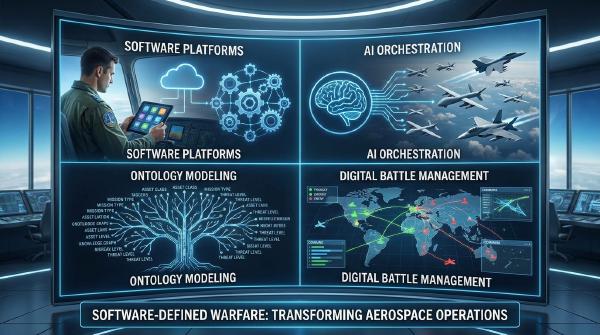
NGC2 instead adopts a software-defined architecture that prioritizes interoperability, rapid integration, and continuous capability upgrades.
Rather than replacing legacy systems outright, the Army intends to connect existing assets through common software standards, reducing integration costs while accelerating deployment of new capabilities.
Outlook #
The Army’s decision to select Anduril as the lead developer for the NGC2 common data layer represents a significant shift toward software-centric military modernization.
By establishing a shared digital backbone based on Lattice while maintaining collaboration with Lockheed Martin and Palantir, the Army is laying the foundation for a more connected battlefield where sensors, AI systems, combat platforms, and commanders can exchange information in real time.
As NGC2 expands beyond initial prototype units into broader operational deployments, the success of the common data layer will likely play a central role in determining how effectively the Army can achieve its vision of fully integrated, multidomain command and control.