Intel Panther Lake-H: ADLINK VNX+ SFF Industrial Board
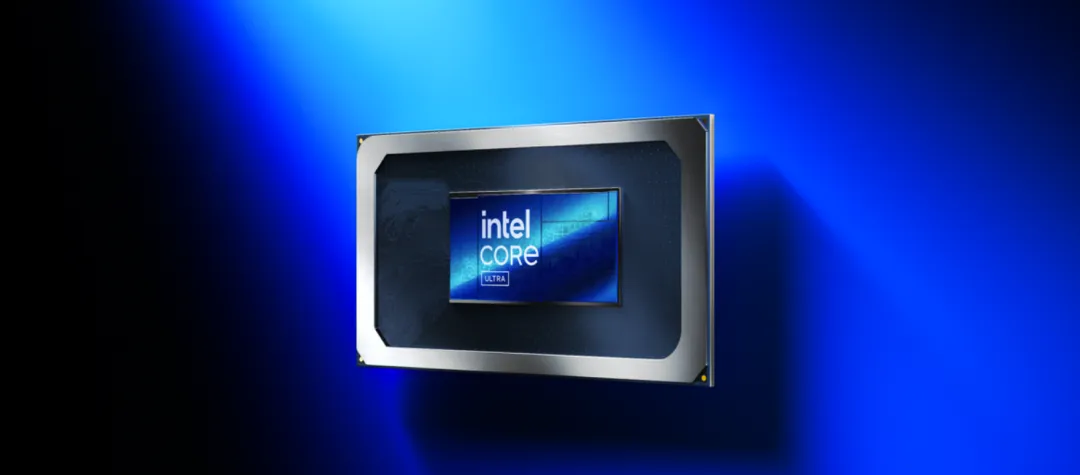
Intel’s Panther Lake-H processor is making its way into compact industrial computing through ADLINK’s VNX+ SFF platform. Designated VNX-PL, this palm-sized embedded computing board combines a hybrid CPU configuration of up to 16 cores with a configurable power envelope reaching 65W.
The platform targets applications where processing density, power management, connectivity, and long-term deployment requirements matter more than desktop-class performance benchmarks. Industrial automation, defense systems, aerospace equipment, and other space-constrained embedded applications are among its intended use cases.
What makes the VNX-PL interesting is the combination of Intel’s next-generation hybrid architecture with the VNX+ module format. Rather than simply putting a notebook processor onto a smaller motherboard, ADLINK provides dedicated networking, PCIe expansion, management interfaces, and modular connectivity for industrial integration.
🧠 Panther Lake-H CPU Architecture #
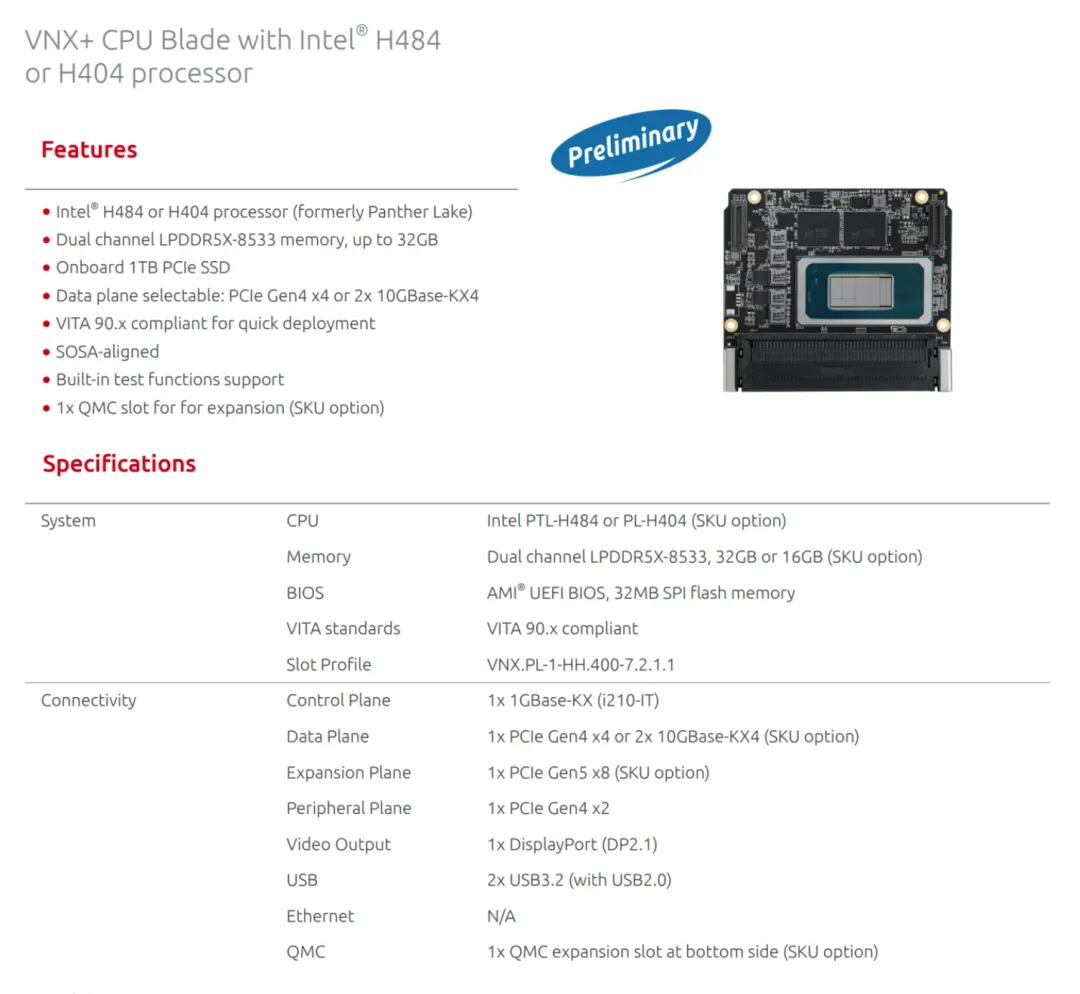
The ADLINK VNX-PL follows the VITA 90.x standard and is designed around two Panther Lake-H processor configurations.
16-Core Configuration #
The higher-core-count configuration combines three types of CPU cores:
- 4 × Cougar Cove Performance cores (P-cores)
- 8 × Darkmont Efficient cores (E-cores)
- 4 × Low-Power Efficient cores (LP-E cores)
This arrangement distributes workloads across high-performance, efficiency-oriented, and low-power processing resources.
P-cores handle latency-sensitive tasks and demanding application threads. E-cores provide additional parallel processing capacity, while LP-E cores target workloads that can run within tighter power constraints.
For embedded systems, this distinction matters. A controller may spend most of its operating time handling background services, monitoring equipment, and processing routine communication traffic. Higher-performance cores can then handle computationally intensive tasks when required.
8-Core Configuration #
The alternative processor configuration reduces the core count:
- 4 × Cougar Cove Performance cores (P-cores)
- 4 × Low-Power Efficient cores (LP-E cores)
This SKU omits the conventional E-core cluster, providing a different balance between processing capacity and power consumption.
Both configurations are specified with a configurable 1W–65W power range. The actual operating point depends on processor configuration, firmware settings, workload, and thermal design. System designers should verify the supported power profiles with ADLINK before selecting a cooling solution or calculating sustained performance.
Panther Lake-H vs. Meteor Lake-H and Arrow Lake-H #
Panther Lake introduces a newer combination of CPU core architectures within Intel’s hybrid processor family.
| Processor Generation | P-Core Architecture | E-Core Architecture | Primary Platform Focus |
|---|---|---|---|
| Meteor Lake-H | Redwood Cove | Crestmont | Mobile computing |
| Arrow Lake-H | Lion Cove | Skymont | Performance-oriented mobile computing |
| Panther Lake-H | Cougar Cove | Darkmont | Next-generation mobile and embedded computing |
The addition of LP-E cores provides another scheduling and power-management option beyond the conventional P-core and E-core arrangement.
However, the core architecture alone does not determine whether a processor is suitable for industrial deployment. Board-level thermal characteristics, firmware support, operating temperature, component selection, and product lifecycle commitments remain relevant.
For additional processor roadmap context, see Intel’s 2025–2026 CPU architecture roadmap.
💾 Memory, Storage, and I/O #
The VNX-PL combines onboard memory and storage with dedicated interfaces for industrial networking and peripheral expansion.
Memory Configuration #
The listed memory specifications include:
- Dual-channel LPDDR5X-8533.
- 16GB or 32GB onboard memory.
- Non-expandable memory configuration.
Using soldered LPDDR5X reduces the physical space required for memory modules and provides a compact board design.
There is one practical limitation: memory capacity cannot be upgraded through conventional SO-DIMM replacement. The required capacity should therefore be selected during initial system configuration.
This is particularly relevant for embedded deployments that may run several applications simultaneously, including real-time control software, communication stacks, diagnostic services, and data acquisition processes.
Storage #
The platform specifies:
- Up to 1TB SSD capacity.
- PCIe Gen4 x1 storage interface.
The PCIe Gen4 x1 connection is worth considering when evaluating storage performance. Although the SSD provides substantial capacity, its single-lane interface has a lower theoretical bandwidth ceiling than a PCIe Gen4 x4 NVMe connection.
For systems that frequently write large datasets, maintain local recording buffers, or process high-speed sensor data, storage throughput should be evaluated alongside capacity.
I/O and Expansion Interfaces #
The VNX-PL provides several interface groups for connecting control systems, networking equipment, and external peripherals.
| Interface | Specification | Intended Function |
|---|---|---|
| Management Ethernet | 1 × 1GBase-KX | Control-plane communication |
| Data plane | Optional 1 × PCIe Gen4 x4 | High-speed data expansion |
| Data plane alternative | 2 × 10GBase-KX4 | High-bandwidth networking |
| Expansion plane | 1 × PCIe Gen5 x8 | High-performance expansion |
| Peripheral plane | 1 × PCIe Gen4 x2 | Peripheral connectivity |
| Display | 1 × DisplayPort 2.1 | Display output |
| USB | 2 × USB 3.2 | External peripherals |
| Modular expansion | 1 × QMC slot | Custom industrial extensions |
The optional data-plane configurations provide different approaches to system connectivity.
PCIe Gen4 x4 offers flexibility for additional expansion hardware, while dual 10GBase-KX4 interfaces provide dedicated high-speed networking capabilities. The appropriate configuration depends on the system’s communication requirements and available module options.
The QMC slot is another useful feature. It allows system integrators to add application-specific functionality without redesigning the entire computing module.
This is particularly relevant for specialized equipment that requires additional communication interfaces, acquisition hardware, or other industrial peripherals.
🔌 PCIe Connectivity, Security, and System Design #
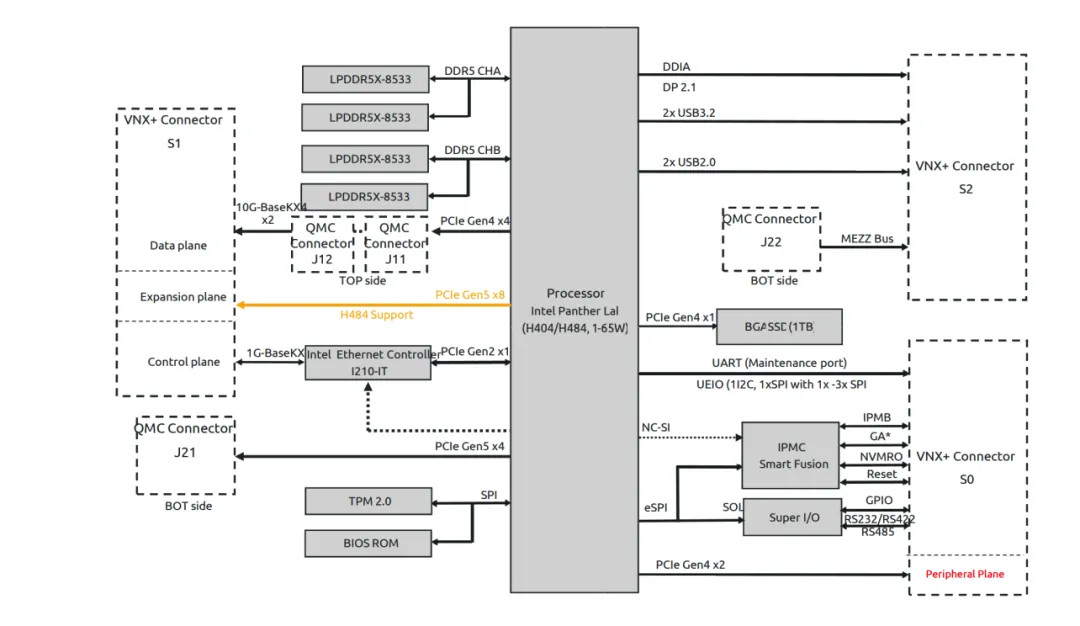
PCIe connectivity is a major part of the VNX-PL architecture. According to the supplied ADLINK block diagram, the platform provides the following PCIe resources:
- 12 PCIe Gen5 lanes.
- 7 PCIe Gen4 lanes.
- 1 PCIe Gen2 lane.
These interfaces support the processor’s expansion architecture and the board’s various connectivity planes.
For system designers, the distinction between available controller lanes and physically exposed expansion interfaces is important. The number of lanes listed in a block diagram does not necessarily mean that every optional interface can operate simultaneously at its maximum configuration. Lane allocation, routing, and any shared resources should be checked against the specific board revision.
TPM 2.0 and Platform Security #
The VNX-PL also includes support for a TPM 2.0 security module.
A TPM provides hardware-backed security functions, including:
- Secure storage for cryptographic keys.
- Platform measurements and integrity verification.
- Support for secure boot workflows.
- Hardware-assisted system authentication.
- Integration with operating-system encryption mechanisms.
For defense and aerospace applications, these capabilities can form part of a broader platform security architecture.
A TPM alone does not automatically provide complete system security. Secure boot requires appropriate firmware configuration and a trusted boot chain, while disk encryption and authentication depend on operating-system policies and key-management procedures.
The complete implementation should therefore be evaluated at the platform level rather than treating TPM 2.0 as a standalone security solution.
PCIe Bandwidth and Industrial Integration #
The combination of PCIe Gen5 and Gen4 interfaces gives the platform room for high-speed expansion.
Potential applications include:
- High-speed data acquisition.
- Industrial Ethernet communication.
- Specialized motion-control interfaces.
- Sensor-processing hardware.
- Custom FPGA-based expansion modules.
- High-throughput storage and peripheral subsystems.
The actual performance available to each application depends on the PCIe topology, peripheral implementation, driver support, and processor power configuration.
⚙️ Intel 18A Process and Xe3 Integrated Graphics #
One of Panther Lake’s major architectural changes is its use of Intel 18A process technology.
Panther Lake represents Intel’s first client processor generation built on this manufacturing node. Intel 18A introduces two significant transistor and power-delivery technologies:
- RibbonFET: Intel’s gate-all-around transistor architecture.
- PowerVia: Backside power delivery designed to improve power distribution and free up front-side routing resources.
These changes target improvements in transistor density, power efficiency, and overall semiconductor performance.
The manufacturing details are discussed further in Intel 18A vs. TSMC N2: Process Technology and Architecture.
Xe3 Integrated GPU #
Panther Lake also introduces Intel’s Xe3 integrated graphics architecture, with configurations offering up to 12 Xe cores.
Compared with Lunar Lake’s maximum eight Xe2 cores, a 12-core configuration represents a 50% increase in GPU core count.
This does not translate directly into a 50% performance improvement. Actual graphics performance depends on GPU configuration, clock speeds, memory bandwidth, thermal limits, and software optimization.
For industrial applications, the integrated GPU can provide additional processing capacity for:
- Multi-display visualization.
- Industrial HMI interfaces.
- Real-time monitoring dashboards.
- GPU-accelerated image processing.
- Machine-vision applications.
- 3D visualization and graphical interfaces.
Using integrated graphics also avoids the need for a separate graphics card in applications where the onboard GPU provides sufficient performance.
For compact embedded systems, eliminating an additional graphics device can simplify the board design, power budget, and thermal management requirements.
🏭 Industrial Applications and Deployment Considerations #
The VNX-PL combines a compact mechanical form factor with a relatively extensive set of computing and expansion interfaces.
Its target applications include industrial automation, defense electronics, aerospace equipment, and other embedded systems that require a combination of CPU processing, networking, and modular expansion.
Several characteristics are relevant when evaluating the board for these environments.
Compact Computing Density #
A 16-core hybrid processor in a VNX+ SFF module provides substantial processing capacity within a limited physical footprint.
This can be useful for equipment that combines multiple functions within one embedded computing module, such as control processing, network communication, data collection, and visualization.
Flexible Power Configuration #
The specified 1W–65W operating range allows the platform to be configured for different power and thermal requirements.
Lower-power profiles can suit systems with strict cooling or power constraints, while higher-power configurations provide additional performance headroom.
However, sustained operation at higher power levels requires adequate heat dissipation and a validated thermal design. Peak processor specifications should not be treated as guaranteed continuous operating conditions.
Modular Expansion #
The VNX+ architecture, PCIe expansion interfaces, and QMC slot provide options for application-specific hardware.
This approach allows equipment manufacturers to adapt the computing platform to different system configurations without developing a completely new motherboard for every application.
Long-Term Maintenance and Qualification #
Industrial deployment involves more than processor performance.
Before adopting the VNX-PL in a production system, engineering teams should verify:
- Operating and storage temperature ratings.
- Mechanical and vibration qualification.
- Power input and transient requirements.
- Firmware and BIOS maintenance commitments.
- Operating-system and driver support.
- Component availability and lifecycle policy.
- Environmental and electromagnetic compatibility requirements.
Compliance with the VITA 90.x standard establishes the relevant module interface framework, but it does not independently guarantee every environmental or reliability qualification required by a particular defense, aerospace, or industrial application.
🚀 Sampling Schedule and Market Positioning #
The original VNX-PL announcement identified the following planned availability schedule:
| Milestone | Announced Schedule |
|---|---|
| Initial sampling | Q4 2025 |
| Industrial board shipments | Early 2026 |
These dates represent the announced development and delivery expectations at the time of publication. Actual availability, production revisions, and ordering arrangements should be confirmed directly with ADLINK.
The broader Panther Lake platform also represents a change in Intel’s hybrid processor roadmap.
Meteor Lake introduced the disaggregated tile-based architecture and hybrid CPU approach to a new generation of mobile systems. Arrow Lake continued the performance-oriented development of that architecture, while Panther Lake adds a newer CPU core design, Intel 18A manufacturing, and Xe3 integrated graphics.
For the VNX-PL, the main engineering proposition is the integration of these technologies into a compact VNX+ industrial computing platform.
Rather than relying solely on higher CPU frequencies or benchmark performance, the platform combines configurable processing power, onboard high-speed memory, dedicated networking, PCIe expansion, hardware security support, and modular interfaces.
For applications in industrial automation, defense electronics, and aerospace equipment, the final decision will depend on validated thermal behavior, interface availability, firmware support, environmental qualification, and the supplier’s documented product lifecycle commitments.