
Introduction to the Design and Analysis of Algorithms: 3rd Edition
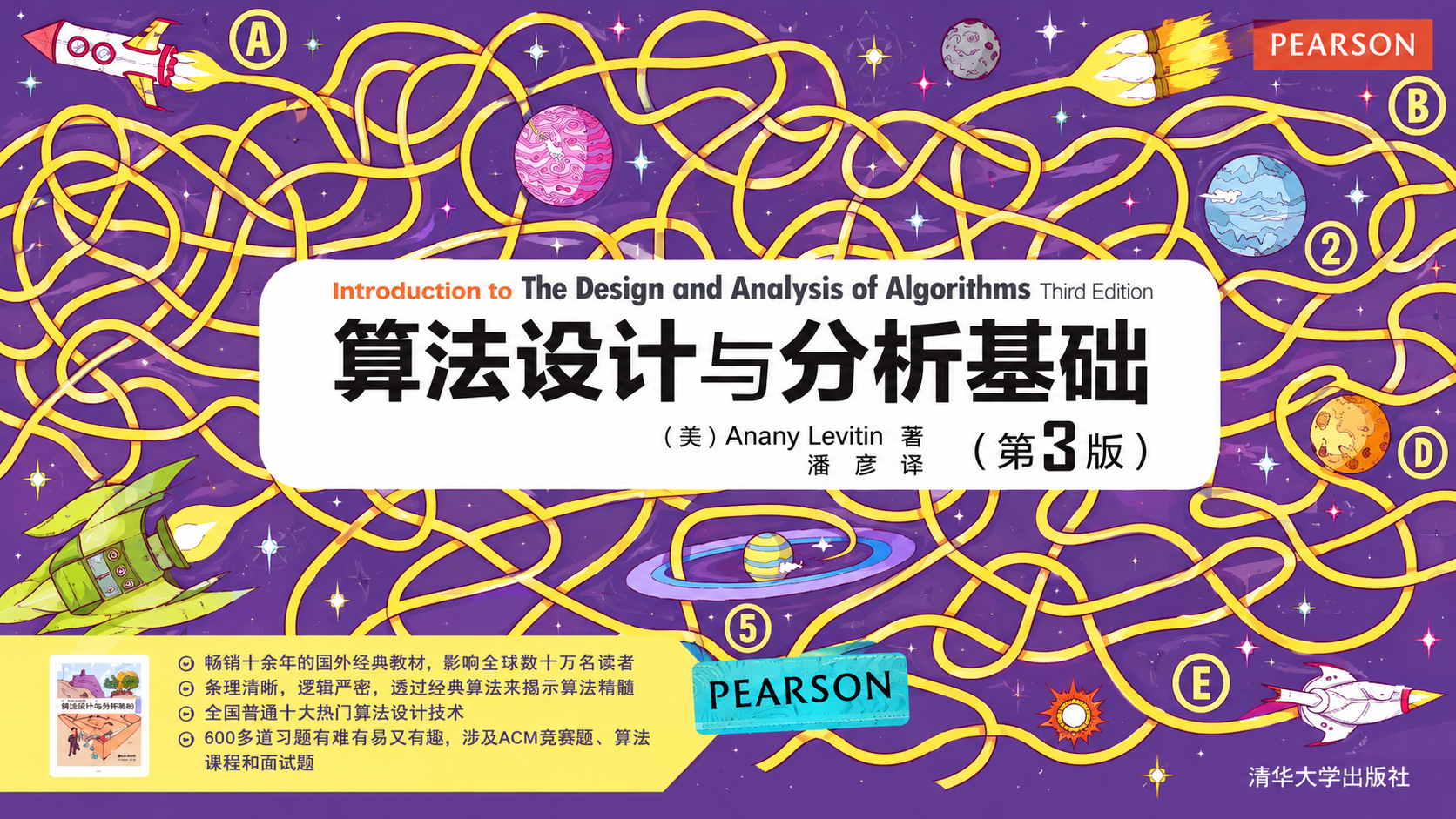
Introduction to the Design and Analysis of Algorithms (3rd Edition) presents a systematic approach to understanding how algorithms are designed, analyzed, and applied to computational problems.
Rather than organizing algorithms solely around individual problems or data structures, the book classifies them according to general problem-solving strategies. This perspective provides a consistent framework for understanding techniques such as brute force, decrease-and-conquer, divide-and-conquer, transform-and-conquer, dynamic programming, greedy methods, and iterative improvement.
The third edition reorganizes several chapters, introduces additional algorithms and applications, and strengthens the connections between individual algorithms and the broader design techniques behind them. It also adds 70 new exercises, including puzzles and interview-oriented problems.
The book is intended primarily as a foundational textbook for algorithm design and analysis. It is also useful for readers who want to develop stronger algorithmic thinking and already have a basic understanding of data structures and discrete mathematics.
🧭 A Strategy-Oriented Approach to Algorithms #
A central feature of the book is its classification of algorithms according to general algorithm design techniques.
Instead of learning algorithms as isolated solutions, readers are encouraged to recognize recurring patterns in computational problem solving. This makes it easier to understand why a particular technique works, when it is appropriate, and how it can be adapted to related problems.
The book develops this perspective through a progression of major design paradigms:
- Brute force — systematically exploring possible solutions.
- Decrease-and-conquer — solving a smaller instance before extending the result to the original problem.
- Divide-and-conquer — decomposing a problem into smaller independent subproblems.
- Transform-and-conquer — transforming a problem or its representation into a form that is easier to solve.
- Space and time trade-offs — using additional memory to improve computational efficiency, or exchanging computation for storage.
- Dynamic programming — exploiting overlapping subproblems and optimal substructure.
- Greedy algorithms — constructing solutions through locally optimal choices.
- Iterative improvement — progressively improving an existing solution.
This organization provides a unified vocabulary for discussing algorithm design and helps connect specific algorithms to broader computational strategies.
📊 Algorithm Analysis and Efficiency #
Algorithm design is closely connected to understanding computational efficiency. The book therefore introduces mathematical techniques for analyzing both recursive and non-recursive algorithms.
The analysis focuses on understanding how an algorithm’s resource requirements grow with input size. This includes examining running time, space requirements, recurrence relations, and the trade-offs that arise when choosing between different algorithmic approaches.
The book also covers empirical analysis, complementing theoretical complexity analysis with experimental evaluation. Algorithm visualization is introduced as another way to understand algorithm behavior and make abstract computational processes easier to inspect.
Useful mathematical references and a dedicated tutorial on recurrence relations are provided in the appendices to support the analysis of algorithm efficiency.
🧩 From Algorithms to Problem-Solving Techniques #
The book treats algorithms not simply as implementations of known procedures, but as general-purpose tools for solving computational problems.
This distinction is important when working with unfamiliar problems. Instead of immediately searching for a specific algorithm, readers can analyze the structure of the problem and determine which design technique may be applicable.
For example, a problem might suggest:
- Exhaustive exploration through brute force.
- Recursive reduction through decrease-and-conquer.
- Independent decomposition through divide-and-conquer.
- A more convenient representation through transform-and-conquer.
- Reuse of previously computed results through dynamic programming.
- Locally optimal decisions through a greedy strategy.
- Progressive optimization through iterative improvement.
Learning these patterns helps develop transferable algorithmic thinking, rather than memorization of individual algorithms.
🧠 Understanding the Limits of Algorithms #
Algorithm design is not only about finding efficient solutions. Some computational problems have fundamental limitations that prevent efficient algorithms from existing under commonly accepted computational models.
The book therefore examines the limitations of algorithmic power and discusses approaches for coping with problems that cannot be efficiently solved using conventional algorithms.
This provides important context for algorithm analysis: when a straightforward efficient solution does not exist, the appropriate response may involve changing the problem formulation, accepting approximation, using heuristics, exploiting special-case structure, or applying other problem-solving strategies.
The treatment helps place algorithm design within the broader context of computational complexity and the practical boundaries of computation.
🎯 Exercises, Puzzles, and Practical Learning #
The third edition contains more than 600 exercises, including hints to support independent study.
The exercises cover both conventional algorithm-analysis problems and more exploratory challenges. Newly added exercises include puzzles and interview questions, providing opportunities to apply algorithmic reasoning outside traditional textbook problems.
This combination makes the exercises useful for several learning goals:
- Reinforcing algorithm design techniques.
- Practicing complexity analysis.
- Applying algorithms to new problem formulations.
- Developing problem-solving intuition.
- Preparing for technical interviews.
- Exploring algorithmic puzzles and games.
An instructor’s manual with detailed solutions is also available for educators using the book as a course textbook.
📚 Table of Contents #
The third edition is organized around the following progression:
Chapter 1: Introduction #
Introduces algorithms, their role in computational problem solving, and the fundamental concepts used throughout the book.
Chapter 2: Fundamentals of the Analysis of Algorithm Efficiency #
Covers the principles and mathematical techniques used to evaluate algorithm efficiency.
Chapter 3: Brute Force #
Explores systematic approaches that evaluate possible solutions directly.
Chapter 4: Decrease-and-Conquer #
Introduces algorithms that reduce a problem to a smaller instance and extend the resulting solution.
Chapter 5: Divide-and-Conquer #
Examines recursive decomposition of problems into smaller subproblems.
Chapter 6: Transform-and-Conquer #
Studies transformations that simplify a problem or convert it into a more convenient representation.
Chapter 7: Space and Time Trade-Offs #
Explores how additional memory, preprocessing, and other techniques can be exchanged for improved execution time.
Chapter 8: Dynamic Programming #
Introduces the principles behind solving problems with overlapping subproblems and reusable intermediate results.
Chapter 9: Greedy Technique #
Examines algorithms that construct solutions through a sequence of locally optimal decisions.
Chapter 10: Iterative Improvement #
Explores methods that progressively improve an existing solution.
Chapter 11: Limitations of Algorithm Power #
Discusses fundamental limitations on what algorithms can efficiently accomplish.
Chapter 12: Coping with the Limitations of Algorithm Power #
Examines practical approaches for dealing with computationally difficult or intractable problems.
Epilogue #
Concludes the main discussion of algorithm design and analysis.
Appendix A: Useful Formulas for Algorithmic Analysis #
Provides mathematical formulas useful for analyzing algorithms.
Appendix B: Short Tutorial on Recurrence Relations #
Provides supporting material for analyzing recursive algorithms.
Hints to Exercises #
Provides hints for the book’s extensive exercise collection.
References #
Lists the references used throughout the book.
🔍 Who Should Read This Book? #
The book is particularly suitable for students and developers who want a structured foundation in algorithm design and analysis.
A basic understanding of data structures and discrete mathematics is recommended. With that foundation, readers can use the book to move beyond implementing individual algorithms and begin reasoning about why particular approaches work, how efficiently they operate, and when alternative strategies may be more appropriate.
Its strategy-oriented classification also makes the book useful as a reference for revisiting fundamental techniques such as divide-and-conquer, dynamic programming, greedy algorithms, complexity analysis, and computational problem solving.
📝 Summary #
Introduction to the Design and Analysis of Algorithms (3rd Edition) provides a systematic framework for studying algorithms through general problem-solving strategies rather than isolated techniques.
Its coverage spans theoretical efficiency analysis, empirical evaluation, algorithm visualization, major algorithm design paradigms, computational limitations, and practical problem solving. The expanded exercise collection further connects the theory to puzzles, interview questions, and independent practice.
For readers building a strong foundation in computer science, the book offers a structured way to understand not only which algorithms solve particular problems, but also how to recognize and apply general algorithm design techniques to new problems.